4CH1
States of Matter
Principles of Chemistry
The particle model
- All chemical substances exist as a , a or a
- The state of a given substance depends on temperature (and, for gases, pressure)
- The particles inside (atoms, molecules or ions) are the same in every state
- What differs between states is the arrangement, motion and energy of the particles
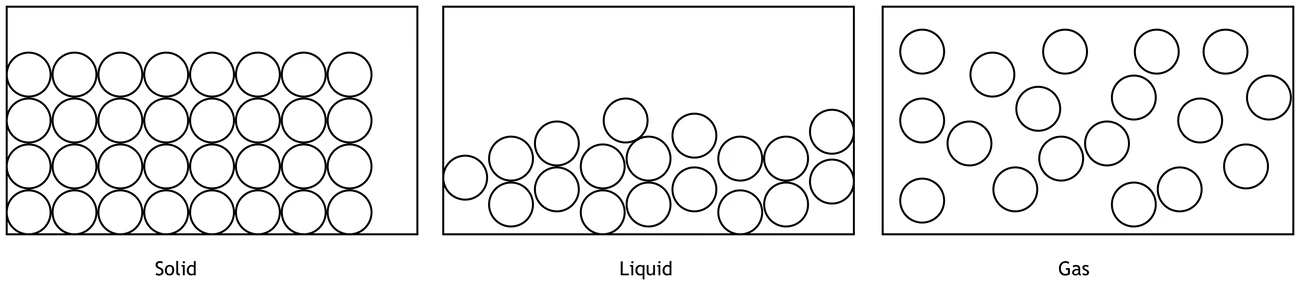
- The model pictures every particle as a small hard sphere
- Used to compare arrangement, spacing and motion between the three states
Comparing the three states
| Property | Solid | Liquid | Gas |
|---|---|---|---|
| Arrangement | Regular arrangement | Randomly arranged | Randomly arranged |
| Spacing | Very close together | Close together (still touching) | Far apart |
| Motion | Vibrate in fixed positions | Move around each other | Move freely in all directions |
| Average energy | Lowest | Intermediate | Highest |
| Fixed shape? | Yes | No (takes the shape of its container) | No (fills its container) |
| Fixed volume? | Yes | Yes | No |
| Compressible? | No | Almost not at all | Yes |
Why state changes need energy
- Particles are held together by attractive forces (intermolecular forces, or ionic / covalent / metallic bonds in giant structures)
- Changing state means giving the particles enough kinetic energy to weaken or overcome those forces
- Stronger forces between particles → higher melting and boiling points
- e.g. iron melts at 1538 °C, sodium chloride at 801 °C
- Weaker forces between particles → lower melting and boiling points
- e.g. oxygen at −183 °C, methane at −161 °C
- A change of state is a physical change, not a chemical one
- The particles themselves are unchanged
- Only the forces holding them in place change
Exam tip
Explaining melting and boiling — the marks are in the forces
What comes up: explain, in terms of particles, why a substance melts or boils, or why one substance has a higher melting/boiling point than another.
Write: heating gives the particles more kinetic energy, which lets them overcome the forces of attraction between the particles. Stronger forces need more energy to overcome, so the melting and boiling points are higher.
Watch out: for simple molecular substances, melting and boiling only overcome the weak forces between the molecules — the strong covalent bonds inside the molecules do not break. Never write "the bonds break".