ChemistryExam code: 4CH1
States of Matter
Principles of Chemistry
- Diffusion is the net movement of particles from a region of high concentration to a region of low concentration, by random particle motion
- Happens in gases and liquids only. Solid particles vibrate in place and cannot migrate
- Requires no external energy input
- Faster at higher temperatures (particles carry more kinetic energy)
- Much faster in gases than in liquids (gas particles are further apart and move faster)
Common exam question
Naming the process that spreads a substance out
Question: Give the name of the process by which a gas, or a dissolved coloured solid, spreads through the air or the water, sometimes with a reason it happens (1–2 marks).
The name is diffusion, credited in 4 of the 23 papers ("diffusing" is accepted too). For the reason, the particles move randomly and spread from where they are more concentrated to where they are less concentrated until they are evenly mixed. When a crystal dropped into water colours the whole beaker, two processes are wanted: dissolving and then diffusion. "Dilution" is not a process here and earns nothing.
Diffusion in gases: the bromine demonstration
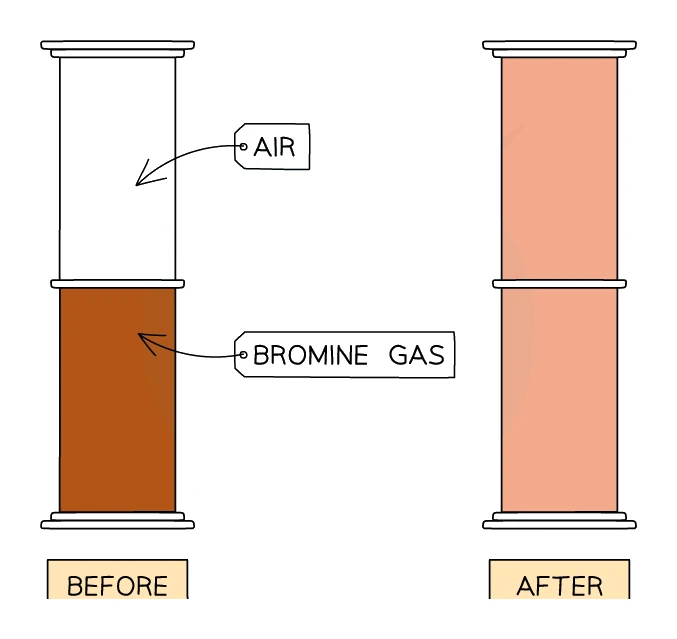
- A gas jar of red-brown bromine vapour is placed beneath an upturned jar of colourless air, separated by a glass cover
- Cover removed → bromine and air particles mix
- After a few minutes both jars show the same uniform pale-brown colour
- Mixing occurs even though bromine vapour is denser than air
Diffusion in liquids: the potassium manganate(VII) demonstration
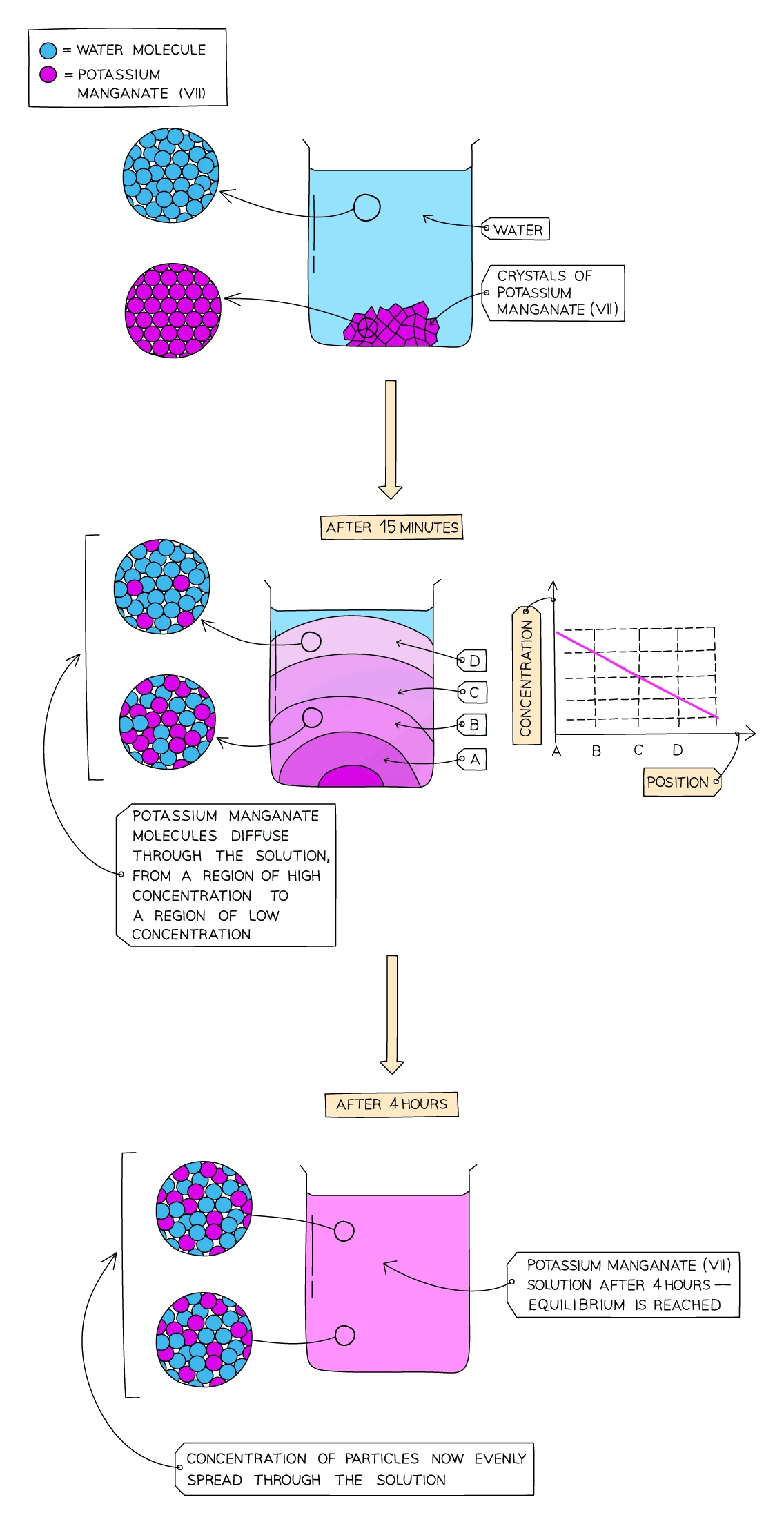
- A small purple crystal of KMnO₄ is dropped into still water
- The colour spreads outwards through the water with no stirring
- After several hours the beaker is uniformly pale purple
- Much slower than gas diffusion (liquid particles are close-packed)