4CH1
States of Matter
Principles of Chemistry
- Solubility is how much solute a particular solvent will hold at a given temperature (and, for gases, at a given pressure)
- Standard unit: grams of solute per 100 g of solvent (usually water)
- e.g. KNO₃ in water at 20 °C: 32 g per 100 g of water means 32 g dissolves; anything more sinks to the bottom
Effect of temperature and pressure
| Solute | Effect of raising temperature | Effect of raising pressure |
|---|---|---|
| Solid | Usually more soluble | Negligible |
| Gas | Less soluble | More soluble |
- Warm fizzy drinks lose their fizz faster than cold ones (gas leaves on warming)
- Carbonation is achieved by forcing CO₂ into solution under pressure
Solubility curves
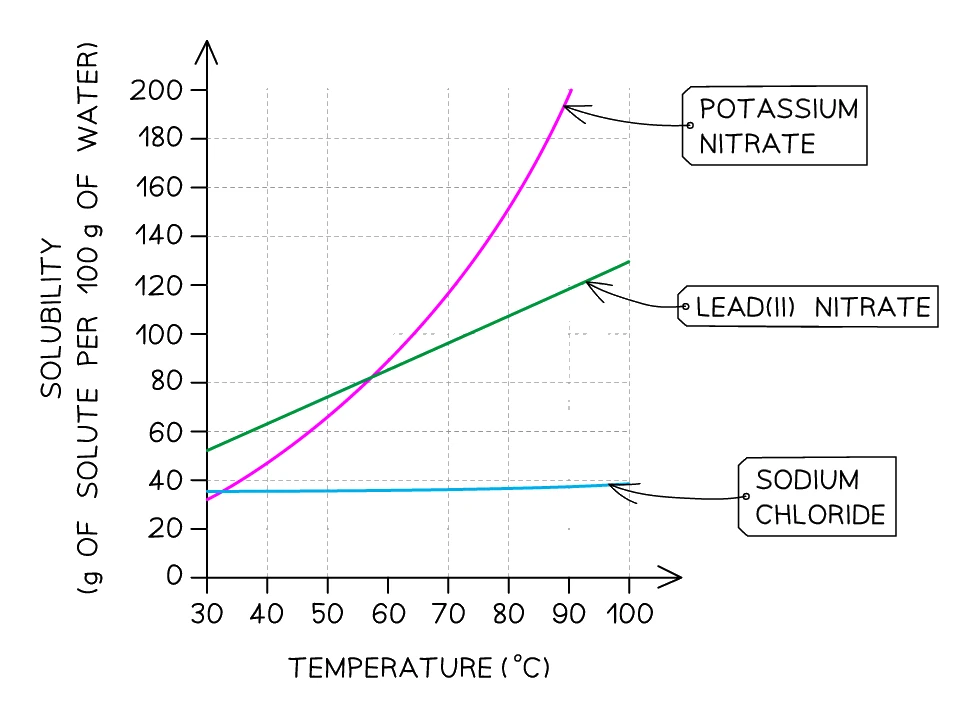
- A solubility curve plots solubility (g per 100 g of water) against temperature (°C)
- Built by measuring the saturation mass at each of several temperatures and joining the points
- Most ionic salts: curve rises with temperature
- Shape varies sharply between salts:
- KNO₃: steep rise
- Pb(NO₃)₂: moderate rise
- NaCl: almost flat across 0–100 °C
Worked example
How much solute crystallises when a saturated solution is cooled
A saturated solution holds 110 g of potassium nitrate per 100 g of water at 60 °C. It is cooled to 20 °C, where the solubility of potassium nitrate is 32 g per 100 g of water. Find the mass of crystals that form (per 100 g of water).
Solution:
- At 60 °C, 100 g of water holds 110 g of dissolved KNO₃.
- At 20 °C, 100 g of water can hold only 32 g.
- The solute that can no longer stay dissolved comes out as crystals.
- Mass of crystals = solubility at 60 °C − solubility at 20 °C = 110 − 32 = 78 g.