4CH1
The Periodic Table
Principles of Chemistry
Layout of the Periodic Table
Arrangement of elements
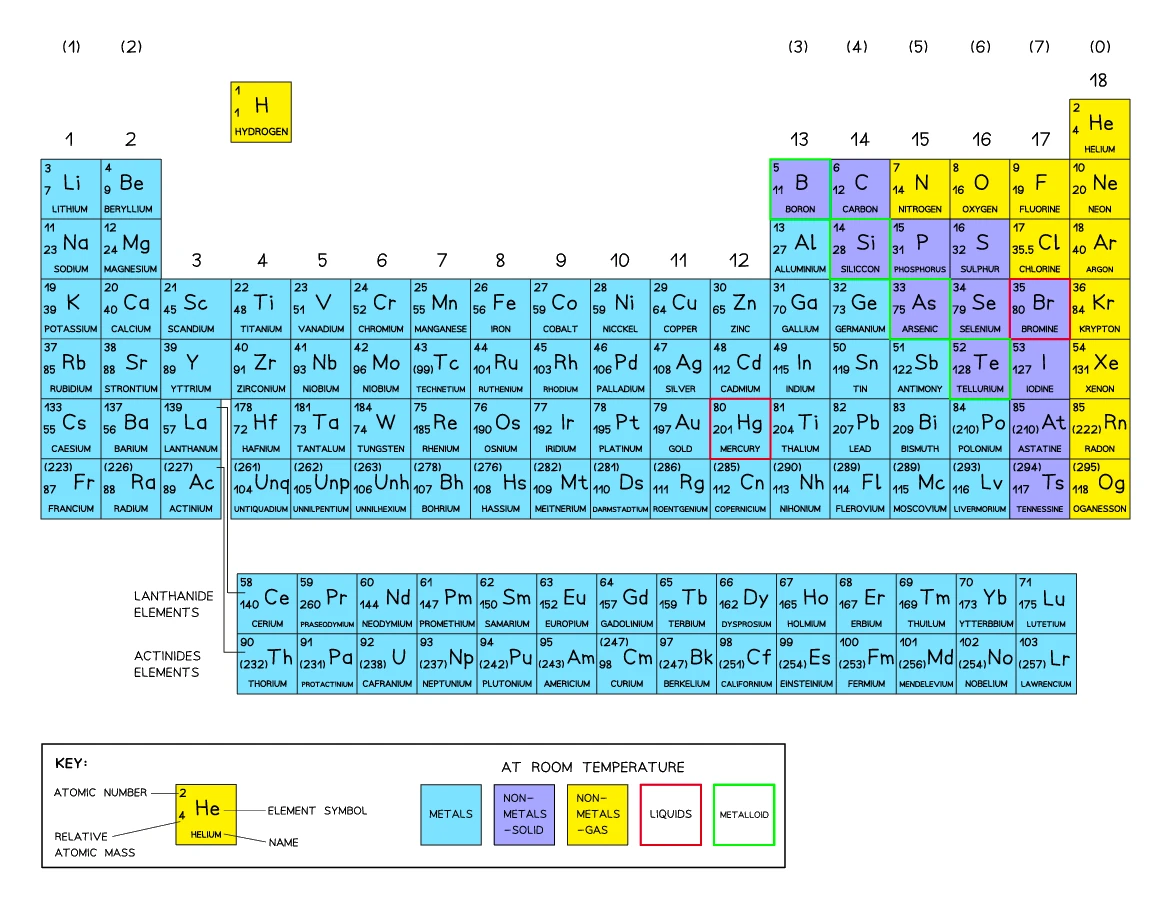
- The periodic table lists every chemical element ever isolated — currently over 100
- Elements are arranged in order of increasing atomic number
- Each successive element has one more proton (and one more electron) than the one before it
- The columns are aligned so that elements with similar chemical behaviour sit above and below each other
Groups and periods
- Periods are the horizontal rows, numbered 1 to 7
- Groups are the vertical columns, numbered 1 to 7, plus 0 on the far right (sometimes called Group 8 in older notations; Edexcel uses Group 0)
- Two links between position and electron arrangement (covered in section 2):
- number = number of occupied electron shells
- Group number = number of electrons in the outer shell (for Groups 1 to 7)
- For example:
- Period 2 elements have 2 electron shells; Period 3 elements have 3 shells
- Group 4 elements have 4 outer electrons; Group 6 elements have 6 outer electrons
Atomic number as a fingerprint
- Every element has its own unique atomic number; no two elements share one
- The atomic number does not change during a chemical reaction; only electrons move
Exam tip
Why elements are arranged in order of atomic number
What comes up: a multiple-choice or short-answer question asks what determines the order of elements in the periodic table.
Write: elements are arranged in order of increasing atomic (proton) number.
Watch out: do not write "increasing relative atomic mass" (mass number) — the mark scheme explicitly rejects this. Atomic number and mass number differ because of neutrons; the table is ordered by protons, not mass.