4CH1
Elements, Compounds and Mixtures
Principles of Chemistry · 2 question types
Element, Compound or Mixture
- Every chemical substance falls into one of three classes:
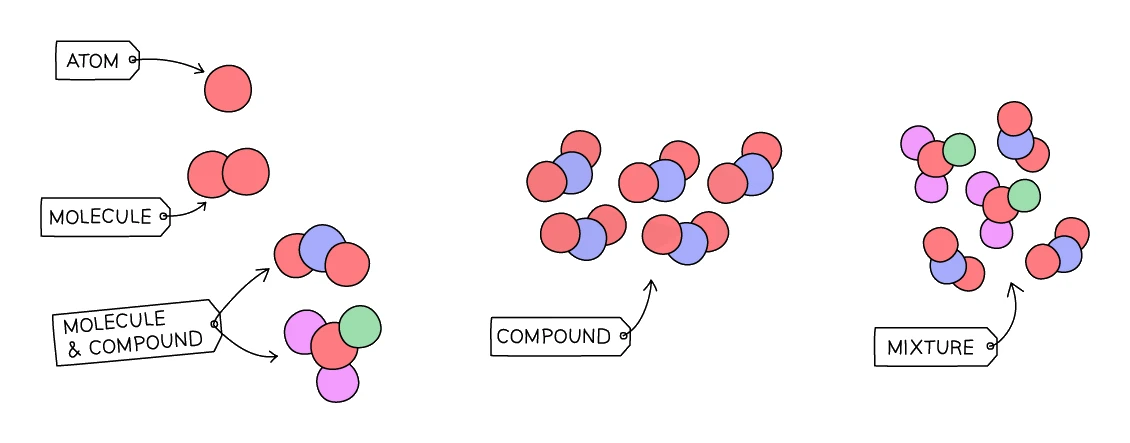
- Edexcel expects you to classify a substance from its name, formula, or particle diagram
Element
- Built entirely from atoms that all share the same proton number
- Each element has its own characteristic proton number (e.g. gold = 79, oxygen = 8)
- Cannot be reduced to anything simpler by ordinary chemical or physical methods
- 118 elements are known, all set out in the Periodic Table
- Examples: iron (Fe), copper (Cu), magnesium (Mg), oxygen (O₂), nitrogen (N₂), sulfur (S₈)
- Diatomic and polyatomic forms are still elements
- O₂ is an element (not a compound), because every atom in it is oxygen
Compound
- A pure substance formed when atoms of two or more different elements join in a fixed ratio through chemical bonds
- Has its own chemical properties, different from those of its elements
- Can only be broken back into its elements by another chemical reaction (not by physical means)
- Millions of different compounds exist
- Composition by mass is fixed
- Water is always H₂O, never H₃O or H₂O₂
- Sodium chloride is always one Na per one Cl
- Examples: water (H₂O), carbon dioxide (CO₂), calcium carbonate (CaCO₃), copper(II) sulfate (CuSO₄)
Mixture
- Two or more substances (any combination of elements and compounds) sharing the same space, with no chemical bonds between them
- Each component keeps its own chemical identity and properties
- Proportions can vary (a salt solution can be weak or strong)
- Components can be separated again by physical methods
- Examples:
- Air (mostly N₂ and O₂, plus Ar, CO₂, water vapour)
- Seawater (water + dissolved salts)
- Iron filings + sulfur powder
- Brass (copper + zinc)
Recognising the class from a formula
| What you see | Class | Examples |
|---|---|---|
| One element symbol only (optionally with subscript denoting a molecule of that element) | Element | Cu, O₂, S₈, P₄ |
| Two or more different element symbols bonded as one unit | Compound | H₂O, NaCl, CaCO₃, NH₃ |
| Two or more formulae written separately ("+", "and", or in a list) | Mixture | Fe + S; sand + water; air |
Exam tip
Explaining why a substance is a compound
What comes up: Given a formula or a diagram showing a molecule, you are asked to explain (for 2 marks) why it is a compound rather than an element or mixture.
Write (two marks): (1) It contains two or more different elements. (2) Those elements are chemically joined (bonded) together.
Watch out: Saying the atoms "are mixed together" or "are next to each other" scores zero for M2 — the mark requires the idea of a chemical bond, not just proximity.