Elements, Compounds and Mixtures
Principles of Chemistry
| Mixture | Best method |
|---|---|
| Insoluble solid + liquid | Filtration |
| Soluble solid + liquid (want the solid back as crystals) | Crystallisation |
| Soluble solid + liquid (want the liquid back pure) | Simple distillation |
| Two or more miscible liquids of different b.p. | Fractional distillation |
| Coloured substances dissolved in a single solvent | Paper chromatography |
Common exam question
Choosing the separation technique for a mixture
Question: Choose from a box, or name, the technique that gives a named substance from a mixture: sand from seawater, water from copper(II) sulfate solution, gasoline from crude oil, the dyes in an ink (1 mark each).
Asked in 10 of the 23 papers, as a word box, a table, a multiple-choice item or a labelled diagram. The matches are fixed: insoluble solid from a liquid, filtration; dissolved solid back as crystals, crystallisation; solvent back from a solution, simple distillation; liquids with different boiling points (ethanol and water, crude oil), fractional distillation; dyes, chromatography.
Write the full name: bare "distillation" was rejected in two mark schemes and accepted in only one, and each distillation was rejected for the other's job ("fractional" for recovering the solvent ethanol from a solution of a solid, "simple" for separating ethanol from water). A gap-fill version wants the steps that take a soluble solid away from an insoluble one: dissolve, filter, evaporate some of the water, crystallise.
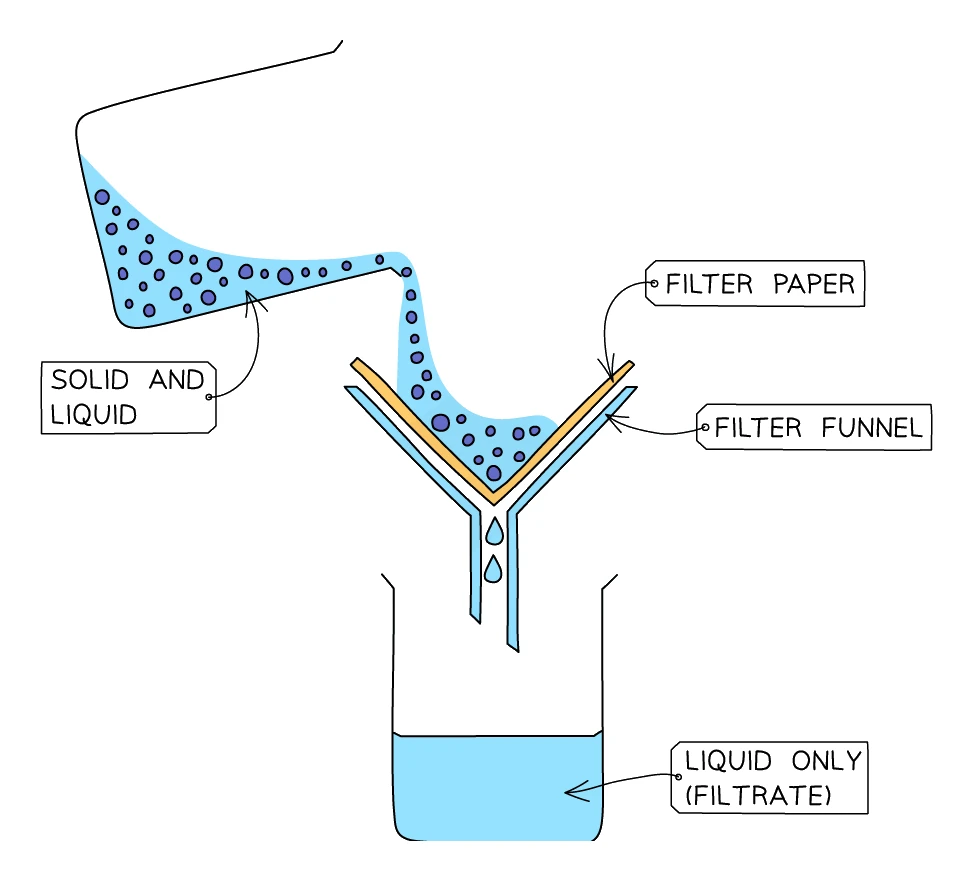
Filtration
- Separates an solid from a liquid (e.g. sand from water)
- Apparatus:
- Folded filter paper in a filter funnel
- Funnel resting on the rim of a beaker (or held in a clamp above it)
- The mixture is poured into the funnel; the paper traps solid particles
- Residue = solid caught on the paper
- Filtrate = liquid that passes through into the beaker
- Centrifugation is an alternative for very fine particles (more common in biology than in chemistry)
Crystallisation
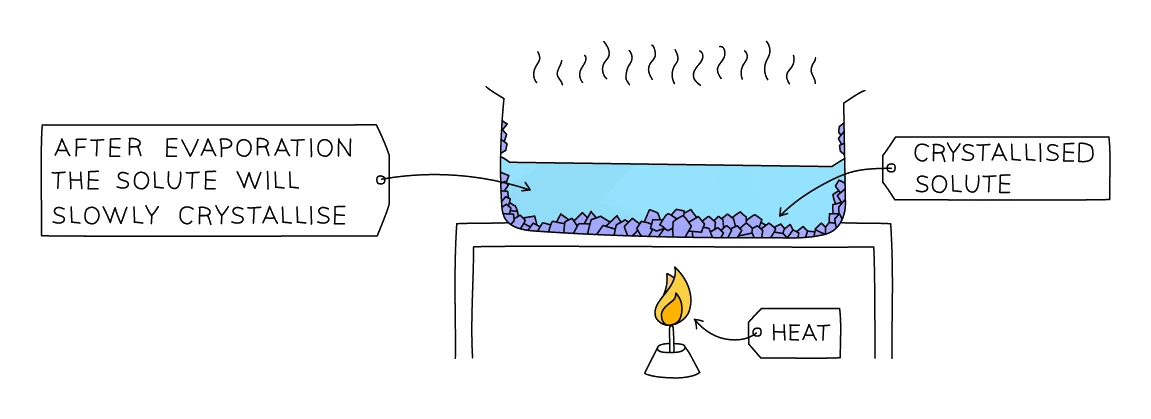
- Pulls a solid back out of its solution as well-formed crystals
- Works because the solubility of most solids falls sharply on cooling
- Procedure:
- Heat the solution gently to evaporate some solvent and concentrate it
- To test for saturation, touch the surface with a chilled, clean glass rod. If crystals form on the rod, the solution is saturated
- Stop heating; cool slowly (slow cooling = larger, better-formed crystals)
- Filter off the crystals; wash with a small volume of cold distilled water to rinse off impurities; pat dry between filter papers
- Standard method for harvesting:
- Hydrated copper(II) sulfate (CuSO₄·5H₂O) from CuSO₄ solution
- Industrially: sugar, alum, potash
Common exam question
Obtaining pure, dry crystals from a solution
Question: Describe how to obtain pure, dry crystals of a salt from its solution (4–5 marks).
Set in 8 of the 23 papers, and four points recur in every scheme. Heat the solution so that some of the water evaporates and it becomes saturated (crystals first appear, or form on a glass rod). Leave it to cool so crystals form. Filter or pour off the remaining liquid. Dry the crystals between filter papers, in a warm oven or in a desiccator.
Heating until all the water has gone is heating to dryness, which the schemes cap at one or two marks of the four or five; two schemes rejected a hot oven or a Bunsen flame for drying. Washing earns nothing, and washing after drying loses the drying mark. When the solution was made with an excess of solid, filtering that excess off first is the fifth mark; when it came from a titration, repeating it without the indicator is.
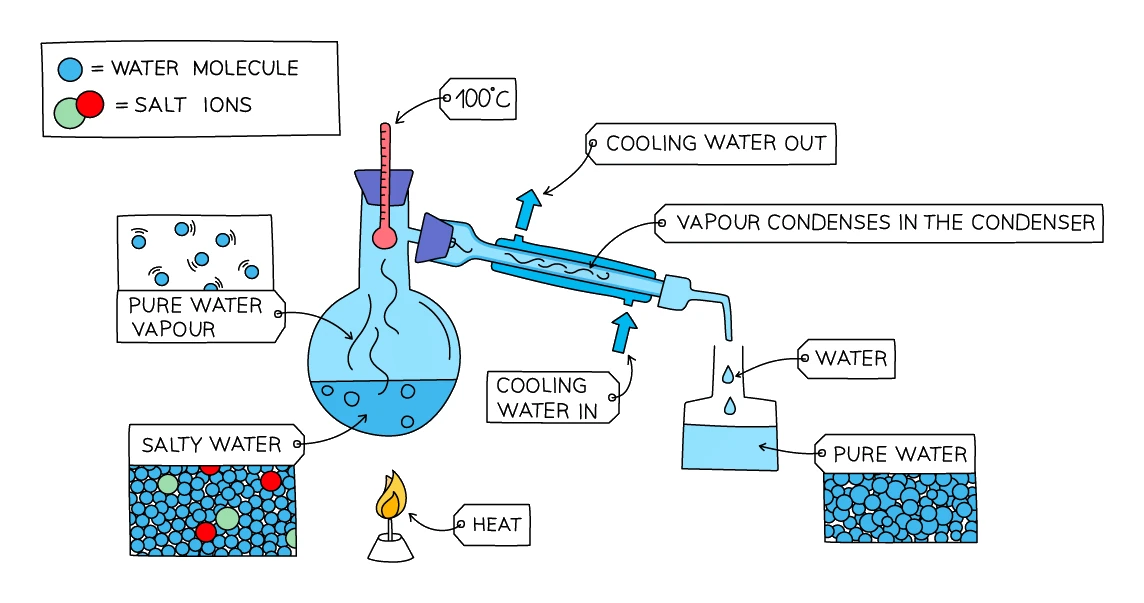
Simple distillation
- Separates a liquid from a dissolved (e.g. pure water from salt water)
- Also isolates a single pure liquid from a mixture whose other components boil much higher
- How it works:
- The solution is heated in a round-bottomed flask
- The volatile component vaporises and rises out of the flask
- The vapour passes into a water-jacketed condenser and is cooled back into liquid form
- The pure liquid is collected in a beaker; the solute stays behind in the flask
Common exam question
Labelling and explaining the distillation apparatus
Question: Name the pieces of apparatus labelled on a distillation diagram, or explain what happens to the vapour in the condenser and why water flows through it (2–3 marks).
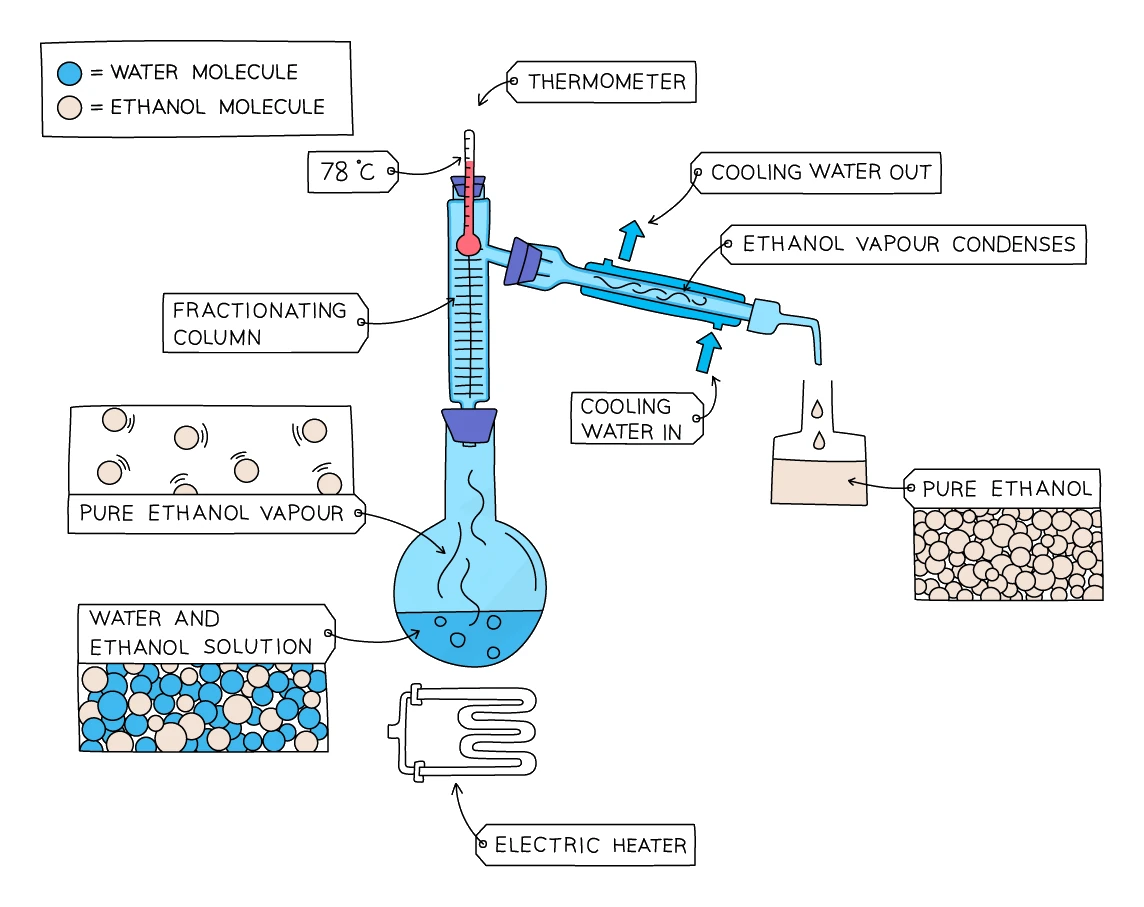
Set in 3 of the 23 papers. The labels wanted are the thermometer above the flask (at the top of the column, since the printed apparatus was a fractional distillation), the Liebig condenser ("condenser" is enough) and the beaker collecting the distillate, one mark each. The condenser question is two linked marks: the cold water cools the vapour (first mark), so it condenses back to a liquid (second mark). Water flows in and out continuously to keep the condenser cold, and saying only that it cools the vapour, without the condensing, is one mark of the two.
Fractional distillation
- Separates two or more liquids with different boiling points
- Example: ethanol (b.p. 78 °C) and water (b.p. 100 °C)
- Industrial example: crude oil into petrol, kerosene, diesel etc. (see Topic 11)
- Apparatus is simple distillation plus a vertical fractionating column between the flask and the condenser
- Column packed with glass beads (or fitted with plates)
- Provides a large surface area for repeated condensation and re-evaporation
- Each cycle enriches the rising vapour in the lower-boiling component
- Procedure (ethanol/water):
- Heat the flask; thermometer at the top of the column reads 78 °C when ethanol vapour reaches it
- Pure (or nearly pure) ethanol distils over; thermometer holds at 78 °C
- When the ethanol is exhausted, the temperature rises towards 100 °C as water starts to come over; stop collecting, or switch flasks
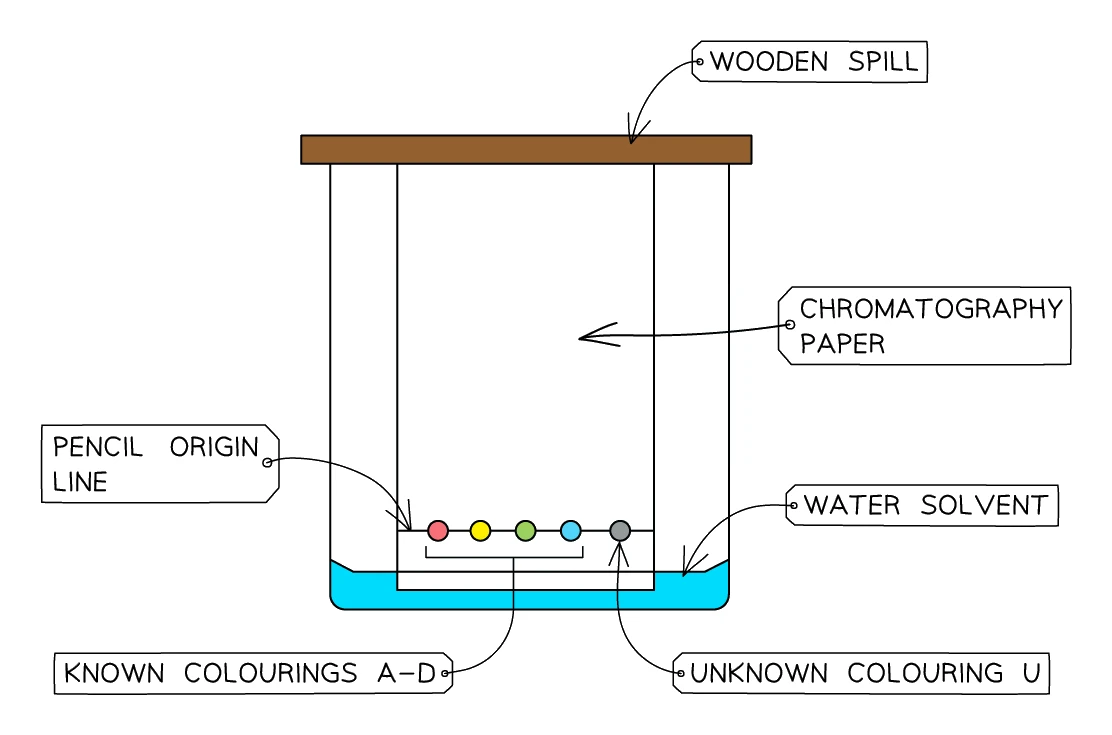
Paper chromatography
- Separates dissolved substances whose solubilities in a single chosen solvent differ from one another
- Typical targets: ink dyes, food colourings, plant pigments
- Procedure:
- Draw a horizontal baseline in pencil about 1–2 cm from one short edge of the chromatography paper
- Pencil graphite is insoluble; pen ink would itself run up the paper
- With a fine capillary tube, place one small spot of each sample on the baseline (fresh tube per sample)
- Stand the paper in a covered beaker with a shallow layer of solvent
- Solvent level must be below the baseline
- The solvent climbs the paper by capillary action, carrying dissolved substances with it
- More soluble in the solvent → travels further
- Less soluble (sticks to paper) → travels less
- When the solvent front is near the top, lift out the paper, mark the solvent front in pencil, and let it dry
- Draw a horizontal baseline in pencil about 1–2 cm from one short edge of the chromatography paper