Elements, Compounds and Mixtures
Principles of Chemistry
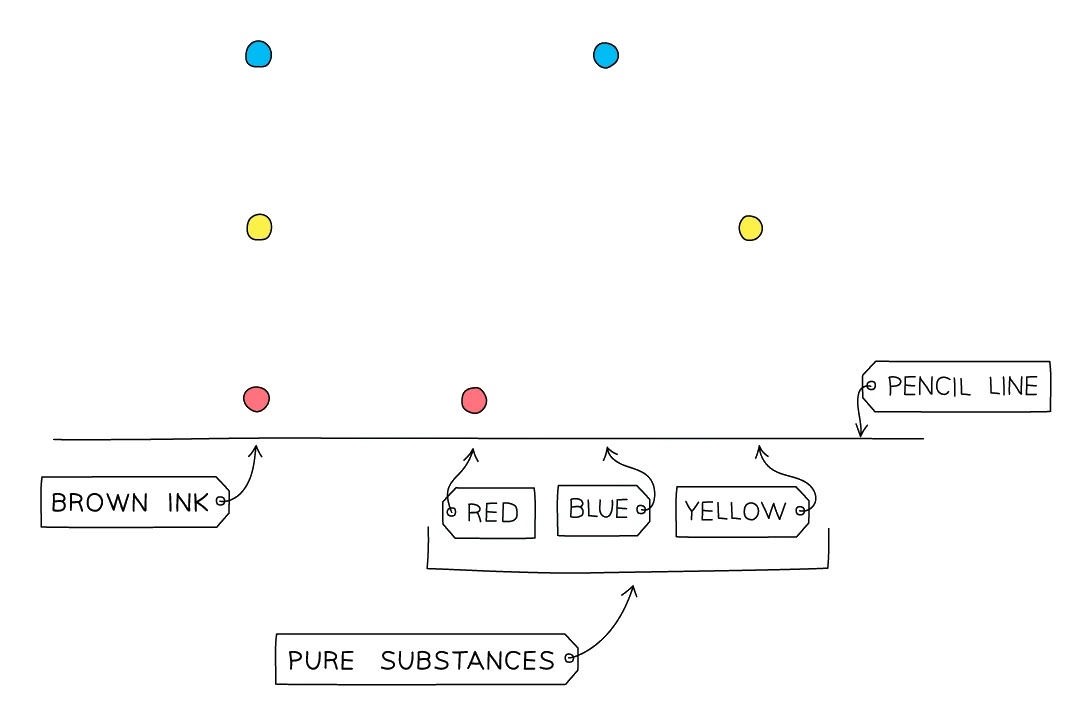
- A chromatogram is read by comparing the spots of an unknown sample against spots from known reference substances
- → a single spot in its lane
- Impure substance → two or more spots in the same lane
- Two samples of the same substance → produce identical chromatograms (same number of spots at the same heights)
- A separates on the paper, with each of its constituent substances showing up as a distinct spot in the lane
- Standard practice is to run known reference samples alongside the unknown in adjacent lanes
- The references give you fixed positions to compare against
- Any spot in the unknown lane that sits at the same height as a reference spot is the same substance
Common exam question
Reading a chromatogram
Question: Use a chromatogram, or a table of Rf values, to say which colourings share a dye, how many dyes one contains, which dye is insoluble, or why one travels furthest (1–2 marks per part).
Asked in 7 of the 23 papers. Two colourings share a dye when they have spots at the same height (same distance, same Rf value); a colouring has as many dyes as spots in its lane; a spot still on the start line (Rf of 0) is a dye insoluble in the solvent; the dye that travels furthest is the most soluble in it.
In a two-mark "explain which" part the reason mark depends on the right pair or lane, so identify first. Give the reason as solubility: "it moves further up the paper" only restates the chromatogram and was ignored. One spot proves a single dye only if it has moved; one still on the line could be several insoluble dyes.
Rf values
- Rf (retention factor) is used to identify a component quantitatively
- Defined by:
- Distance moved by the substance is measured from the baseline up to the centre of the spot
- Distance moved by the solvent is measured from the baseline up to the front
- Properties:
- Has no units (it's a ratio)
- Always less than 1 (a spot can't travel further than the solvent that carries it)
- Constant for a given solute, solvent and paper at a given temperature
- Changes if you change the solvent or the paper
Common exam question
Measuring and calculating an Rf value
Question: Calculate the Rf value of a dye from a chromatogram, or describe how to find it (2–3 marks).
Set in 5 of the 23 papers. Measure both distances from the start line, not the paper's bottom edge: to the centre of the spot and to the solvent front. The readings are the first mark (one each in one paper); dividing the spot's distance by the solvent's is the next. Readings are accepted within a couple of millimetres, and a wrong one written down still earns the division mark by follow-through.
Rf is always less than 1: the inverted fraction scored one mark of three. Round correctly: the last mark was withheld for a wrongly rounded value, and when two significant figures are asked for, the unrounded 0.808 still earns the working marks but only 0.81 earns the last. One paper instead listed two students' Rf values and asked which was impossible: the one above 1, as a spot cannot pass the solvent front.
Worked example
Calculating an Rf value from a chromatogram
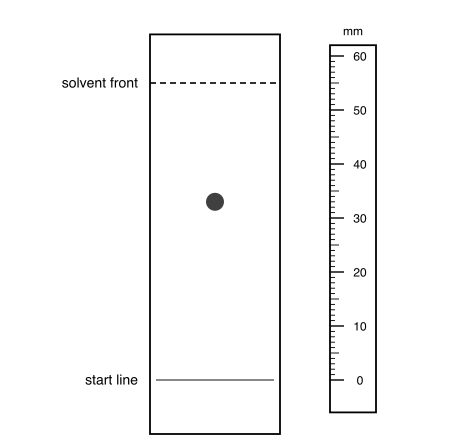
The diagram shows a chromatogram of a single dye, with a millimetre ruler laid beside it so that its zero is on the start line. Use the ruler to work out the dye's Rf value, to two significant figures.
Solution:
- Take both readings from the start line: the spot's centre is at 33 mm and the solvent front at 55 mm
- Rf = how far the dye moved ÷ how far the solvent moved = 33 ÷ 55
- Rf = 0.6 exactly, written to two significant figures as 0.60 (no units: it is a ratio, and always less than 1)