States of Matter
Principles of Chemistry
The Three States of Matter
The particle model
- All chemical substances exist as a , a or a
- The state of a given substance depends on temperature (and, for gases, pressure)
- The particles inside (atoms, molecules or ions) are the same in every state
- What differs between states is the arrangement, motion and energy of the particles
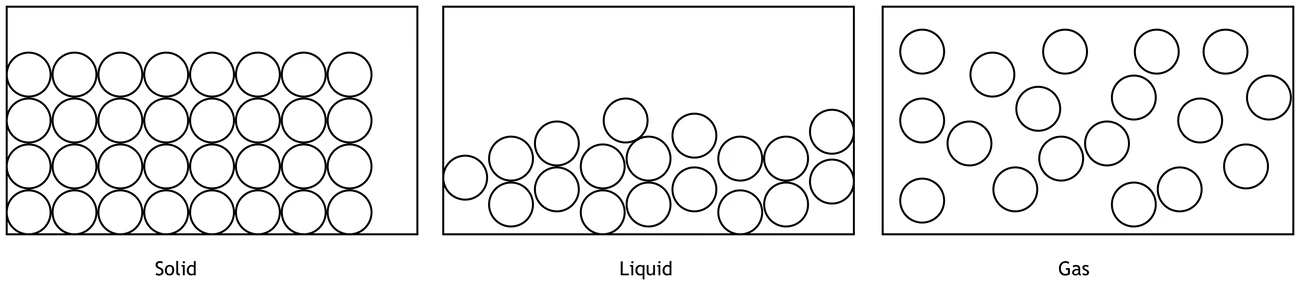
- The model pictures every particle as a small hard sphere
- Used to compare arrangement, spacing and motion between the three states
Comparing the three states
| Property | Solid | Liquid | Gas |
|---|---|---|---|
| Arrangement | Regular arrangement | Randomly arranged | Randomly arranged |
| Spacing | Very close together | Close together (still touching) | Far apart |
| Motion | Vibrate in fixed positions | Move around each other | Move freely in all directions |
| Average energy | Lowest | Intermediate | Highest |
| Fixed shape? | Yes | No (takes the shape of its container) | No (fills its container) |
| Fixed volume? | Yes | Yes | No |
| Compressible? | No | Almost not at all | Yes |
Common exam question
Describing or drawing the particles in a state
Question: Describe the arrangement and movement of the particles in a solid, compare their movement in two states, or complete a particle diagram for a liquid or a gas (1–2 marks).
Asked in 6 of the 23 papers. Describing a solid earns one mark for the arrangement (regular, closely packed) and one for the movement (vibrate about fixed positions). Comparing two states earns one mark per state: solid particles vibrate about fixed positions, liquid particles move around each other, gas particles move randomly and quickly; spacing earns nothing there. Avoid "do not move" for a solid: one mark scheme rejects it, though another accepts it.
For a drawing, the marks are in the spacing. Gas particles go far apart, randomly spaced and not touching; liquid particles go close together, mostly touching and filling the box from the bottom, in a random arrangement. A neat regular grid drawn for a liquid scores nothing.
Why state changes need energy
- Particles are held together by attractive forces (intermolecular forces, or ionic / covalent / metallic bonds in giant structures)
- Changing state means giving the particles enough kinetic energy to weaken or overcome those forces
- Stronger forces between particles → higher melting and boiling points
- e.g. iron melts at 1538 °C, sodium chloride at 801 °C
- Weaker forces between particles → lower melting and boiling points
- e.g. oxygen at −183 °C, methane at −161 °C
- A change of state is a physical change, not a chemical one
- The particles themselves are unchanged
- Only the forces holding them in place change
Exam tip
Forces are overcome, bonds are not broken
Whenever a question asks what happens to the particles as a substance melts, boils or evaporates, the credited idea is that the particles gain kinetic energy and overcome the forces of attraction between them. For a simple molecular substance those are the weak forces between the molecules; the covalent bonds inside each molecule stay intact. One mark scheme lets "break the forces between the molecules" through, but another rejects "breaking bonds" outright, so the safe wording is always "overcome the forces between the molecules".