States of Matter
Principles of Chemistry
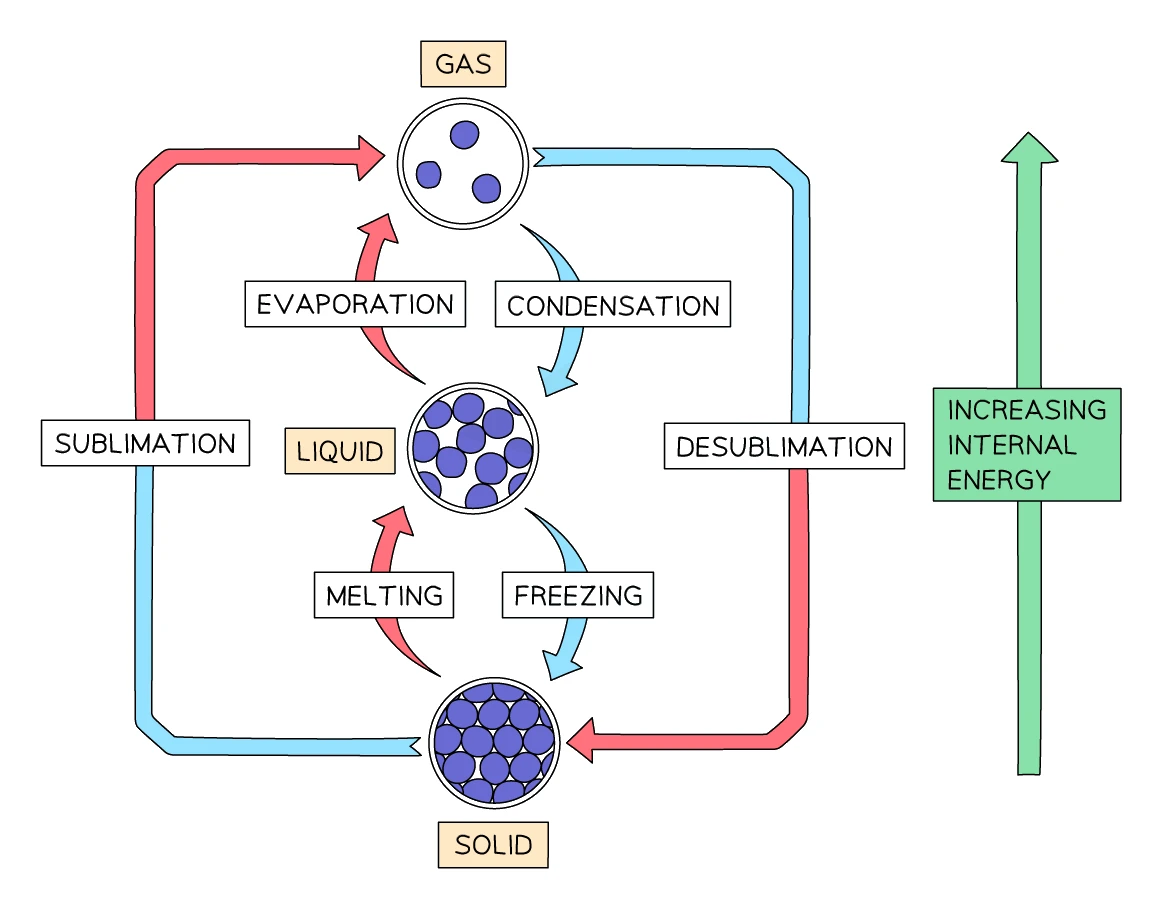
| Process | Direction | Energy |
|---|---|---|
| Melting | solid → liquid | absorbed |
| Boiling / evaporation | liquid → gas | absorbed |
| Sublimation | solid → gas | absorbed |
| Freezing | liquid → solid | released |
| Condensation | gas → liquid | released |
| Deposition | gas → solid | released |
Naming a change of state
Naming a change of state from its direction comes up on almost every paper, so you need to know all six: melting (s→l), freezing (l→s), boiling/evaporation (l→g), condensation (g→l), sublimation (s→g), deposition (g→s). Read the direction carefully — freezing and condensation are the easiest pair to swap.
Melting
- Solid changes to liquid
- Particles gain kinetic energy and escape their fixed lattice positions, starting to slide
- Happens at one specific temperature, the point (m.p.)
- A pure substance has a sharp m.p. (a standard purity test)
Freezing
- Liquid changes to solid (the reverse of melting)
- Particles lose kinetic energy and lock back into a fixed arrangement
- For a pure substance, freezing point = melting point
- Water freezes / ice melts at 0 °C
Boiling
- Liquid changes to gas at one specific temperature, the point (b.p.)
- Vapour bubbles form throughout the bulk of the liquid
- The temperature of the liquid stays at the b.p. while boiling continues
- Continuous heating is needed to maintain the change
Evaporation
- Liquid changes to gas at any temperature below the b.p.
- A surface-only process: only particles at the liquid surface escape
- The fastest-moving surface particles have enough kinetic energy to break free
- Speeds up when:
- surface area is larger
- temperature is higher
- a draught removes the escaping vapour
Explain why a liquid evaporates faster (e.g. hot water vs cold)
Write (two marks): (1) the particles gain more kinetic energy and move faster; (2) so a greater number of surface particles have enough energy to break free and overcome the forces of attraction.
Watch out: both points are needed — just saying "the particles move faster" without "more particles escape" usually scores only one mark. Evaporation happens only at the surface and at any temperature below the boiling point, unlike boiling.
Condensation
- Gas changes to liquid on cooling
- Particles lose kinetic energy, and attractive forces hold colliding particles together
- Occurs over a range of temperatures, not at one fixed value
Sublimation and deposition
- Sublimation = solid → gas, skipping the liquid state
- Solid iodine (purple vapour on warming)
- Solid carbon dioxide ("dry ice")
- (also "desublimation") = gas → solid, skipping the liquid state
- Frost forming on cold glass from water vapour