4CH1
Metallic Bonding
Principles of Chemistry · 2 question types
The Metallic Bond
Metals as giant lattices
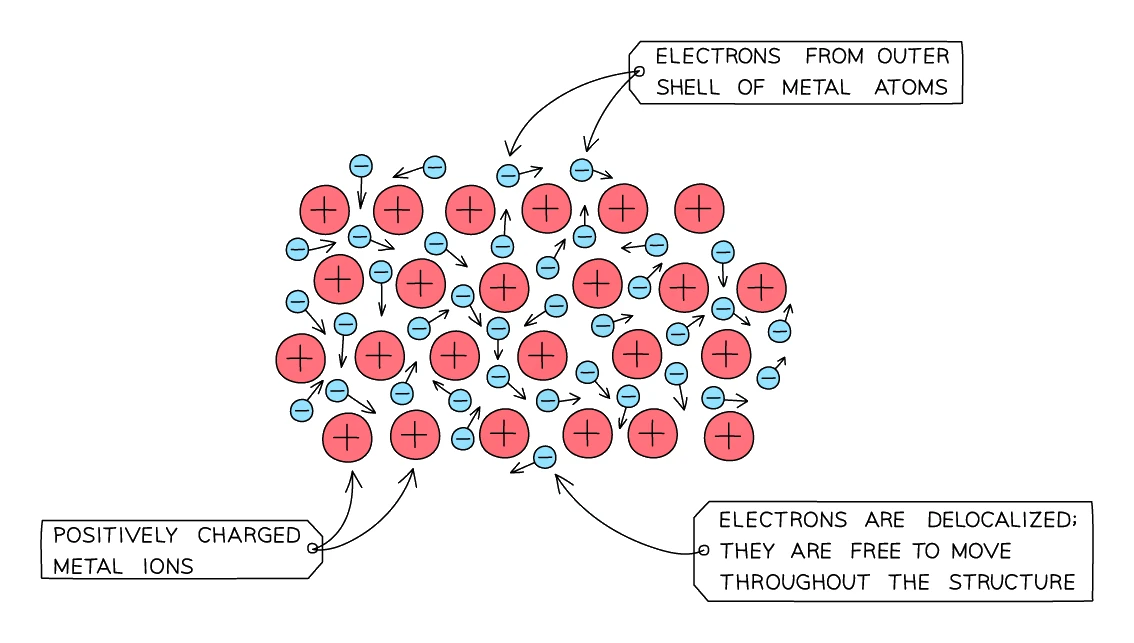
- A metal is a giant metallic lattice of metal atoms packed in a regular arrangement
- Each atom releases its outer-shell electrons into the lattice
- These electrons are no longer attached to any single atom
- They are described as
- They move freely throughout the whole lattice, forming a
- What remains at the lattice positions are the positive metal ions (cations)
What the metallic bond is
- The metallic bond is the electrostatic attraction between the positive metal ions and the surrounding delocalised electrons
- The attraction acts in every direction through the lattice and holds the whole structure together
- The same bonding model applies to pure metals and to alloys, which are mixtures of a metal with one or more other elements
Exam tip
Forces in metallic bonding
Describing the forces in metallic bonding is a common 2-marker, so you need to know it is the electrostatic attraction between the positive metal ions and the delocalised electrons. Don't mention ionic or covalent bonding, sharing electrons, or intermolecular forces — those score zero.