Metallic Bonding
Principles of Chemistry · 2 question types
High melting and boiling points
- Most metals have high melting and boiling points
- The electrostatic attraction between the positive metal ions and the delocalised electrons is strong
- Breaking apart the lattice needs a large amount of energy, so the melting and boiling temperatures are high
- Group 1 metals are partial exceptions (sodium melts at about 98 °C) because the attraction is weaker when each atom only releases one electron
Electrical and thermal conductivity
- Metals conduct electricity in both the solid and the liquid state
- The delocalised electrons are free to move through the lattice
- When a voltage is applied, they drift toward the positive terminal and carry the charge
- Metals also conduct heat well
- The delocalised electrons gain kinetic energy at the hot end and pass it rapidly through the structure
Why metals conduct electricity
What comes up: "Explain why metals conduct electricity" (2 marks).
Write (two marks): (1) The electrons are delocalised (2) and can move or flow through the structure, carrying charge.
Watch out: Any mention of ions or atoms moving to carry charge scores zero for M2. The answer must name electrons specifically in the first mark point — the mark scheme requires electrons to be mentioned in M1 before M2 can be awarded.
Malleability and ductility
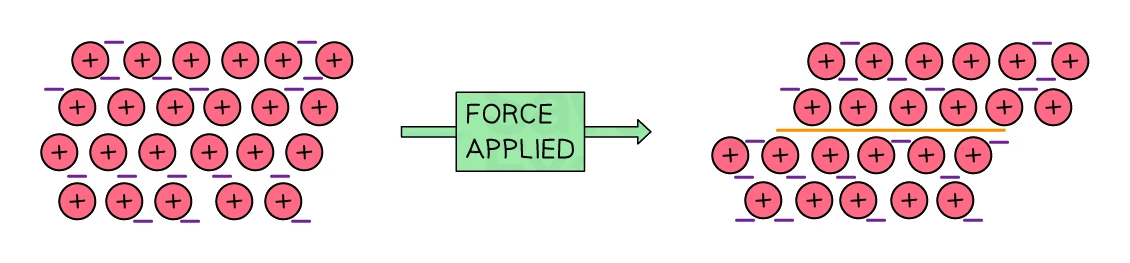
- Metals are malleable: they can be hammered into shape
- Metals are also ductile: they can be drawn into wires
- Both properties follow from the same feature of the lattice
- The metal atoms/ions sit in layers
- Applying a force lets the layers slip past one another into a new arrangement
- The delocalised electrons rearrange around the shifted ions, so the metallic bonding survives the change of shape
- The metal changes shape without breaking
Why metals are malleable (or ductile)
What comes up: "Explain why metals are malleable" or "suggest why metals can be stretched into wires" (2 marks).
Write (two marks): (1) The metal ions/atoms are arranged in layers (2) the layers can slide over one another when a force is applied.
Watch out: The mark scheme rejects any reference to intermolecular forces, and also rejects answers that describe electrons sliding. Do not say the metallic bonds break — the bonding survives because the delocalised electrons rearrange around the shifted ions.