4CH1
Metallic Bonding
Principles of Chemistry · 2 question types
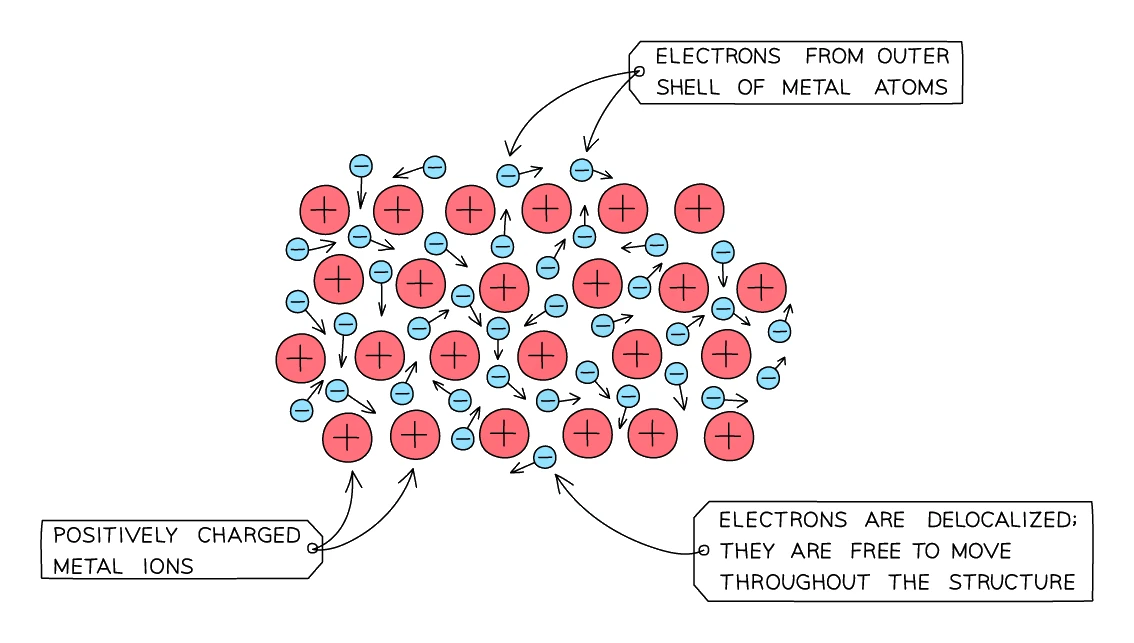
Metals as giant lattices
- A metal is a giant metallic lattice of metal atoms packed in a regular arrangement
- Each atom releases its outer-shell electrons into the lattice
- These electrons are no longer attached to any single atom
- They are described as
- They move freely throughout the whole lattice, forming a
- What remains at the lattice positions are the positive metal ions (cations)
What the metallic bond is
- The metallic bond is the electrostatic attraction between the positive metal ions and the surrounding delocalised electrons
- The attraction acts in every direction through the lattice and holds the whole structure together
- The same bonding model applies to pure metals and to alloys, which are mixtures of a metal with one or more other elements
Exam tip
Describing the metallic bond
Asked to describe the attractions in metallic bonding (2 marks, set once in the 23 papers), give both halves of the electrostatic attraction, one mark each: the positive metal ions ("the nuclei of the metal atoms" is also accepted) and the delocalised electrons between them. Any mention of ionic bonding, sharing electrons or intermolecular forces loses both marks. The same idea, with "strong" in front, is the credited reason for a metal's high melting point. Asked to label a printed lattice diagram, use "positive ion" (or cation) and "delocalised electron": "atom" is allowed for the first, "proton" is rejected.