Covalent Bonding
Principles of Chemistry
What they are
- A (also called a macromolecule) contains a vast number of non-metal atoms joined by strong covalent bonds in one continuous lattice
- Two classic examples, both built from carbon only:
- Diamond and graphite are of carbon: different forms of the same element with different bonding arrangements
Why all giant covalent structures have high melting points
- There are many strong running throughout the lattice
- Melting or vaporising the solid requires breaking very large numbers of these bonds
- That takes a great deal of thermal energy, so the melting point is high
Common exam question
Why a giant covalent substance has a high melting point
Question: Explain why diamond, graphite or silicon dioxide has a high melting point, on its own or compared with a simple molecular substance (3 marks alone, 4–6 in a comparison).
Asked in 5 of the 23 papers. Three linked points: the substance has a giant covalent structure; it contains many strong covalent bonds, which must be broken; and a large amount of energy is needed to break them. Write "giant covalent structure": one scheme credits a bare "giant structure" only when the covalent-bonds mark is also earned. In a comparison the final mark is for saying that breaking these bonds takes far more energy than overcoming the weak forces between the other substance's molecules.
One slip costs the bond and energy marks in four of the five schemes and halves the total in the fifth: mentioning intermolecular forces (one scheme adds ions) in the giant covalent substance. It has no molecules, so there are no intermolecular forces to overcome; the covalent bonds themselves break.
Diamond
- Each carbon atom forms 4 single to four other carbon atoms
- The result is a rigid 3D tetrahedral network extending throughout the crystal
- Every outer electron on every carbon is locked into a covalent bond → no free electrons
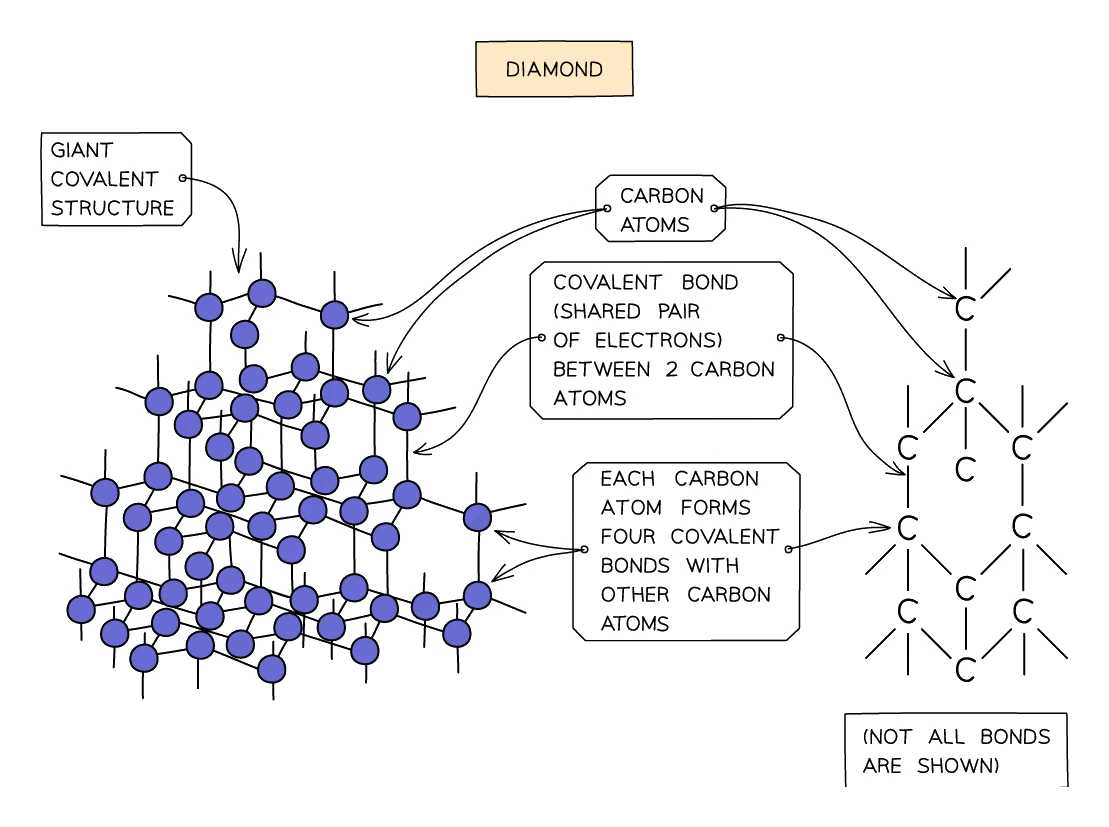
Properties of :
- Very hard: the rigid 3D network of strong covalent bonds resists deformation. Diamond is used in cutting tools, drill bits and saw edges where extreme hardness matters
- High melting point: the many strong covalent bonds running through the lattice need a large amount of energy to break
- Does not conduct electricity: every outer electron is locked in a covalent bond, so there are no free electrons or ions to move and carry charge
Graphite
- Each carbon atom forms only 3 single covalent bonds with three other carbon atoms
- These bonded atoms arrange themselves into flat layers of hexagons (sometimes called sheets)
- Each carbon has 4 outer electrons in total; 3 are used in bonds and the 4th is a that can move freely along the layer
- The hexagonal layers stack on top of each other, held together only by weak forces between the layers, not by covalent bonds
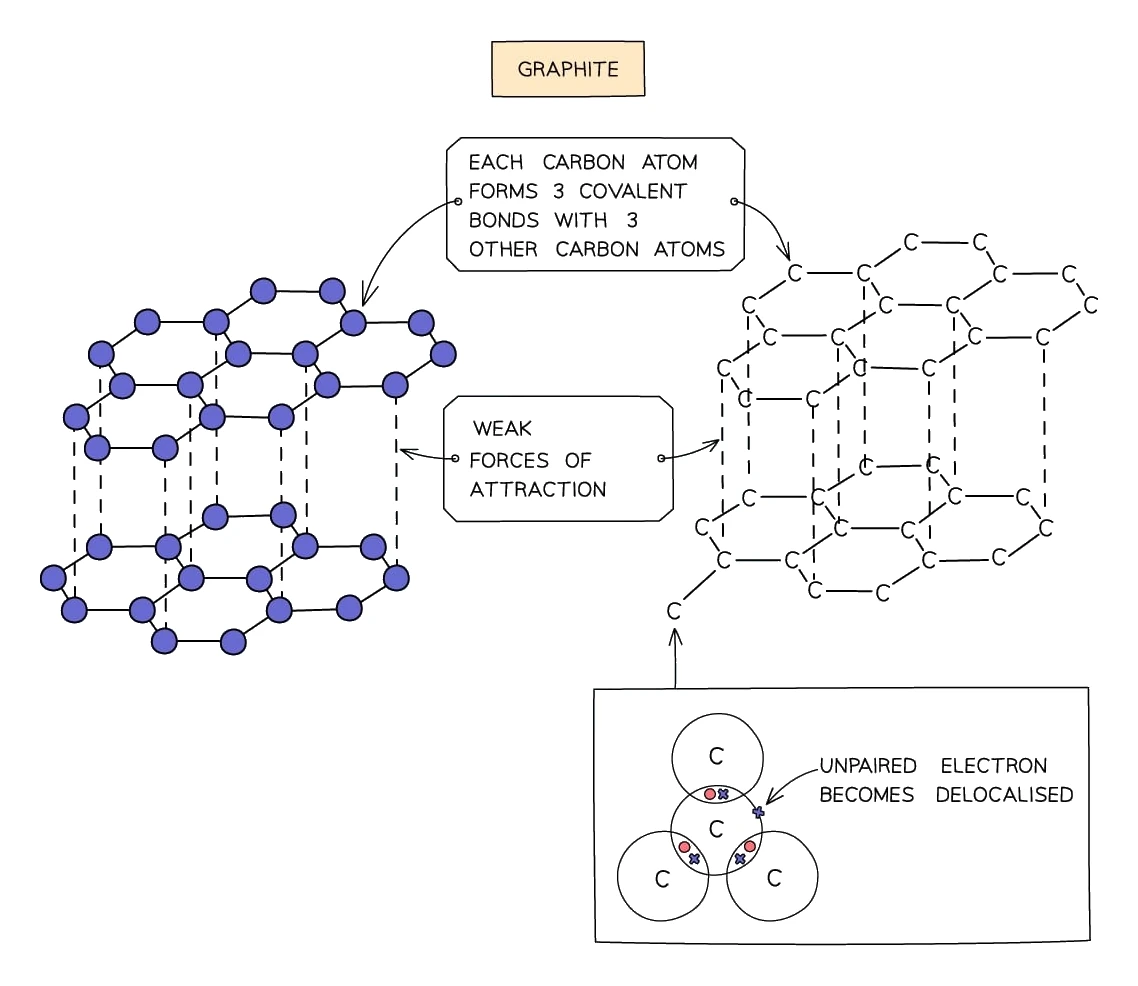
Properties of :
- Soft and slippery: the weak forces between layers let the layers slide easily over each other. Graphite is used as a dry lubricant and as the writing "lead" in pencils
- Conducts electricity (and heat): the delocalised electrons can move along the layers and carry charge. Graphite is one of the very few non-metals that conducts electricity well
- High melting point: within each layer the covalent bonds are strong, and a great deal of energy is needed to break enough of them for the structure to fall apart
Common exam question
Why diamond is hard but graphite is soft
Question: Explain why diamond is hard but graphite is soft, sometimes inside a longer comparison of the two structures (2–4 marks).
Asked in 4 of the 23 papers. For diamond: a rigid three-dimensional (tetrahedral) lattice in which every carbon is bonded to four others, plus, in the 4-mark version, a second mark for those bonds needing a lot of energy to break. For graphite: it is made of layers, and the layers can slide over one another; the sliding mark depends on having said "layers". The softness marks come from the layers, not from the covalent bonds within them.
Do not mention intermolecular forces in diamond: the schemes reject the diamond marks if you do. For the forces between graphite's layers, write "weak forces between the layers". Graphite has no molecules, so "intermolecular forces" here is ignored by two schemes and rejected by two others.
Why diamond doesn't conduct but graphite does
- An electric current is a flow of mobile charged particles
- In , every carbon uses all 4 of its outer electrons in covalent bonds. There are no free electrons available to move, so diamond is an electrical insulator
- In , every carbon uses only 3 of its 4 outer electrons in bonds. The 4th is delocalised and can move freely along the layer, carrying charge along with it. Graphite therefore conducts electricity
Common exam question
Why graphite conducts electricity
Question: Explain why graphite conducts electricity, or why it is a good conductor of electricity (2 marks).
Set as a 2-mark part in 3 of the 23 papers and inside a longer graphite question in 2 more. The two marks: graphite has delocalised electrons (each carbon bonds to only three others, leaving one electron per atom), and those electrons can move through the structure. Two of the three schemes make the second mark depend on the first, so name the electrons before you say what moves.
Three wordings matter. "Free electrons" and "sea of electrons" are ignored, so write "delocalised". "They carry the charge" or "carry the current" is also ignored: the credited idea is that the electrons move or flow. And any mention of ions in graphite, or of atoms moving, scores zero for the whole part. In the longer versions, "each carbon forms three covalent bonds" and "one delocalised electron per carbon" are separate marks.