4CH1
Covalent Bonding
Principles of Chemistry · 5 question types
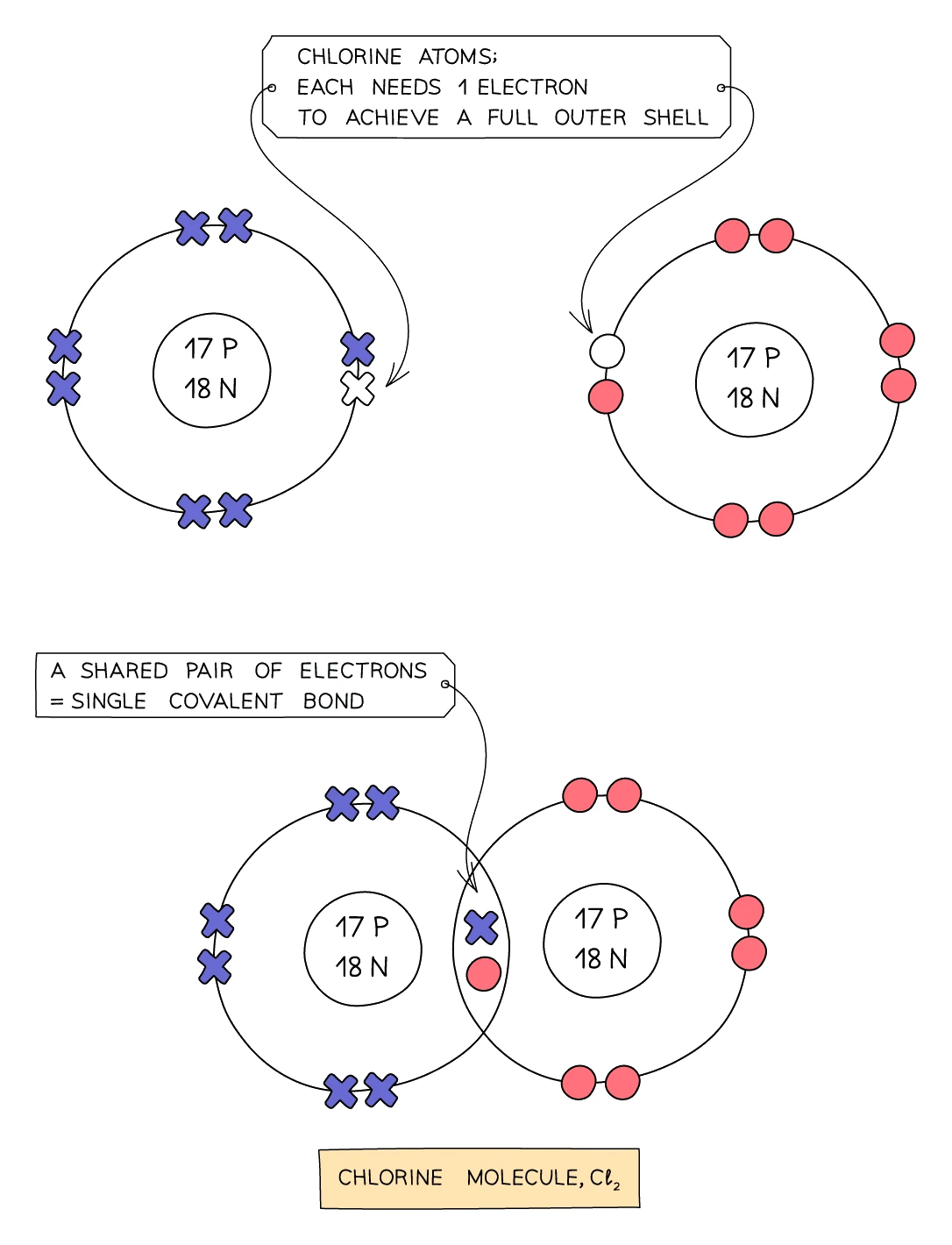
What a covalent bond is
- A forms when two non-metal atoms share a pair of electrons
- Each atom contributes one electron to the shared pair
- The shared pair counts toward each atom's outer shell, so both atoms end up with a full (noble-gas) outer shell
- Covalent bonds are very strong
Bonding and non-bonding electrons
- The two shared electrons in a bond are the bonding electrons (or a bonding pair)
- Outer-shell electrons that are not part of any bond are non-bonding electrons or
What holds a covalent bond together
- The shared pair of electrons (negative) sits between the two nuclei (positive)
- Both nuclei are electrostatically attracted to the same shared pair
- That mutual pull on the same electrons is what holds the atoms together
Exam tip
A near-every-paper question: what forces hold a covalent bond together?
Write: the (electrostatic) attraction between the shared pair of electrons and the two nuclei.
Watch out: say nuclei (plural), and name both the electrons and the nuclei. "Atoms sharing electrons" on its own scores nothing.
Notation: a line for each bond
- A single covalent bond is drawn as a short straight line between two atom symbols:
- H–H means a single bond between two hydrogen atoms
- A double bond is drawn as two lines:
- O=O means a double bond
- A triple bond is drawn as three lines:
- N≡N means a triple bond
Covalent vs ionic — the key difference
- In a covalent bond, electrons are shared. No atom permanently gains or loses an electron, and no ions form
- In an ionic bond (Topic 6), electrons are transferred from one atom to another, and oppositely charged ions form
Two kinds of covalent substance
- Every covalent substance falls into one of two structural classes:
- Simple molecular — small, discrete molecules (H₂O, O₂, CO₂); covered in section 3
- Giant covalent (also called macromolecules) — many millions of atoms covalently bonded into one continuous lattice (diamond, graphite); covered in section 4