4CH1
Covalent Bonding
Principles of Chemistry · 5 question types
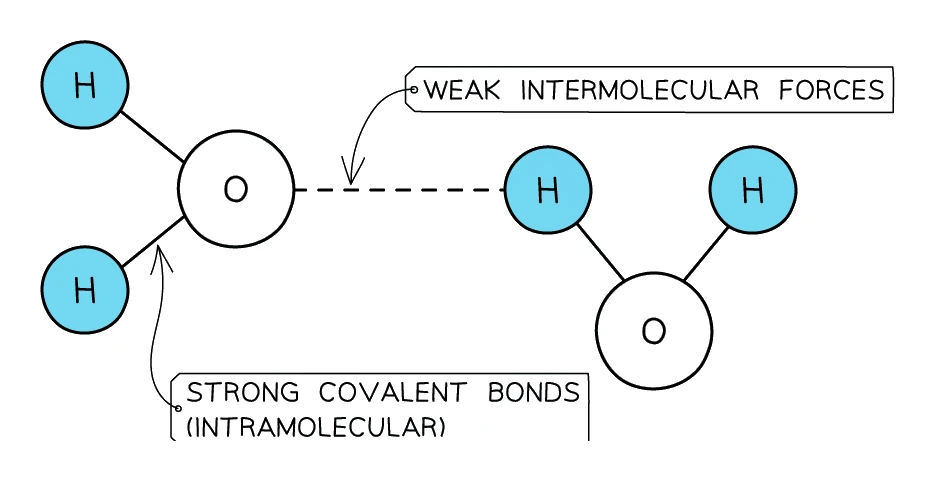
Bonding inside vs forces between molecules
- A simple molecular substance is built from many small discrete molecules (e.g. H₂O, O₂, CO₂, HCl, NH₃, CH₄)
- Inside each molecule, the atoms are held by strong
- Between neighbouring molecules, there are weak
- When the substance melts or boils, only the weak intermolecular forces are overcome; the strong covalent bonds inside the molecules stay intact
Low melting and boiling points
- Simple molecular substances generally have low melting and boiling points because:
- The intermolecular forces are weak
- Only a small amount of thermal energy is needed to overcome them
- Most simple molecular substances are gases or liquids at room temperature; only a few exist as soft solids with low melting points
Exam tip
Low melting point of a simple molecular substance
What comes up: explain why a simple molecular substance melts or boils easily.
Watch out: the credited idea is that only the weak intermolecular forces between molecules are overcome — never write "the covalent bonds break" or "weak covalent bonds". The strong covalent bonds inside the molecules stay intact.
Trend: larger molecules, higher melting and boiling points
- As the relative molecular mass of the molecule increases, melting and boiling points increase too
- A bigger molecule has more electrons, so the intermolecular forces between molecules are stronger and need more thermal energy to overcome
- e.g. in the alkane family (Topic 16), methane is a gas, hexane is a liquid, and the waxy long-chain alkanes are soft solids. The trend follows molecular size
Electrical conductivity
- Simple molecular substances do not conduct electricity in any state (solid, liquid or gas)
- Reason: there are no free charge carriers. No mobile ions and no delocalised electrons
- This is why plastics, rubber, wax and most solid sugars are good electrical insulators — the plastic coating around household wiring is a covalent polymer for exactly this reason