Examo

About us

Built to close the gap between knowing and scoring.

Most students who lose marks in IGCSE exams aren't short on knowledge. They're short on understanding what examiners actually want, and on remembering it on the day. Examo is built to fix both.

What makes Examo different

Revision that earns marks, not just hours.

Re-reading and highlighting are how most students revise, and research rates them among the least useful ways to learn. Testing yourself and spacing it out over time are among the most useful (Dunlosky and colleagues, 2013). So Examo is built on two ideas: start from what the mark scheme rewards, and turn every topic into something you recall, not just read.

  • Revision notes

    Notes that start from the mark scheme

    Every topic follows your exam board's specification, point by point. Common exam question boxes show a question that keeps coming back, how many of the real papers asked it, and how its marks are earned. Exam tips come from what the real mark schemes accept and reject, and worked examples use fresh numbers, never a past paper's.

    • 712 common exam questions, measured on real papers
    • Exam tips taken from the real mark schemes
    • 229 topics across 7 IGCSE courses
    Explore revision notes
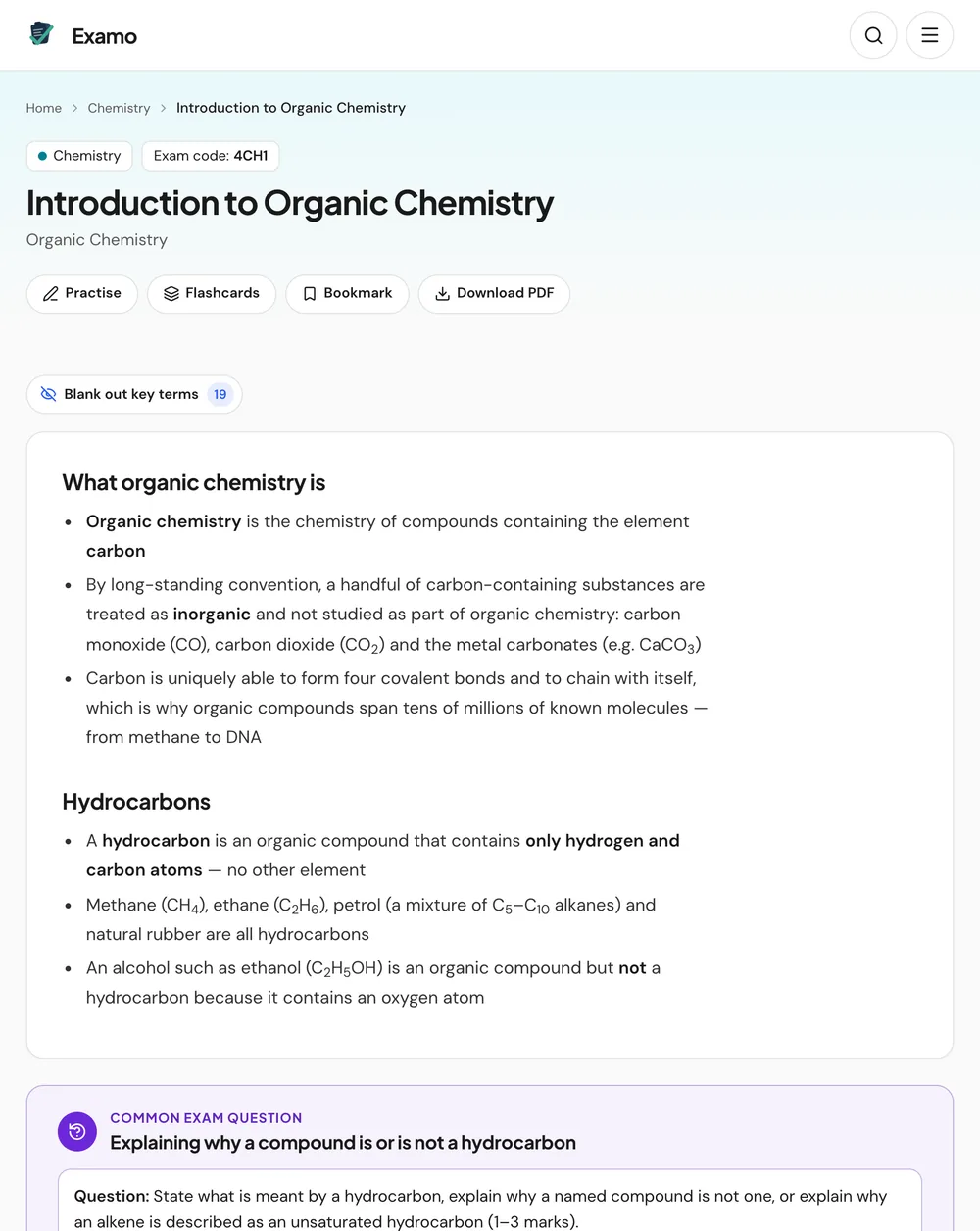
    The Introduction to Organic Chemistry revision note, with its Blank out key terms button above the first section.
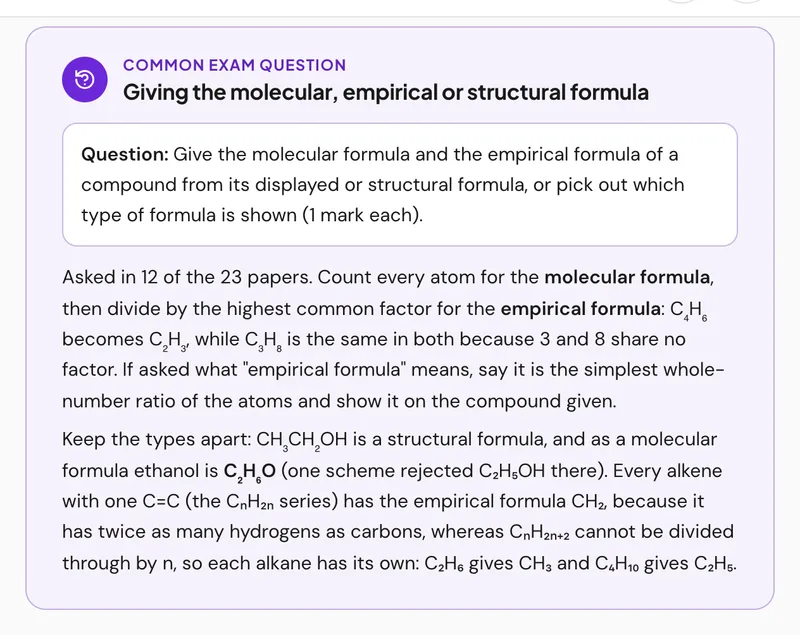
    A common exam question box on giving a molecular, empirical or structural formula, asked in 12 of the 23 papers.
  • Exam questions

    Every answer marked the way an examiner would

    Write your answer as you would in the exam. Each point on the mark scheme is checked on its own, so you see which marks you earned, which you missed and what would have earned them. A valid alternative method gets the credit, and a slip early on doesn't cost you the marks that follow it.

    • 2,898 original exam-style questions
    • Hints that point the way without giving the answer
    • Predict your mark first, then see how close you were
    Explore exam questions
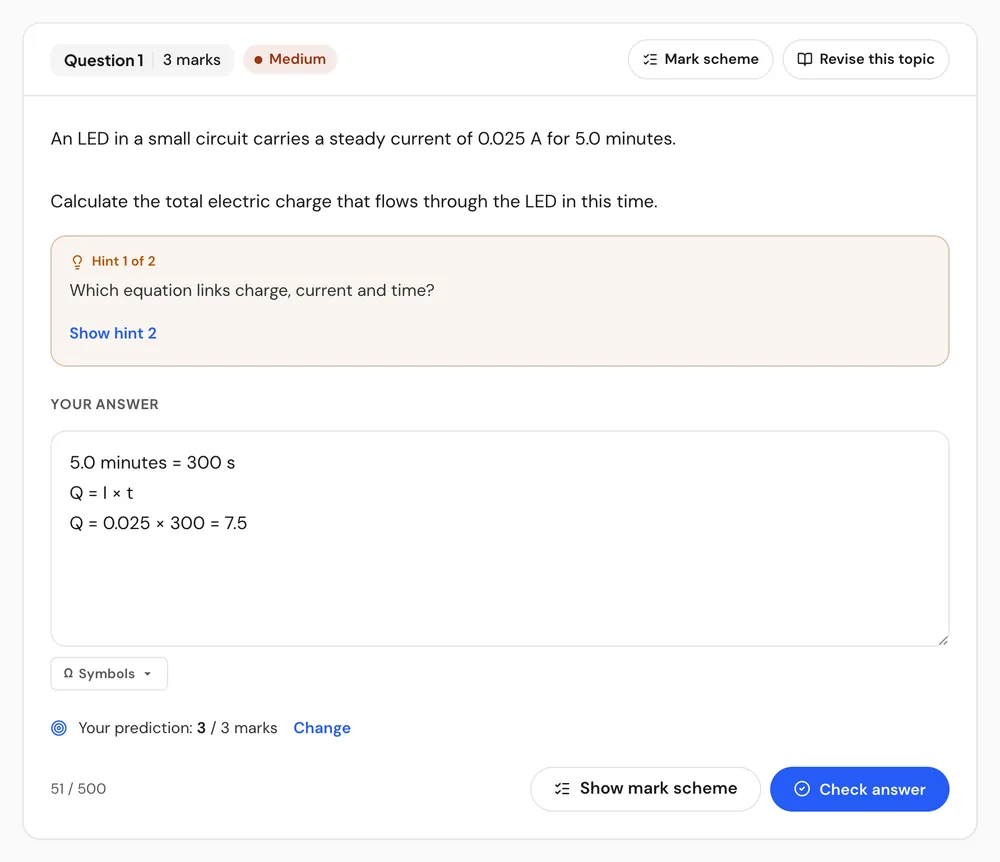
    A Physics question about the charge through an LED, with its first hint showing, a worked answer typed in and a predicted mark of 3.
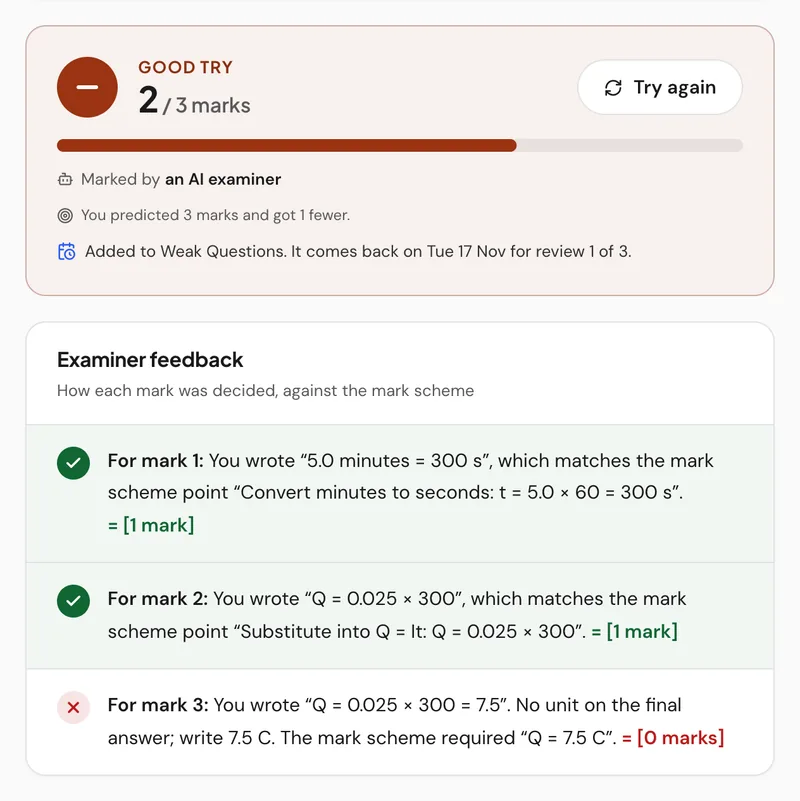
    The marked answer: 2 of 3 marks, each mark scheme point explained, the missing unit pointed out, and the question added to Weak Questions.
  • Test yourself

    Recall it, don't just re-read it

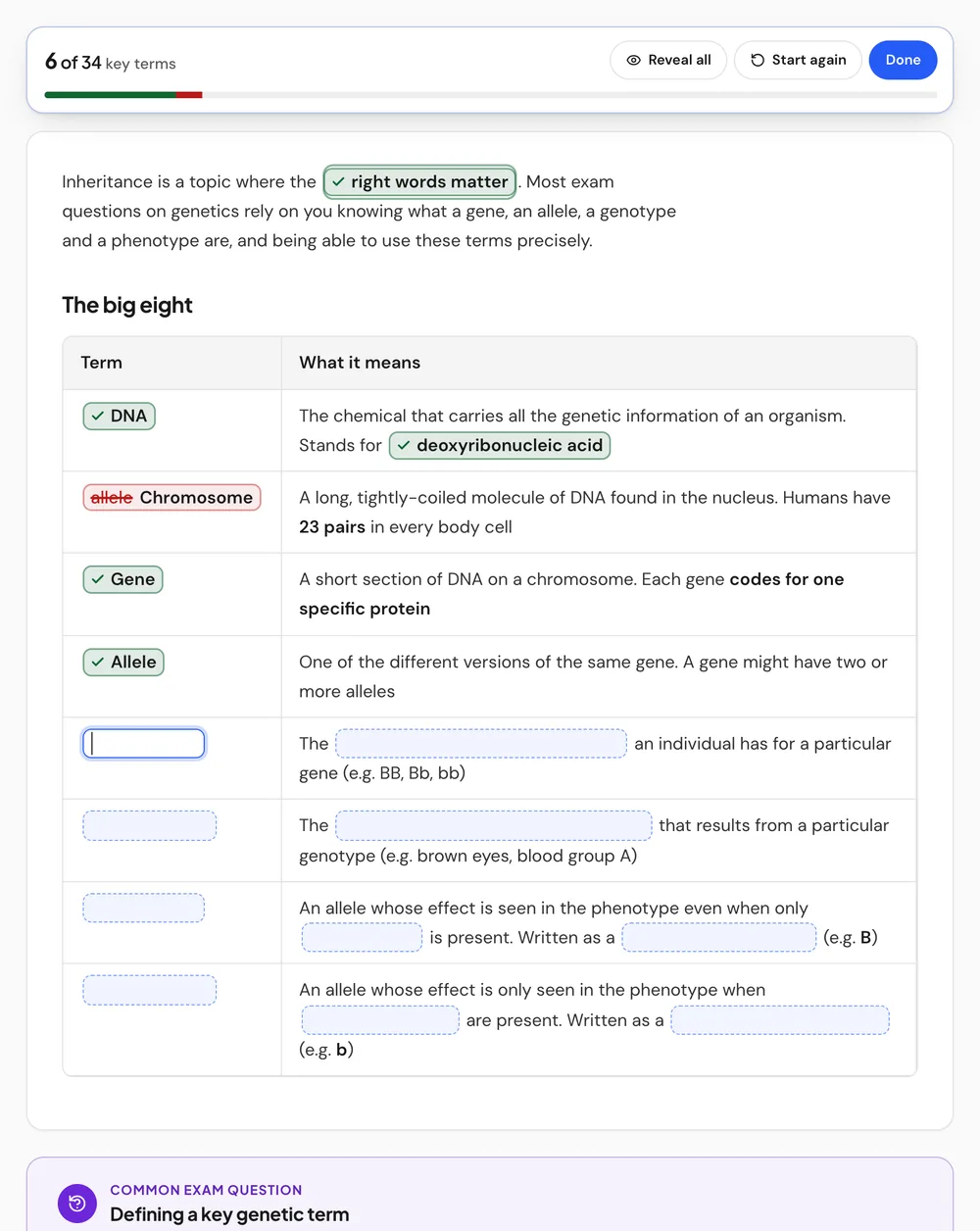
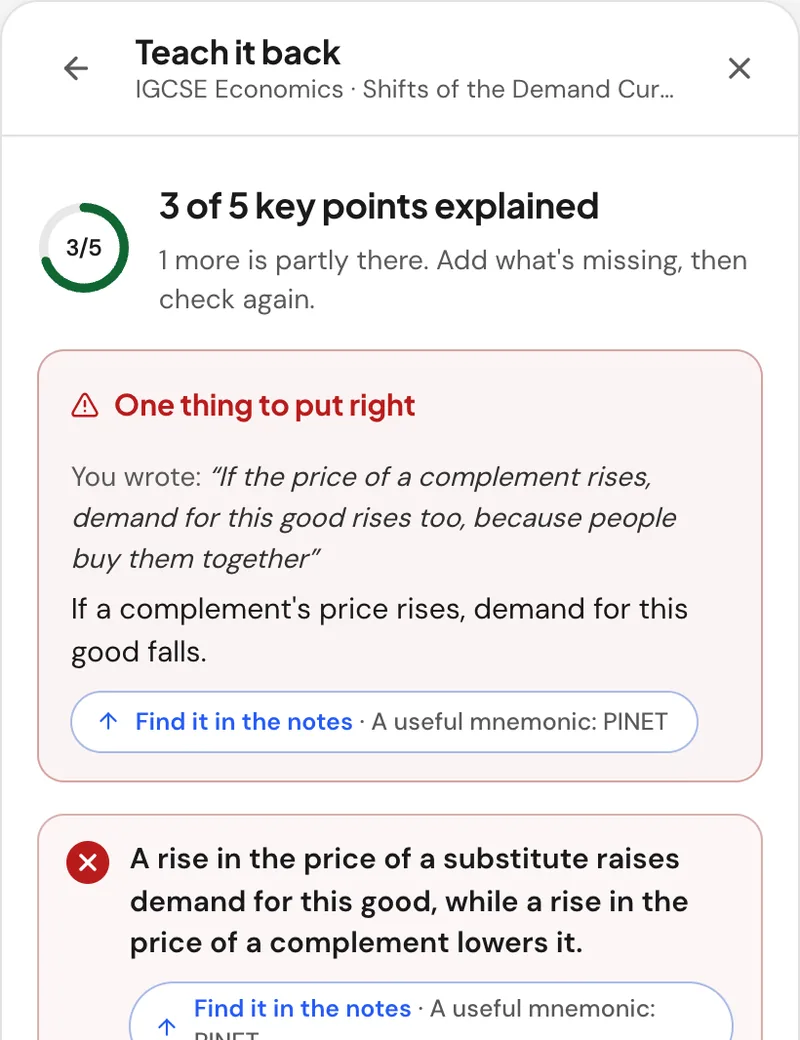
    Reading a note feels like learning, but what counts is what you can recall later. So every note can become a test: blank out its key terms and type them back, take the quick check at the end, or explain the topic to the AI tutor with Teach it back and see which key points you missed or got wrong. Every topic has a flashcard deck too.

    • Blank-out mode on every note with key terms
    • A quick check at the end of every note
    • Teach it back: explain it, then see the gaps
    Explore flashcards
    Blank-out mode on a Biology note: five key terms typed back correctly, one answered wrongly, and the next blank ready to fill.
    Teach it back in the AI tutor: 3 of 5 key points explained, one thing to put right, and the points still missing.
  • Exam ready

    Practice that keeps coming back until exam day

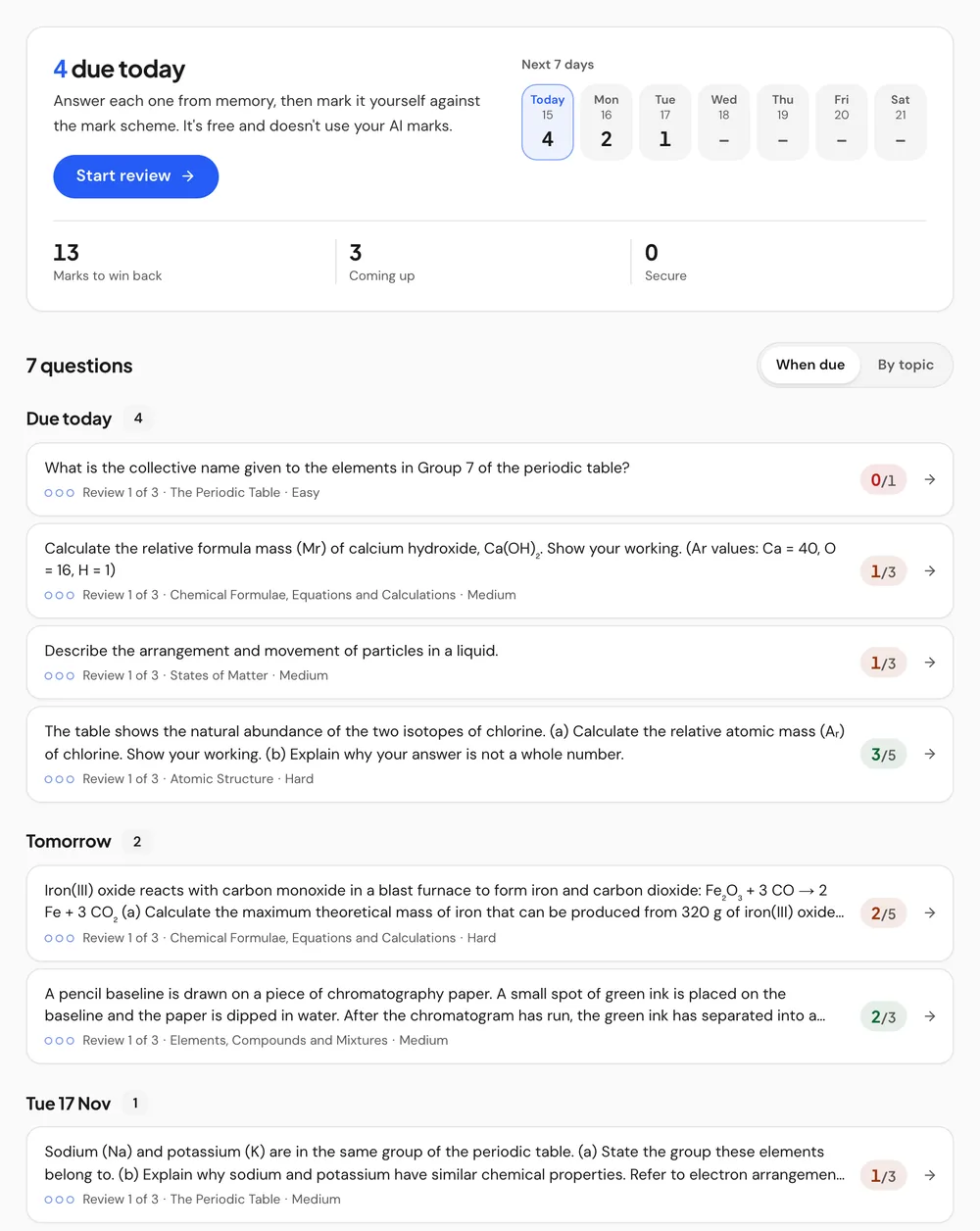
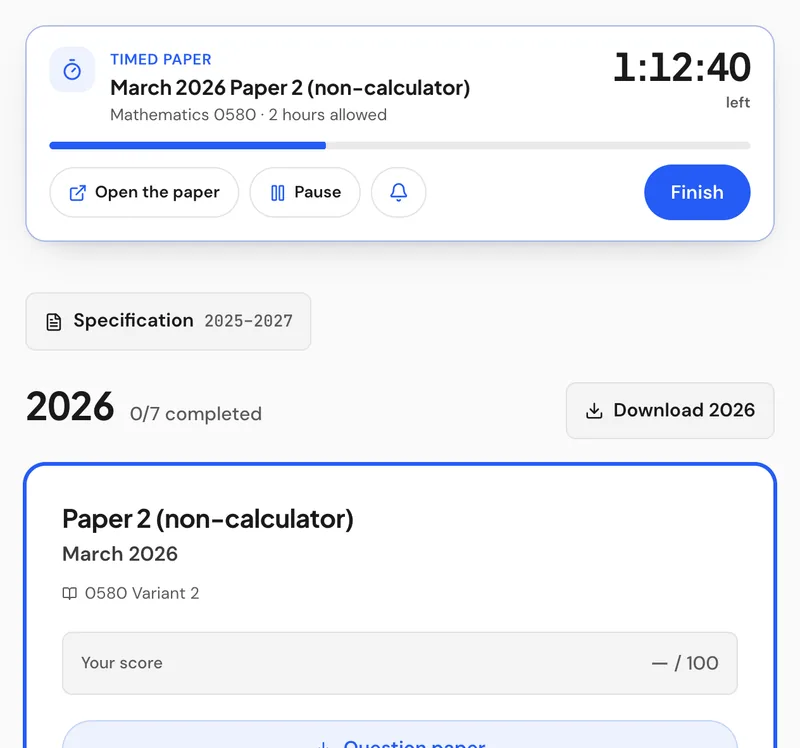
    Any question you drop marks on comes back after 2, 5 and 12 days, until you can answer it in full from memory. The study plan books every topic around your exam dates and spaces out the reviews. And as the exam gets close, sit real past papers against the clock, just as you will on the day.

    • Weak Questions back after 2, 5 and 12 days
    • A study plan built around your exam dates
    • Past papers for 70 IGCSE specifications
    Explore the study planner
    Weak Questions: 4 questions due today, the reviews booked for the next 7 days, and the questions listed by when they are due.
    A Mathematics 0580 past paper being sat against the clock, with 1 hour 12 minutes left and buttons to open the paper, pause or finish.

The science

Built on how memory actually works.

Each tool on Examo puts a well-tested finding from learning research to work. This is what each one is based on.

  • Testing yourself

    Recalling something makes it last longer than reading it again.

    On ExamoQuick checks, flashcards and exam questions

    Roediger and Karpicke, 2006

  • Spacing it out

    Reviews spread over days and weeks beat the same time spent in one go.

    On ExamoWeak Questions and the study plan

    Cepeda and colleagues, 2006

  • Producing the answer

    A word you come up with yourself is remembered better than one you only read.

    On ExamoBlank-out mode

    Slamecka and Graf, 1978

  • Explaining it

    Explaining what you've learned, as if teaching it, helps you understand and remember it.

    On ExamoTeach it back

    Fiorella and Mayer, 2013

  • Knowing what you know

    Students who are struggling tend to overestimate how well they will do.

    On ExamoPredict your mark

    Hacker and colleagues, 2000

  • Just enough help

    A good tutor gives just enough help for you to take the next step yourself.

    On ExamoHints on every exam question

    Wood, Bruner and Ross, 1976

  • Exam conditions

    What you learn is easiest to use when you practise it the way you will be tested.

    On ExamoTimed past papers

    Morris, Bransford and Franks, 1977

  • Learning from examples

    For a new method, studying a worked example first is quicker than working it out alone.

    On ExamoWorked examples in the notes

    Sweller and Cooper, 1985

The research in full
  1. Cepeda, N. J., Pashler, H., Vul, E., Wixted, J. T., & Rohrer, D. (2006). Distributed practice in verbal recall tasks: A review and quantitative synthesis. Psychological Bulletin, 132(3), 354–380.
  2. Dunlosky, J., Rawson, K. A., Marsh, E. J., Nathan, M. J., & Willingham, D. T. (2013). Improving students' learning with effective learning techniques: Promising directions from cognitive and educational psychology. Psychological Science in the Public Interest, 14(1), 4–58.
  3. Fiorella, L., & Mayer, R. E. (2013). The relative benefits of learning by teaching and teaching expectancy. Contemporary Educational Psychology, 38(4), 281–288.
  4. Hacker, D. J., Bol, L., Horgan, D. D., & Rakow, E. A. (2000). Test prediction and performance in a classroom context. Journal of Educational Psychology, 92(1), 160–170.
  5. Morris, C. D., Bransford, J. D., & Franks, J. J. (1977). Levels of processing versus transfer appropriate processing. Journal of Verbal Learning and Verbal Behavior, 16(5), 519–533.
  6. Roediger, H. L., & Karpicke, J. D. (2006). Test-enhanced learning: Taking memory tests improves long-term retention. Psychological Science, 17(3), 249–255.
  7. Slamecka, N. J., & Graf, P. (1978). The generation effect: Delineation of a phenomenon. Journal of Experimental Psychology: Human Learning and Memory, 4(6), 592–604.
  8. Sweller, J., & Cooper, G. A. (1985). The use of worked examples as a substitute for problem solving in learning algebra. Cognition and Instruction, 2(1), 59–89.
  9. Wood, D., Bruner, J. S., & Ross, G. (1976). The role of tutoring in problem solving. Journal of Child Psychology and Psychiatry, 17(2), 89–100.

How it started

A revision tool born from a frustration.

Examo started with a simple observation: the students who scored highest in IGCSE exams weren't necessarily the ones who knew the most. They were the ones who understood the mark scheme.

Two students could give answers that sounded equally sensible. One would get full marks. The other would get half. The difference was almost never about knowledge. It was about which specific words, in which order, were on the examiner's checklist.

Every existing revision resource we looked at optimised for coverage: big textbooks, endless videos, flashcards for every obscure fact. None of them started from the mark scheme and worked backwards. So we built the one that does.

Then we turned to the research on how students remember what they learn, and built each new tool around it: less re-reading, more recalling, spread over the weeks before the exam.

Why we do, what we do

Your grade shouldn't depend on luck.

In too many schools, exam technique is something you learn from a teacher who happens to be a good examiner, or you don't learn it at all. That shouldn't decide whether a student earns a 7 or a 9.

Examo puts the same insight that the best tutors quietly share with their students into a tool that any student can use, at any hour, without paying hourly for it. Every mark point, every common mistake, every mark scheme phrase, all built into every topic page so the raw material of an expensive tutor is there when you open the site.

FAQ

Frequently asked questions.

What is Examo?

Examo is free IGCSE revision built around the mark scheme. The notes follow your exam board's specification, the exam-style questions are marked point by point against their mark schemes, and every tool is built on what learning research shows works: testing yourself, spacing it out and explaining it in your own words.

What makes Examo different from other revision sites?

It starts from the mark scheme. Its 712 common exam question boxes say how often each question came up on the real past papers, its exam tips come from the real mark schemes, and every answer you write is marked point by point. And it is built to make revision stick: blank-out mode, a quick check at the end of every note, Teach it back, and questions that come back on a schedule until you know them.

How does the AI marking work?

Your answer is marked by an AI examiner against the question's mark scheme, which is written the way IGCSE examiners write theirs. Unlike simple keyword matching, it understands meaning. It reads your full answer and judges each mark scheme point on its own, and for every point you miss, it explains what was wrong and how to earn the mark next time. A valid alternative method gets the credit. For a borderline answer, check the mark scheme yourself too.

Which subjects and exam boards are supported?

Edexcel International GCSE Chemistry (4CH1), Physics (4PH1) and Biology (4BI1), and Cambridge IGCSE Computer Science (0984/0478), Economics (0455) and Mathematics (0580, at Core and Extended tier) have notes, questions and flashcards. Past Papers covers 70 IGCSE specifications. The practice questions are Examo's own, written in the style of the real exam papers.

Is Examo free to use?

Yes. Examo is free, and so is the account that unlocks every topic, question and tool. AI marking is free too, up to 15 AI marks a day per account.

Start with one topic.

Read the notes, blank out the key terms, then answer an exam-style question marked point by point. That's the whole loop.

Image credits

Many of the diagrams in our revision notes are third-party illustrations used under open licences from Wikimedia Commons, OpenStax, plus public-domain works from agencies such as the US EPA and NIH. Each is credited to its author below under its Creative Commons or public-domain licence. Any other diagrams are credited to their source in the caption beneath the figure.

View all 17 image credits