4CH1
Ionic Bonding
Principles of Chemistry · 2 question types
Formation of Ions
What an ion is
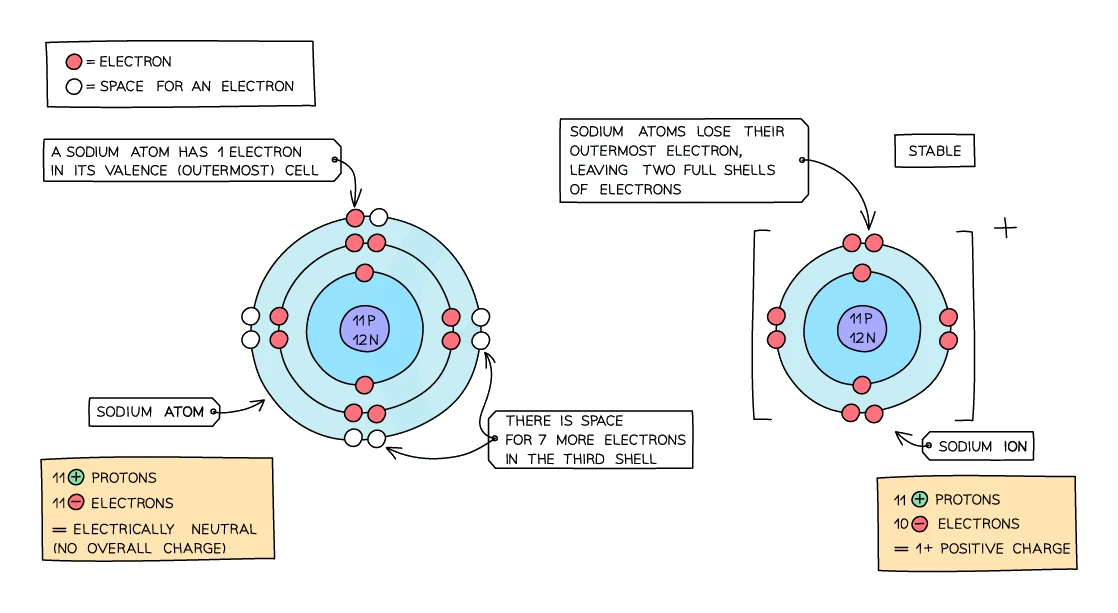
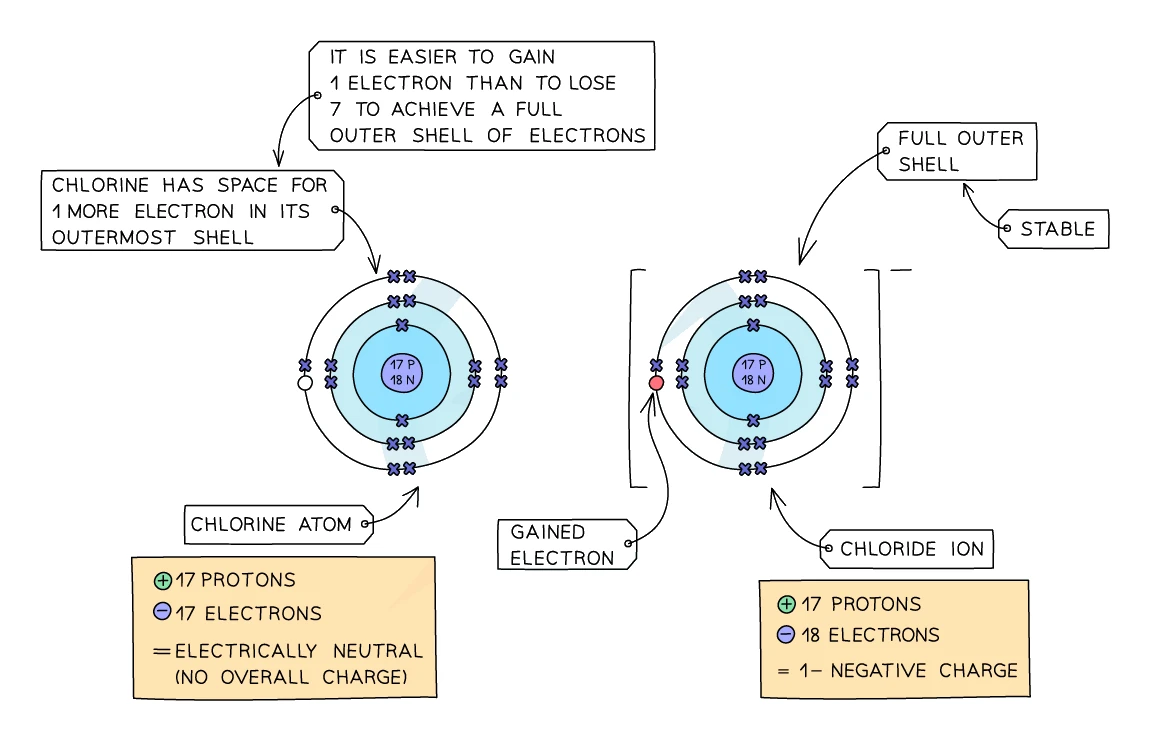
- An ion is a charged atom (or group of atoms) formed when an atom loses or gains electrons
- The number of electrons transferred equals the size of the charge:
- lose 1 electron → 1+ charge
- lose 2 electrons → 2+ charge
- gain 1 electron → 1− charge
- gain 2 electrons → 2− charge
Cations and anions
- A cation is a positive ion, formed when an atom loses electrons (it now has fewer electrons than protons)
- An anion is a negative ion, formed when an atom gains electrons (it now has more electrons than protons)
- The driving force in every case is to reach a full outer shell — the stable electron arrangement of a noble gas
- Metals (1–3 outer electrons) lose those few electrons to form cations
- Non-metals (5–7 outer electrons) gain electrons to form anions
- Group 4 elements rarely form simple ions (losing or gaining 4 electrons costs too much energy)
- Group 0 noble gases already have full outer shells and so do not form ions
Predicting ion charges from group number
| Group | Outer electrons | Ion charge |
|---|---|---|
| 1 | 1 | 1+ |
| 2 | 2 | 2+ |
| 3 | 3 | 3+ |
| 5 | 5 | 3− |
| 6 | 6 | 2− |
| 7 | 7 | 1− |
Exam tip
Describing electron changes when ions form
What comes up: "Describe the changes in electronic configuration of [metal] and [non-metal] atoms to form the ions in [compound]."
Write (two marks): (1) State that the metal atom loses the correct number of electrons (e.g. each sodium atom loses one electron, changing from 2,8,1 to 2,8). (2) State that the non-metal atom gains the correct number of electrons (e.g. the oxygen atom gains two electrons, changing from 2,6 to 2,8).
Watch out: Any mention of sharing electrons scores zero for this type of question — describe electron transfer (loss and gain), never sharing. Name each atom separately and state the specific number of electrons it loses or gains.