Ionic Bonding
Principles of Chemistry
What an ion is
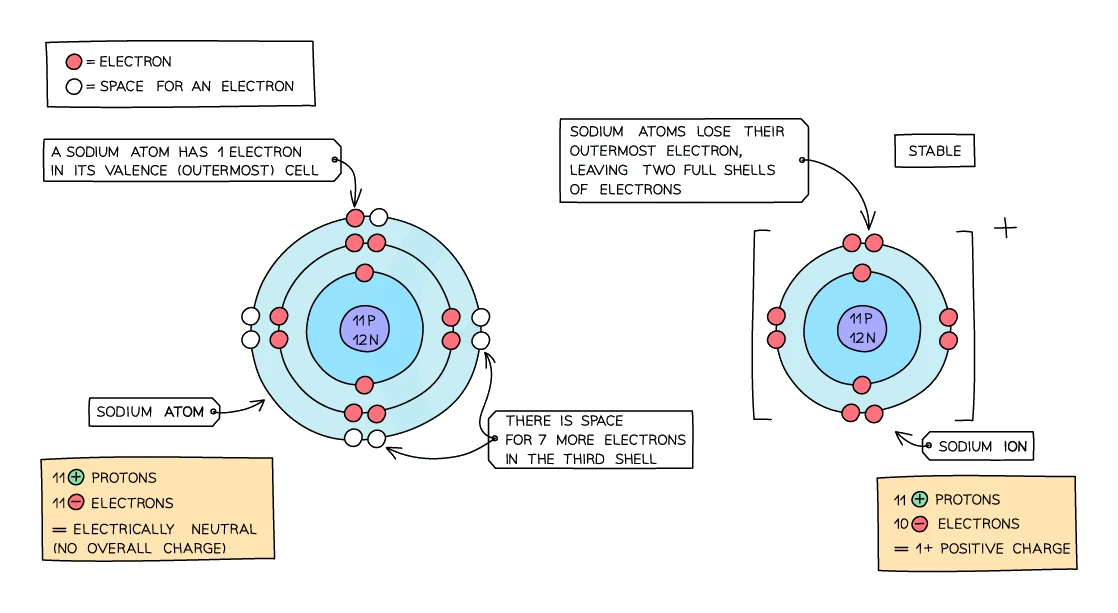
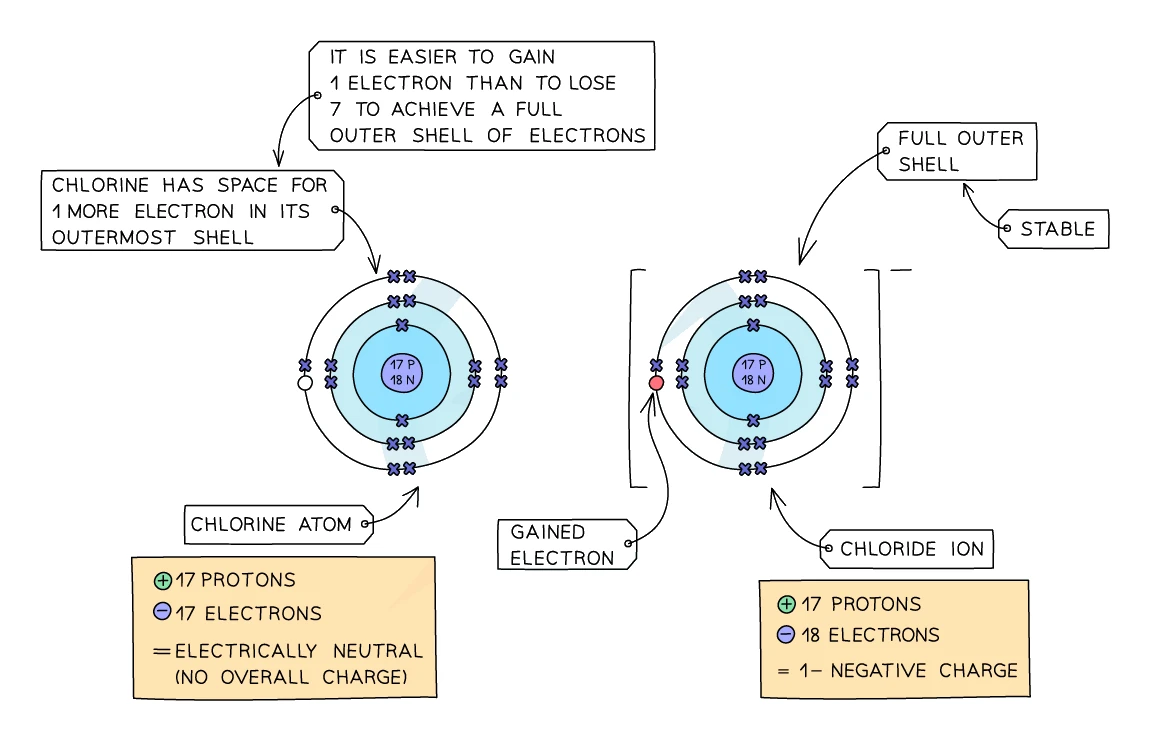
- An ion is a charged atom (or group of atoms) formed when an atom loses or gains electrons
- The number of electrons transferred equals the size of the charge:
- lose 1 electron → 1+ charge
- lose 2 electrons → 2+ charge
- gain 1 electron → 1− charge
- gain 2 electrons → 2− charge
Cations and anions
- A cation is a positive ion, formed when an atom loses electrons (it now has fewer electrons than protons)
- An anion is a negative ion, formed when an atom gains electrons (it now has more electrons than protons)
- The driving force in every case is to reach a full outer shell — the stable electron arrangement of a noble gas
- Metals (1–3 outer electrons) lose those few electrons to form cations
- Non-metals (5–7 outer electrons) gain electrons to form anions
- Group 4 elements rarely form simple ions (losing or gaining 4 electrons costs too much energy)
- Group 0 noble gases already have full outer shells and so do not form ions
Common exam question
Describing electron transfer when ions form
Question: Describe, in terms of electrons or electronic configurations, what happens when a metal and a non-metal form an ionic compound such as sodium oxide or magnesium chloride (2–3 marks).
Asked in 5 of the 23 papers. One mark is for the metal atom losing electrons and one for the non-metal atom gaining them; saying that two electrons transfer from the magnesium atom to the sulfur atom earns both. The third mark is for the numbers, matched to the formula: each sodium atom loses one electron and the oxygen atom gains two, or magnesium loses two and each of two chlorine atoms gains one. One scheme lets both ions' configurations (2,8) earn it instead; when the ions' charges are also asked for, they are the third mark.
Any mention of sharing electrons scores zero in two schemes, and "chloride gains an electron" is not credited: the chlorine atom gains, the chloride ion is the result.
Predicting ion charges from group number
| Group | Outer electrons | Ion charge |
|---|---|---|
| 1 | 1 | 1+ |
| 2 | 2 | 2+ |
| 3 | 3 | 3+ |
| 5 | 5 | 3− |
| 6 | 6 | 2− |
| 7 | 7 | 1− |
Common exam question
Giving the charge on an ion
Question: Give the charge on the ion formed from an atom whose electronic configuration is drawn, on a named ion such as bromide, or on the metal ion in a compound such as PbO (1 mark, usually multiple choice).
Asked in 4 of the 23 papers. Count the outer electrons: one, two or three means a metal that loses them, so 1+, 2+ or 3+; five, six or seven means a non-metal that gains, so 3−, 2− or 1−. An "-ide" name is that non-metal's simple ion, so bromide is 1− and sulfide is 2−.
For a metal ion inside a compound, balance the partner: oxide is 2−, so the lead ion in PbO is 2+. Write the size then the sign, as in 2+; one scheme also accepts the sign first. Two more papers give proton and electron numbers instead: the charge is protons minus electrons, so a 2+ ion has two electrons fewer than its atom.