4CH1
Chemical Formulae, Equations and Calculations
Principles of Chemistry · 6 question types
Avogadro's law
- Avogadro's law states that, at the same temperature and pressure, equal volumes of any gases contain equal numbers of molecules
- Consequence: at the same temperature and pressure, the ratio of any two gases is the same as the volume ratio of those gases
Molar gas volume
- RTP stands for room temperature and pressure, taken as 20 °C and 1 atm
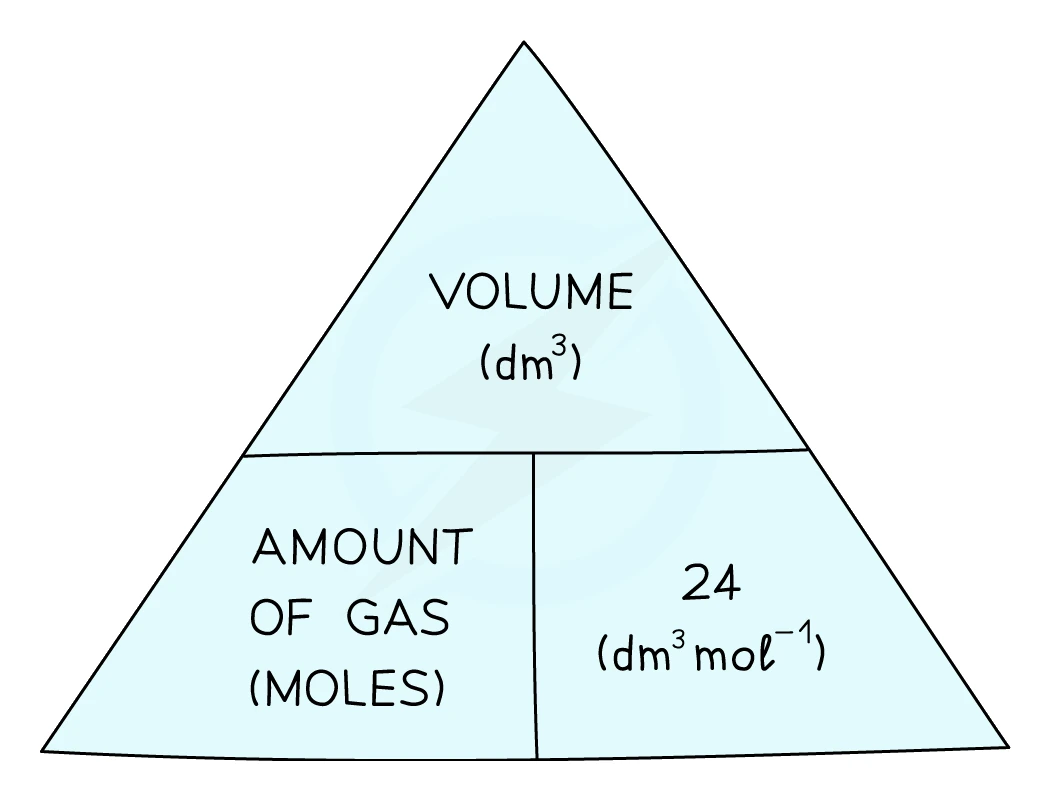
- At RTP, one mole of any gas occupies a volume of 24 dm³ (equivalently 24 000 cm³)
- This value is called the molar gas volume at RTP
The key formula
- For a gas at RTP:
- or equivalently, when V is given in cm³:
- Rearranged:
- volume (dm³) = moles × 24
- volume (cm³) = moles × 24 000
Example. What volume does 88 g of CO₂ occupy at RTP?
- Mr(CO₂) = 44, so moles = 88 / 44 = 2.0 mol
- Volume = 2.0 × 24 = 48 dm³
Example. Methane burns completely:
CH₄ (g) + 2O₂ (g) → CO₂ (g) + 2H₂O (g)
What volume of oxygen reacts with 100 cm³ of methane, and what total volume of gas products forms? All volumes are measured at the same temperature and pressure.
- Mole ratio CH₄ : O₂ = 1 : 2, so volume of O₂ needed = 2 × 100 = 200 cm³
- Total moles of products per mole of CH₄ = 1 (CO₂) + 2 (H₂O) = 3
- Total volume of products = 3 × 100 = 300 cm³
Worked example
Gas volume at RTP
Calculate the volume of carbon dioxide, measured at RTP, produced when 25 g of calcium carbonate decomposes completely.
CaCO3 → CaO + CO2 (Mr of CaCO3 = 100; molar gas volume = 24 dm³/mol at RTP)
Solution:
- Moles of CaCO3 = mass ÷ Mr = 25 ÷ 100 = 0.25 mol
- The mole ratio CaCO3 : CO2 is 1 : 1, so moles of CO2 = 0.25 mol
- Volume = moles × 24 = 0.25 × 24 = 6 dm³
Mixing units is the main source of dropped marks: use 24 dm³/mol for an answer in dm³, or 24 000 cm³/mol for cm³. If the question wanted cm³, multiply the dm³ answer by 1000 (6 dm³ = 6000 cm³).