Chemical Formulae, Equations and Calculations
Principles of Chemistry · 6 question types
Definitions
- The gives the actual number of each kind of atom in one molecule of the substance
- e.g. ethanoic acid: C₂H₄O₂
- The gives the simplest whole-number ratio of the atoms
- e.g. ethanoic acid: CH₂O
- For organic molecules, the empirical formula and the molecular formula are often different
- For ionic compounds, the formula given (e.g. NaCl, MgCl₂) is always the empirical formula
Calculating an empirical formula
Use a table to keep the working tidy:
- List each element in its own column
- Write the mass (or % by mass) of each
- Write each element's Ar
- Calculate moles = mass ÷ Ar
- Divide every mole value by the smallest — this gives the simplest ratio
- If the ratio isn't whole numbers, multiply all values by the same factor (×2, ×3, etc.) until they are
Example. A 24 g sample of magnesium burns fully and the magnesium oxide formed weighs 40 g. Find its empirical formula.
| Mg | O | |
|---|---|---|
| Mass / g | 24 | 40 − 24 = 16 |
| Ar | 24 | 16 |
| Moles | 24 / 24 = 1 | 16 / 16 = 1 |
| Divide by smallest | 1 | 1 |
Empirical formula: MgO
Example. A compound contains 40.0 % carbon, 6.7 % hydrogen and 53.3 % oxygen by mass. Find its empirical formula.
| C | H | O | |
|---|---|---|---|
| % mass | 40.0 | 6.7 | 53.3 |
| Ar | 12 | 1 | 16 |
| Moles | 40.0 / 12 = 3.33 | 6.7 / 1 = 6.7 | 53.3 / 16 = 3.33 |
| Divide by smallest (3.33) | 1 | 2 | 1 |
Empirical formula: CH₂O
Calculating a molecular formula
- A molecular formula is always a whole-number multiple of the empirical formula
- To find it, the question must also give the actual Mr of the compound
Procedure:
- Calculate Mr of the empirical formula
- Divide: n = (real Mr) ÷ (empirical Mr)
- Multiply every subscript in the empirical formula by n
Example. A compound has empirical formula CH₂O and Mr = 180. Find its molecular formula.
- Mr(CH₂O) = 12 + 2 + 16 = 30
- Multiplier: 180 / 30 = 6
- Molecular formula: C₆H₁₂O₆ (glucose)
Practical: formula of magnesium oxide
Aim. Find the empirical formula of magnesium oxide by burning a known mass of magnesium in air.
Method:
- Weigh the empty crucible with its lid
- Add a coil of clean magnesium ribbon (around 10 cm); reweigh the crucible + lid + ribbon; calculate the mass of magnesium used
- Heat strongly with a Bunsen burner. Lift the lid briefly every few seconds so that more air (oxygen) can reach the ribbon, but lower it again quickly so very little white magnesium oxide smoke escapes
- Continue heating until no further glow can be produced and the mass has stopped changing
- Allow the crucible to cool and reweigh; calculate the mass of magnesium oxide formed
Calculation: apply the empirical-formula procedure with the two columns "Mg" and "O":
- mass of Mg from step 2
- mass of O = (mass of MgO) − (mass of Mg)
- moles of each = mass ÷ Ar
- simplest mole ratio → empirical formula
Typical result: ratio Mg : O = 1 : 1, so the formula is MgO.
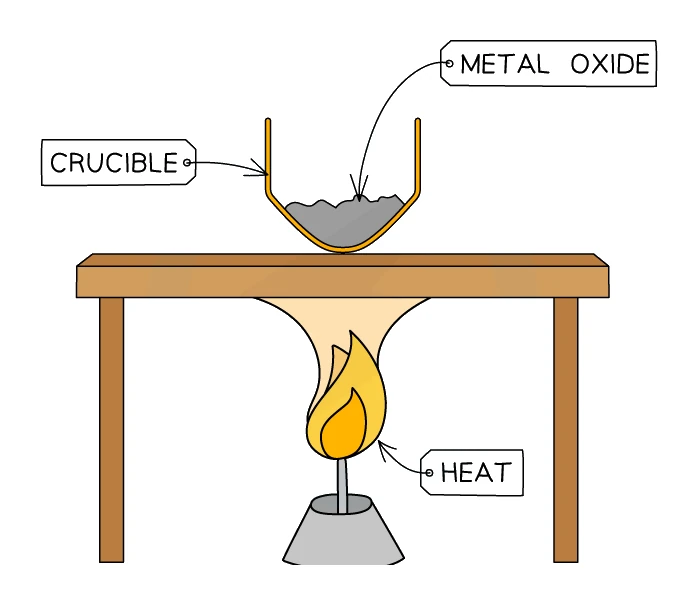
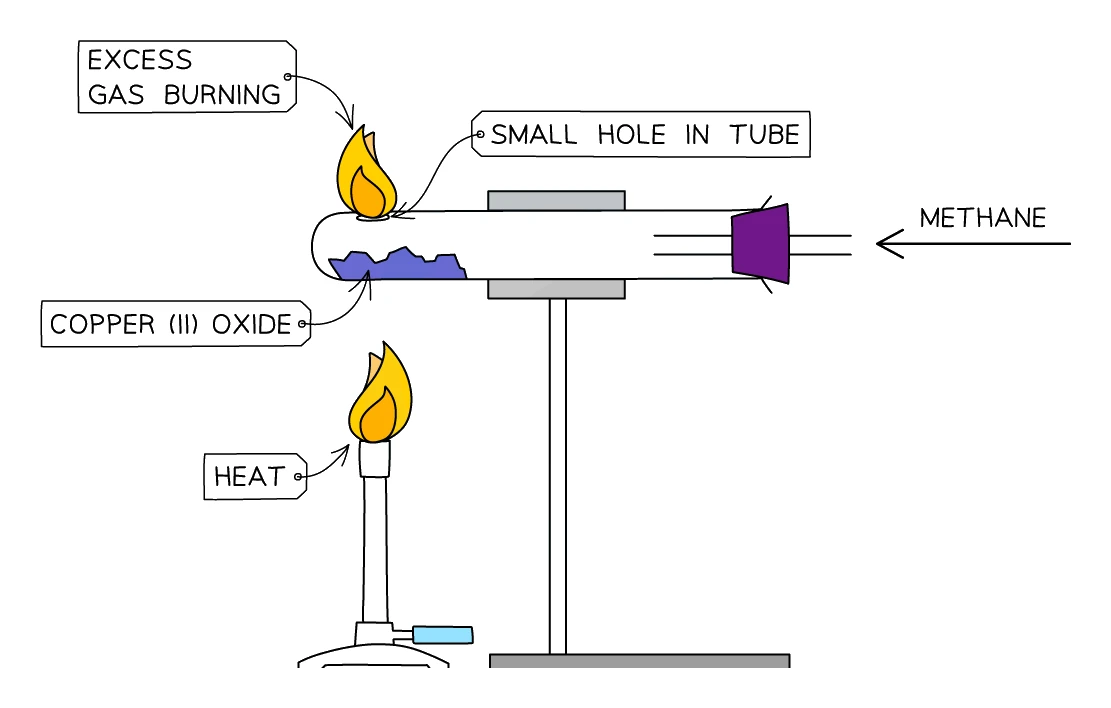
The specification allows the formula of a metal oxide to be found by combustion, as here, or by reduction, for example passing a stream of methane or hydrogen over heated copper(II) oxide so that the oxygen is removed; the mass lost gives the mass of oxygen and the mass remaining gives the mass of copper, which are then turned into a mole ratio in the same way.
Practical: formula of a hydrated salt
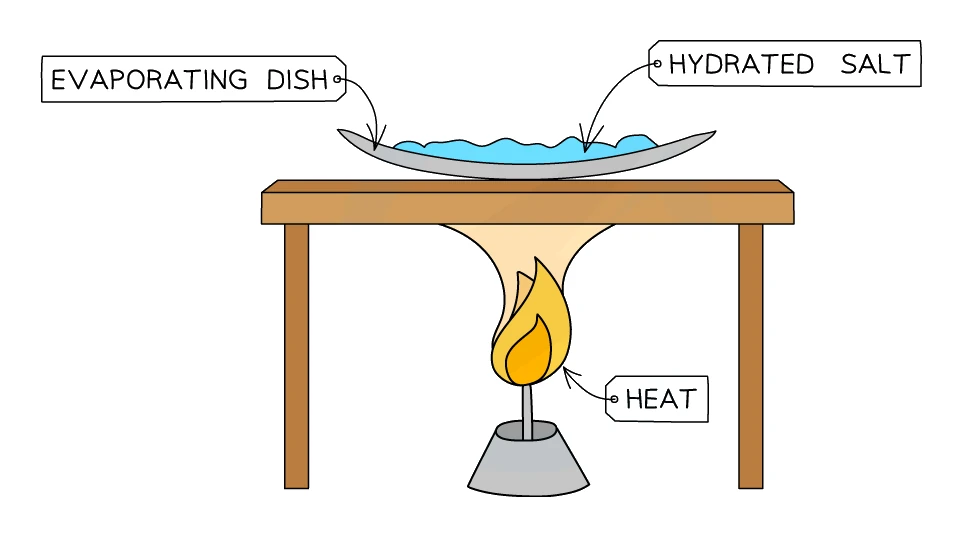
- A hydrated salt is a crystalline solid that has fixed numbers of water molecules locked into its structure
- The trapped water is called the water of crystallisation
- The formula is written with a dot: e.g. CuSO₄·5H₂O (copper(II) sulfate pentahydrate)
Aim. Find x in CuSO₄·xH₂O by heating to drive off the water.
Method:
- Weigh an empty evaporating dish
- Add a known mass of the blue hydrated copper(II) sulfate crystals; reweigh
- Heat gently on a tripod and gauze, stirring with a glass rod, until the salt is completely white (all water has been driven off as steam — this is the anhydrous salt)
- Cool and reweigh; the mass lost is the mass of water
Calculation: apply the empirical-formula procedure with "anhydrous salt" and "water" as the two components.
- Mr(CuSO₄) = 159.5, Mr(H₂O) = 18
- Moles of each = mass ÷ Mr
- Simplest ratio gives 1 : x
For copper(II) sulfate, the result is CuSO₄·5H₂O (so x = 5).
Empirical formula from percentage composition
What comes up: you are given the percentage by mass of each element and asked to find the empirical formula.
Write: divide each percentage by the element's relative atomic mass (not its atomic number) to get moles, then divide every mole value by the smallest of the results to obtain the whole-number ratio.
Watch out: dividing by atomic numbers rather than relative atomic masses — or performing the division the wrong way round — scores zero for the entire calculation, not just the steps where the error appears. Keep the step order strict: % ÷ Ar first, then divide by the smallest value.