Chemical Formulae, Equations and Calculations
Principles of Chemistry · 6 question types
Solute, solvent and solution
- The solute is the substance that dissolves
- The solvent is the liquid in which the solute dissolves
- The solution is the homogeneous mixture that results
- Most reactions in solution chemistry happen between solutes dissolved in water (an aqueous solution)
What concentration means
- Concentration is the amount of solute dissolved in a fixed volume of the solution
- The greater the amount of solute in a given volume, the more concentrated the solution
- Edexcel uses two units of concentration:
- g/dm³ — grams of solute per dm³ of solution
- mol/dm³ — moles of solute per dm³ of solution
The key formula
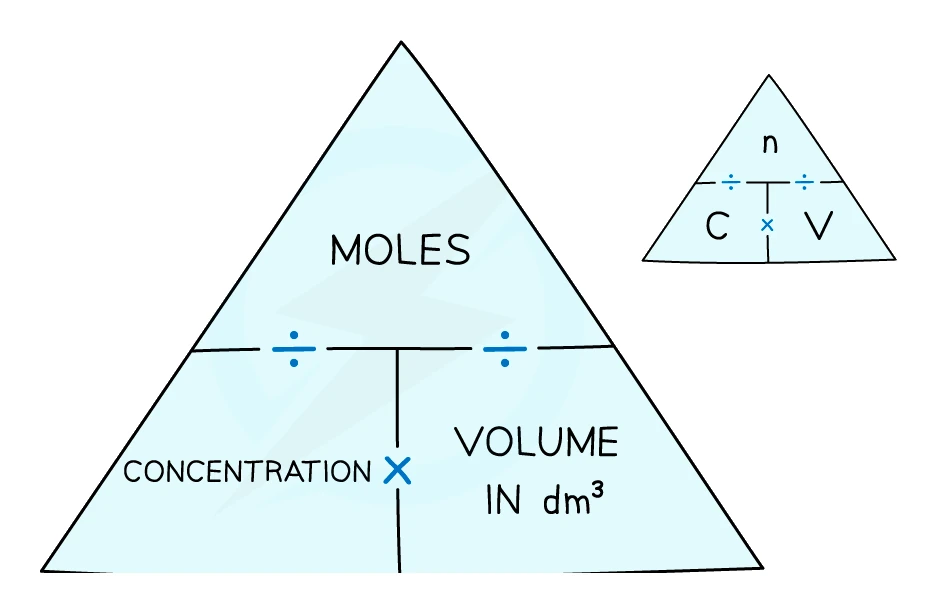
- For concentration in mol/dm³:
- where:
- c = concentration in mol/dm³
- n = moles of solute
- V = volume of solution in dm³
- Rearranged:
- = × volume (in dm³)
- volume (in dm³) = moles ÷ concentration
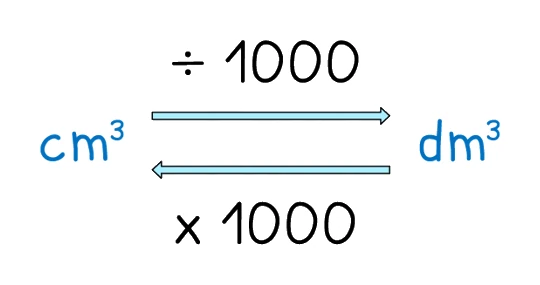
Unit conversion:
- cm³ → dm³: divide by 1000
- dm³ → cm³: multiply by 1000
Example. What is the concentration, in mol/dm³, of a solution made by dissolving 8.0 g of NaOH in water to make 250 cm³ of solution?
- Mr(NaOH) = 40, so moles of NaOH = 8.0 / 40 = 0.20 mol
- Volume = 250 / 1000 = 0.25 dm³
- c = 0.20 / 0.25 = 0.80 mol/dm³
Example. 25.0 cm³ of 0.10 mol/dm³ sodium carbonate is exactly neutralised by dilute hydrochloric acid. The equation is:
Na₂CO₃ + 2HCl → 2NaCl + H₂O + CO₂
If 20.0 cm³ of the acid is required, what is its concentration?
- Moles of Na₂CO₃ = 0.10 × (25.0 / 1000) = 0.00250 mol
- Mole ratio HCl : Na₂CO₃ = 2 : 1, so moles of HCl = 2 × 0.00250 = 0.00500 mol
- Volume of HCl = 20.0 / 1000 = 0.020 dm³
- c(HCl) = 0.00500 / 0.020 = 0.25 mol/dm³
Finding concentration from a titration
What comes up: given volumes and the concentration of one solution, calculate the concentration of the other — typically 3 marks.
Write (three marks): (1) Convert the volume in cm³ to dm³ (divide by 1000), then calculate moles = concentration × volume. (2) Use the mole ratio from the balanced equation to find moles of the second substance. (3) Divide by its volume in dm³ to get its concentration.
Watch out: the most common slip is skipping step 2 — applying the mole ratio. If the two substances react 1:2 (or 2:1), missing that step gives an answer that is exactly double or half the correct value. The mark scheme awards partial credit for this slip but not full marks, so always write the ratio step explicitly even when it looks trivial.