4CH1
Chemical Formulae, Equations and Calculations
Principles of Chemistry · 6 question types
What a mole is
- A (symbol mol) is the chemist's unit for counting chemical particles
- One mole of any substance always contains exactly the same number of particles — the Avogadro constant:
- The "particles" can be atoms, molecules, ions, electrons or formula units — whichever the substance is made of
- 1 mole of helium (He) → 6.02 × 10²³ atoms
- 1 mole of water (H₂O) → 6.02 × 10²³ molecules
- 1 mole of sodium chloride (NaCl) → 6.02 × 10²³ formula units
Molar mass
- The molar mass is the mass, in grams, of one mole of a substance
- Numerically:
- For an element, molar mass = Ar in grams
- For a compound, molar mass = Mr in grams
- Examples:
- 1 mol of carbon (Ar = 12) weighs 12 g
- 1 mol of water (Mr = 18) weighs 18 g
- 1 mol of sodium chloride (Mr = 58.5) weighs 58.5 g
Converting between mass and moles
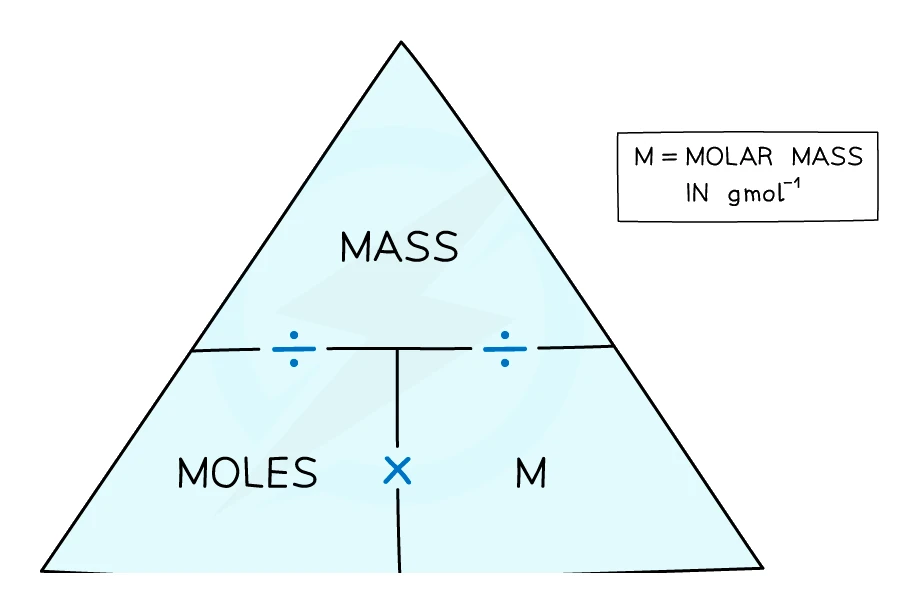
- The key relationship is:
- where n = number of moles, m = mass in grams, and Mr = molar mass in g/mol
- Rearranged:
- mass = moles × Mr
- Mr = mass ÷ moles
Example. How many moles are in 5.0 g of NaOH?
- Mr(NaOH) = 23 + 16 + 1 = 40
- n = 5.0 / 40 = 0.125 mol
Example. What is the mass of 2.5 mol of glucose, C₆H₁₂O₆?
- Mr(C₆H₁₂O₆) = (6 × 12) + (12 × 1) + (6 × 16) = 180
- m = 2.5 × 180 = 450 g