Covalent Bonding
Principles of Chemistry
Formation of Covalent Bonds
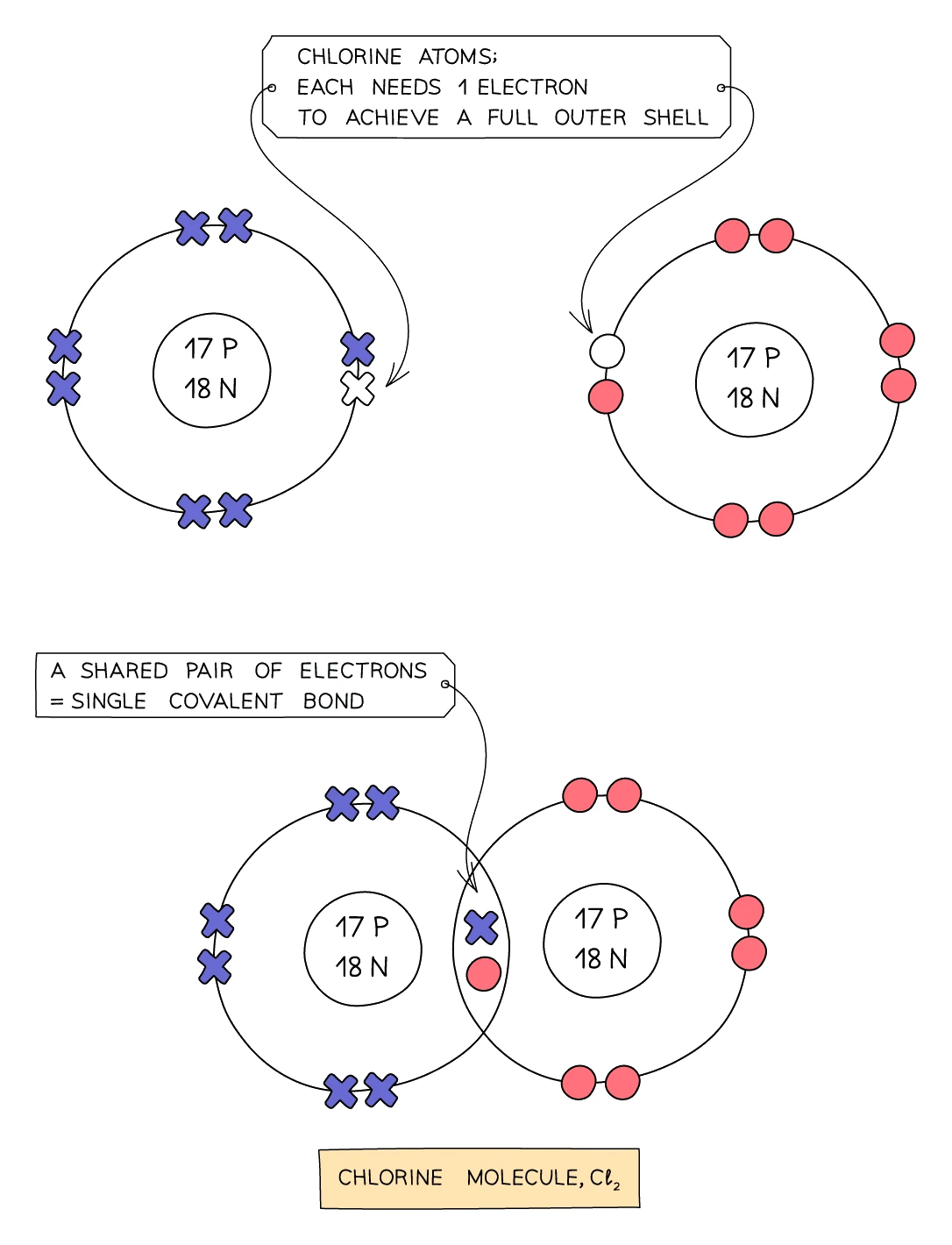
What a covalent bond is
- A forms when two non-metal atoms share a pair of electrons
- Each atom contributes one electron to the shared pair
- The shared pair counts toward each atom's outer shell, so both atoms end up with a full (noble-gas) outer shell
- Covalent bonds are very strong
Bonding and non-bonding electrons
- The two shared electrons in a bond are the bonding electrons (or a bonding pair)
- Outer-shell electrons that are not part of any bond are non-bonding electrons or
What holds a covalent bond together
- The shared pair of electrons (negative) sits between the two nuclei (positive)
- Both nuclei are electrostatically attracted to the same shared pair
- That mutual pull on the same electrons is what holds the atoms together
Common exam question
Describing the forces in a covalent bond
Question: Describe the forces of attraction in a covalent bond, or say, in terms of electrostatic attractions, what a covalent bond is (2 marks).
Asked in 8 of the 23 papers, always on Paper 1. One mark is for the shared pair of electrons and the other for the electrostatic attraction between that pair and the two nuclei. Write "nuclei", plural: the schemes insist on it and a bare "nucleus" is rejected. Name the electrons as well as the nuclei, because two of the schemes give the nuclei mark only once electrons have been mentioned, and an answer that only says the atoms share electrons earns at most one mark.
Keep intermolecular forces out of it: they act between molecules, not inside a bond, and one scheme takes both marks away for mentioning them. The same two points answer a question about the forces holding the atoms together in a named molecule such as propene.
Notation: a line for each bond
- A single covalent bond is drawn as a short straight line between two atom symbols:
- H–H means a single bond between two hydrogen atoms
- A double bond is drawn as two lines:
- O=O means a double bond
- A triple bond is drawn as three lines:
- N≡N means a triple bond
Covalent vs ionic — the key difference
- In a covalent bond, electrons are shared. No atom permanently gains or loses an electron, and no ions form
- In an ionic bond (Topic 6), electrons are transferred from one atom to another, and oppositely charged ions form
Two kinds of covalent substance
- Every covalent substance falls into one of two structural classes:
- Simple molecular — small, discrete molecules (H₂O, O₂, CO₂); covered in section 3
- Giant covalent (also called macromolecules) — many millions of atoms covalently bonded into one continuous lattice (diamond, graphite); covered in section 4
Common exam question
Spotting a giant covalent substance in a properties table
Question: From a table of melting points and whether each substance conducts electricity when solid and when molten, say which substance could be diamond or is giant covalent, or fill in its type of bonding and structure (1 mark per item).
Asked in 3 of the 23 papers, once from a word box rather than a table. The giant covalent substance is the one with a very high melting point that does not conduct electricity as a solid or when molten (graphite is the exception: giant covalent, yet it conducts as a solid). Every other row fails one test: a metal conducts when solid, an ionic compound conducts only when molten (or dissolved), and a simple molecular substance never conducts but has a low melting point.
When the table asks for names, give both words: bonding "covalent", structure "giant covalent" (giant molecular, giant covalent lattice and macromolecular are all accepted). The ionic row wants "giant ionic lattice", and "giant" on its own is ignored there.