Ionic Bonding
Principles of Chemistry
The giant ionic lattice
- In the solid state, the cations and anions arrange themselves into a regular, repeating three-dimensional pattern with positive and negative alternating in every direction
- This is called a
- Each ion is surrounded by ions of the opposite charge as its nearest neighbours
- The whole solid is one continuous structure containing many millions of alternating ions
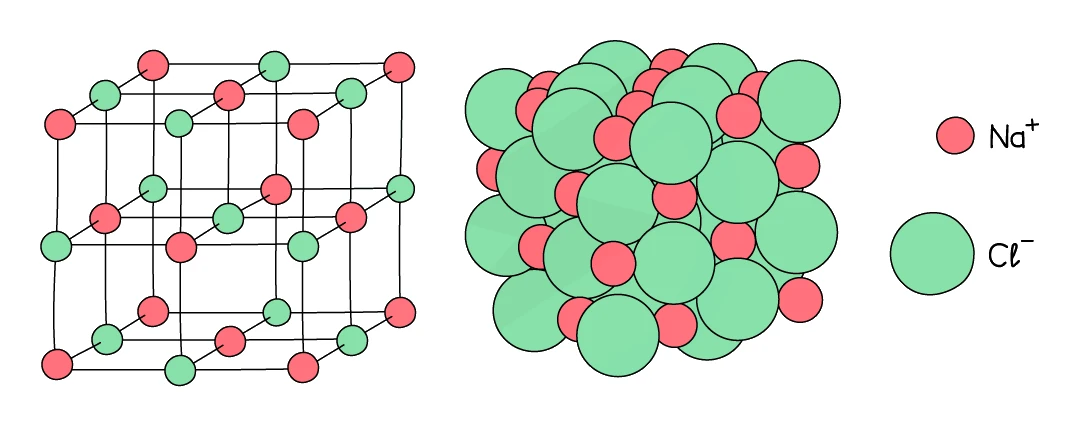
Ionic bonding as electrostatic attraction
- An ionic bond is the electrostatic attraction between oppositely charged ions
- The forces act in all directions and extend throughout the entire lattice
- These forces are very strong
Exam tip
Defining ionic bonding
If you are asked what the term ionic bonding means (2 marks), give the two halves: electrostatic attraction, and between oppositely charged ions (positive and negative ions, or cations and anions, are accepted). Electron transfer is not needed: the definition is about the force holding the ions together, not how they formed. Any wording that implies covalent bonding loses the second mark. The same two phrases are the core of every mark scheme for an ionic compound's high melting point, so learn them as one unit.
High melting and boiling points
- Ionic compounds have high melting and boiling points
- Reason: melting or boiling the solid requires overcoming the many strong electrostatic forces between every pair of opposite ions in the lattice. That takes a lot of thermal energy
- The greater the charges on the ions, the stronger the attraction and the higher the melting point
- Magnesium oxide (Mg²⁺ and O²⁻, both 2-charge) melts at about 2852 °C
- Sodium chloride (Na⁺ and Cl⁻, both 1-charge) melts at about 801 °C
Common exam question
Explaining the high melting point of an ionic compound
Question: Explain, referring to structure and bonding, why an ionic compound has a high melting point, or a much higher one than a simple molecular substance (3–5 marks).
Asked in 7 of the 23 papers. Give the giant ionic lattice (a mark in five of the seven schemes), strong electrostatic forces of attraction ("strong ionic bonds" is accepted; "strong" is not optional) between oppositely charged ions, and a lot of energy needed to overcome the forces or break the ionic bonds. Say "a lot of", not "more": the schemes ignore "more energy" except in a comparison, where the extra marks are that the other substance is simple molecular with weak intermolecular forces needing much less energy. "Weak forces between bonds" is rejected, and so is breaking covalent bonds.
Two schemes give zero overall if covalent bonds, intermolecular forces or molecules appear in the ionic explanation; the others withhold some or all ionic marks for that slip.
Electrical conductivity
- An electric current is a flow of charged particles
- In an ionic compound the ions are the charge carriers (not free electrons)
- Solid ionic compound: poor conductor. The ions are locked in fixed positions in the lattice and cannot move
- Molten or dissolved in water (aqueous): good conductor. The ions are free to move and carry charge
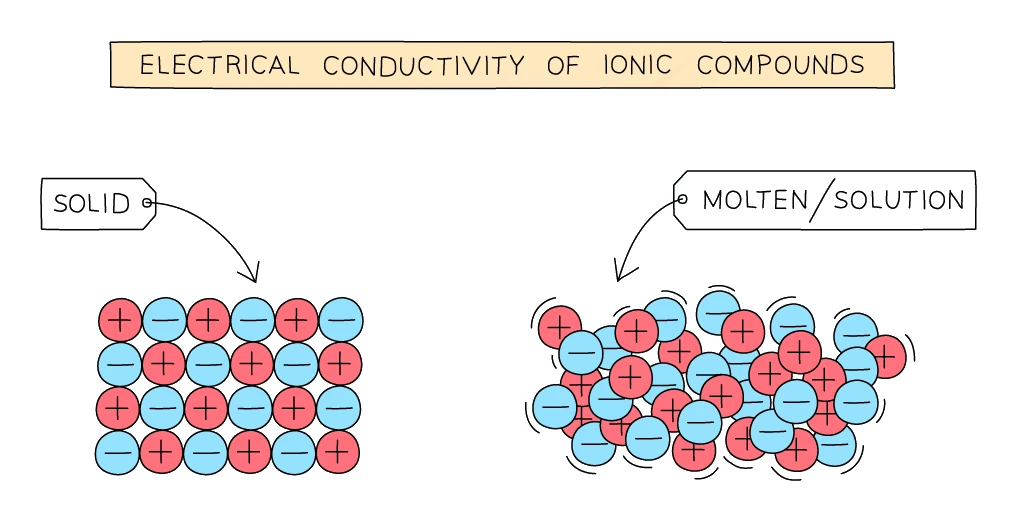
Common exam question
Why ionic compounds conduct only when molten or dissolved
Question: Explain why an ionic compound conducts electricity when molten or in solution but not when solid, or why a molten electrolyte or a salt solution conducts (1–4 marks).
Asked in 7 of the 23 papers, often in an electrolysis question. In the solid the ions are held in fixed positions in the lattice and cannot move; when molten or dissolved the ions are free to move. Both halves must say ions: two schemes give zero to an answer with electrons moving, two more reject electrons for the ion mark, and "can move" is credited only once ions have been named. For a solid alone, one scheme also credits no delocalised electrons. A metal, by contrast, conducts through delocalised electrons; an insoluble ionic solid in water does not conduct for two reasons, each a mark: its ions are still held in place, and water is covalent so it does not conduct either.
In a properties table, conduction only when molten plus a high melting point identifies the ionic substance ("giant" alone earns nothing for the structure).
Solubility in water
- Many ionic compounds are soluble in water
- Water's polar molecules pull the ions out of the lattice and surround them in solution
- e.g. NaCl, KNO₃ and Na₂SO₄ all dissolve readily in water
Brittleness
- Ionic crystals are
- A sharp blow can shift one layer of ions sideways across the next, bringing ions of the same charge next to one another. They repel, and the crystal cracks along that plane