ChemistryExam code: 4CH1
Ionic Bonding
Principles of Chemistry
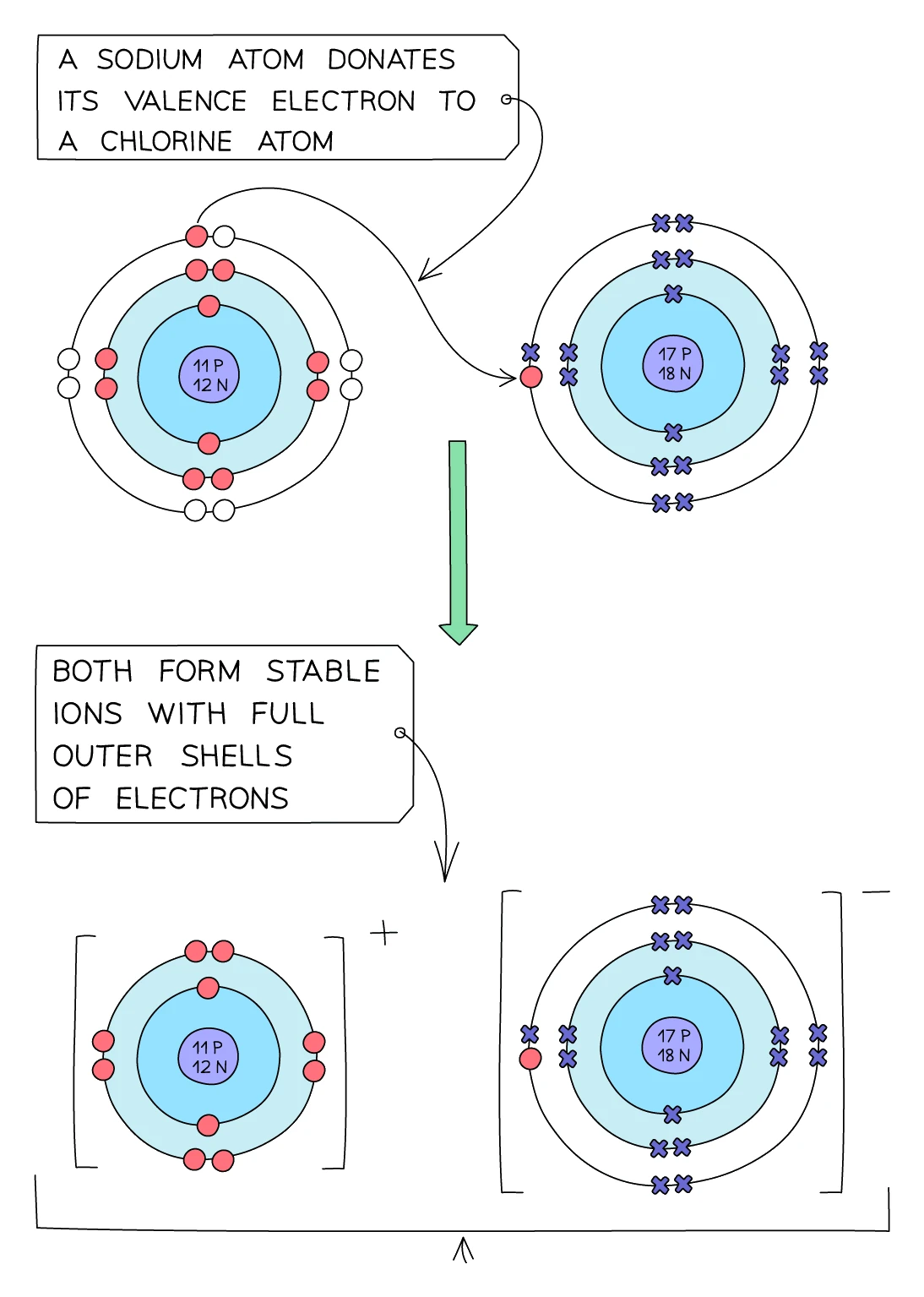
- A dot-and-cross diagram shows the transfer of electrons when atoms become ions and an ionic bond forms
- Conventions to follow:
- Use dots for one atom's electrons and crosses for the other atom's electrons
- Show only the outer-shell electrons (Edexcel does not require inner shells)
- Place each finished ion inside square brackets with its charge written as a superscript at the top-right, outside the brackets
- Any transferred electron keeps the symbol of its original atom (so a cross from chlorine onto the sodium ion is still drawn as a cross)
Sodium chloride: Na⁺ and Cl⁻
- Sodium (Group 1) has 1 outer electron and loses it
- Chlorine (Group 7) has 7 outer electrons and gains 1 to make 8
- One electron transfers from Na to Cl
- The Na atom becomes Na⁺ (configuration 2,8); the Cl atom becomes Cl⁻ (configuration 2,8,8)
- Formula: NaCl
Magnesium oxide: Mg²⁺ and O²⁻
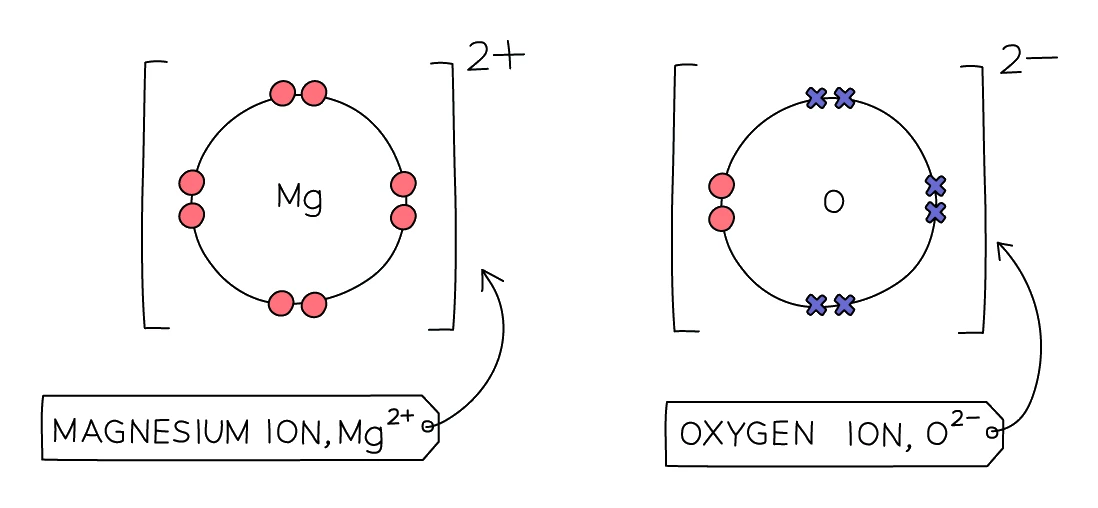
- Magnesium (Group 2) has 2 outer electrons and loses both
- Oxygen (Group 6) has 6 outer electrons and gains 2 to make 8
- Two electrons transfer from Mg to O
- The Mg atom becomes Mg²⁺; the O atom becomes O²⁻
- Formula: MgO
What goes in, what stays out
- Only the outer shell of each atom is drawn (inner shells are omitted)
- The transferred electrons still belong to their original atom and so are drawn as their original symbol on the new ion
- Square brackets and charge superscripts go around each finished , not around the starting atoms
Exam tip
Draw every shell of an ion, not just the outer one
A dot-and-cross diagram needs only the outer shells, but when a question asks you to draw the electronic configuration of a metal ion and a non-metal ion (3 marks), it wants every shell: the scheme that set it capped a diagram showing only the outer electrons at one mark for the two ions together. The third mark is the charge on each ion, so label them, 2+ and 1−. Dots, crosses or any mixture are accepted. The reverse also holds: when asked to describe the changes in words, one scheme gives both marks for correct diagrams of the ions' configurations, so a clear labelled diagram is never wasted.