4CH1
Covalent Bonding
Principles of Chemistry · 5 question types
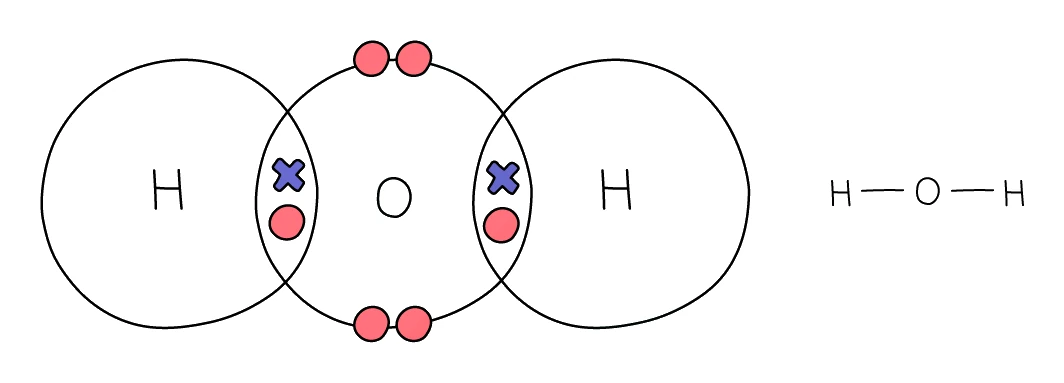
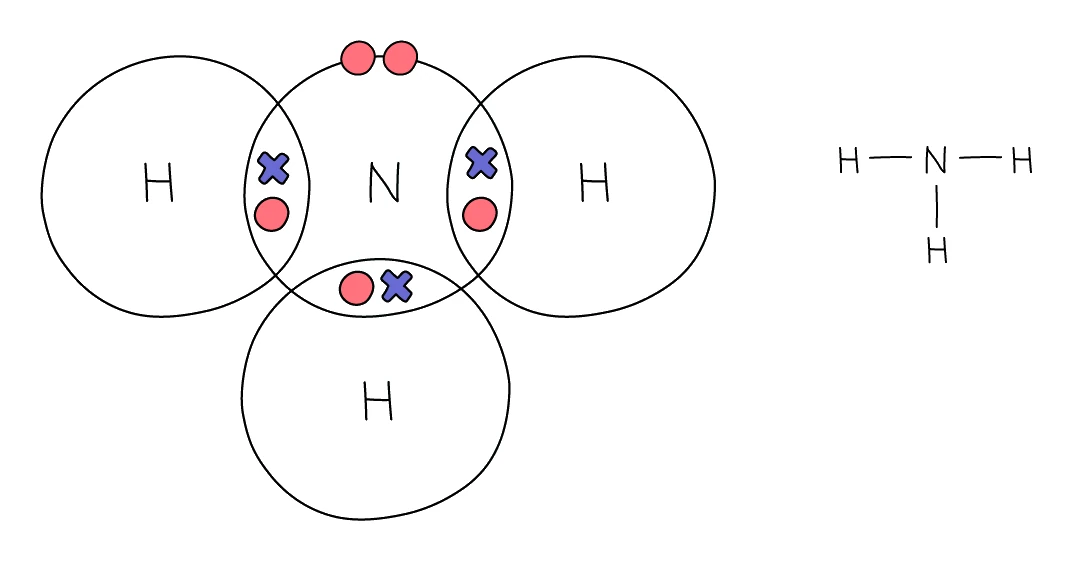
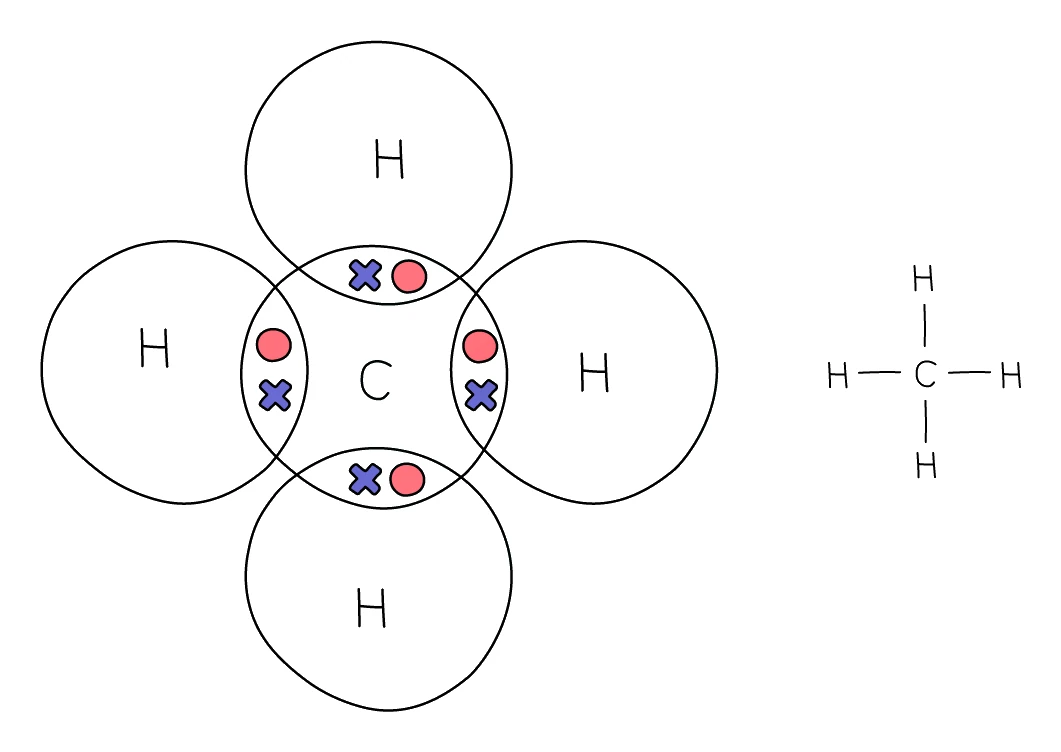
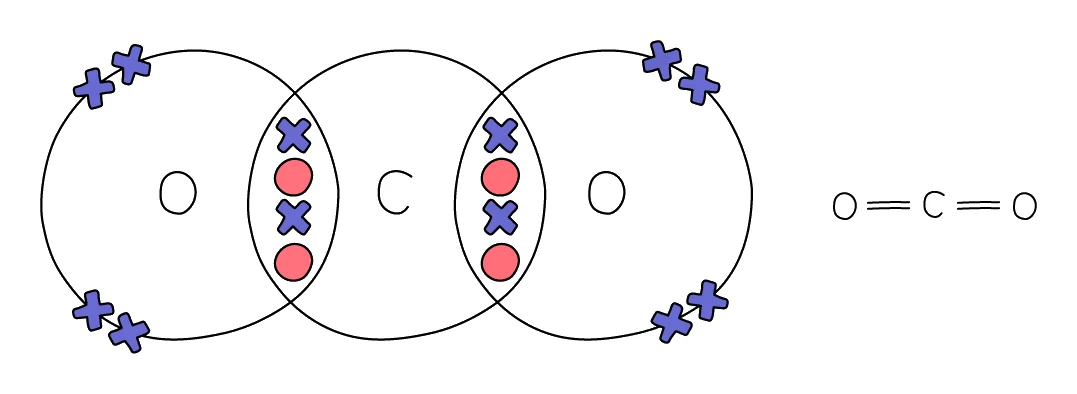
- A dot-and-cross diagram shows which atom each shared electron originally came from
- Conventions to follow:
- Use dots for one element's electrons and crosses for the other element's
- Show only the outer-shell electrons (Edexcel does not require inner shells)
- The two electrons of a shared pair sit in the overlap region between the atoms — one dot + one cross for each shared pair
- Lone pairs sit on the outside of the atom, away from the bond
- Edexcel Section 1.7 expects dot-and-cross diagrams for: H₂, Cl₂, HCl, O₂, N₂, H₂O, NH₃, CH₄ and CO₂
Diatomic molecules
| Molecule | Bond type | Shared electrons | Outer-shell arrangement |
|---|---|---|---|
| H₂ | single | 2 (1 pair) | each H has 2 (full 1st shell) |
| Cl₂ | single | 2 (1 pair) | each Cl has 8; 3 lone pairs each |
| HCl | single | 2 (1 pair) | H has 2; Cl has 8 with 3 lone pairs |
| O₂ | double | 4 (2 pairs) | each O has 8; 2 lone pairs each |
| N₂ | triple | 6 (3 pairs) | each N has 8; 1 lone pair each |
Polyatomic molecules
| Molecule | Central atom | Bonds | Shape | Lone pairs |
|---|---|---|---|---|
| H₂O | O | 2 single (O–H) | bent | 2 on O |
| NH₃ | N | 3 single (N–H) | trigonal pyramidal | 1 on N |
| CH₄ | C | 4 single (C–H) | tetrahedral | 0 |
| CO₂ | C | 2 double (O=C=O) | linear | 2 on each O |
Counting electrons in a bond
- One covalent bond = one shared pair = 2 electrons
- One double bond = 4 electrons shared (two pairs)
- One triple bond = 6 electrons shared (three pairs)
- e.g. in O₂, the two oxygen atoms share 4 electrons in total through a double bond
Exam tip
Common: complete a dot-and-cross diagram
What comes up: you're given a small molecule (a different one most years, such as NH₃, N₂ or H₂O) and asked to complete its dot-and-cross diagram.
Write: one shared pair in each overlap, then add lone pairs until every atom's outer shell is full.
Watch out: hydrogen needs only 2 electrons, never 8; don't forget the lone pairs on N (1) and O (2).