The Periodic Table
Principles of Chemistry
Writing the configuration
- An atom's electron arrangement can be shown in two ways:
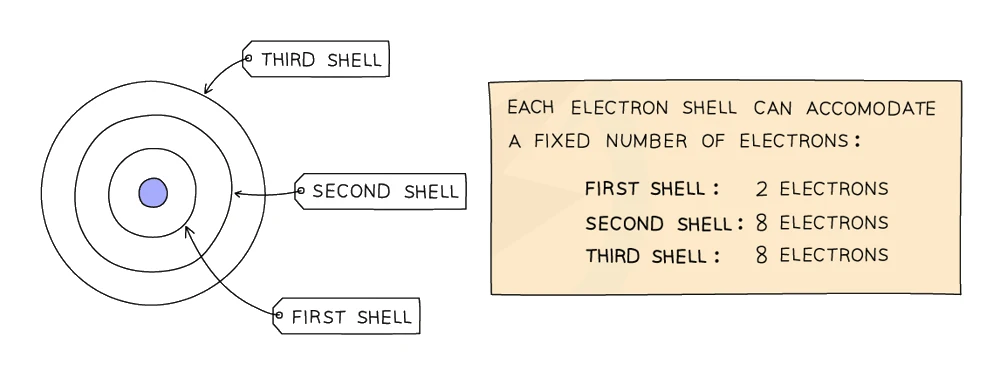
- As an electron shell diagram (nucleus drawn with concentric shells, electrons placed as dots)
- As an electronic configuration (also called electronic structure): the number of electrons in each shell, comma-separated, innermost shell first
- Shell-filling rules for the first 20 elements:
- 1st shell holds up to 2 electrons
- 2nd shell holds up to 8 electrons
- 3rd shell holds up to 8 electrons (a simplification used at this level: once the 3rd shell reaches 8, the 4th shell begins to fill before the 3rd fills further)
- 4th shell starts to fill once the 3rd reaches 8
- Once the 3rd shell has 8 electrons, the next two electrons (for potassium and calcium) go into the 4th shell first, before the 3rd shell continues filling for heavier elements
Electronic configurations of the first 20 elements
| Element | Z | Configuration |
|---|---|---|
| Hydrogen | 1 | 1 |
| Helium | 2 | 2 |
| Lithium | 3 | 2,1 |
| Beryllium | 4 | 2,2 |
| Boron | 5 | 2,3 |
| Carbon | 6 | 2,4 |
| Nitrogen | 7 | 2,5 |
| Oxygen | 8 | 2,6 |
| Fluorine | 9 | 2,7 |
| Neon | 10 | 2,8 |
| Sodium | 11 | 2,8,1 |
| Magnesium | 12 | 2,8,2 |
| Aluminium | 13 | 2,8,3 |
| Silicon | 14 | 2,8,4 |
| Phosphorus | 15 | 2,8,5 |
| Sulfur | 16 | 2,8,6 |
| Chlorine | 17 | 2,8,7 |
| Argon | 18 | 2,8,8 |
| Potassium | 19 | 2,8,8,1 |
| Calcium | 20 | 2,8,8,2 |
Common exam question
Writing the electronic configuration of an atom
Question: Give the electronic configuration of an atom of an element such as phosphorus, from its atomic number or the periodic table (1 mark).
Set in 2 of the 23 papers, both on Paper 2 and both for phosphorus. An atom has as many electrons as its atomic number, the figure printed at the bottom of each element's box on the table (the relative atomic mass is the one at the top), so take that number and fill the shells in order: 2, then 8, then 8, with the fourth shell starting at potassium. Phosphorus has 15 electrons, so its configuration is 2,8,5. Both 2,8,5 and 2.8.5 are credited, and so is a correctly drawn shell diagram. Check that your numbers add up to the atomic number before moving on.
Configurations of ions
- An ion's configuration is its atom's configuration adjusted for electrons gained or lost
- Sodium atom (Na): 11 electrons, configuration 2,8,1
- Sodium ion (Na⁺): 1 electron lost → 10 electrons → 2,8 (same as neon)
- Chlorine atom (Cl): 17 electrons, configuration 2,8,7
- Chloride ion (Cl⁻): 1 electron gained → 18 electrons → 2,8,8 (same as argon)
- Many ions end up with the same configuration as the nearest noble gas, which is why those ions are stable
Reading position from the electronic configuration
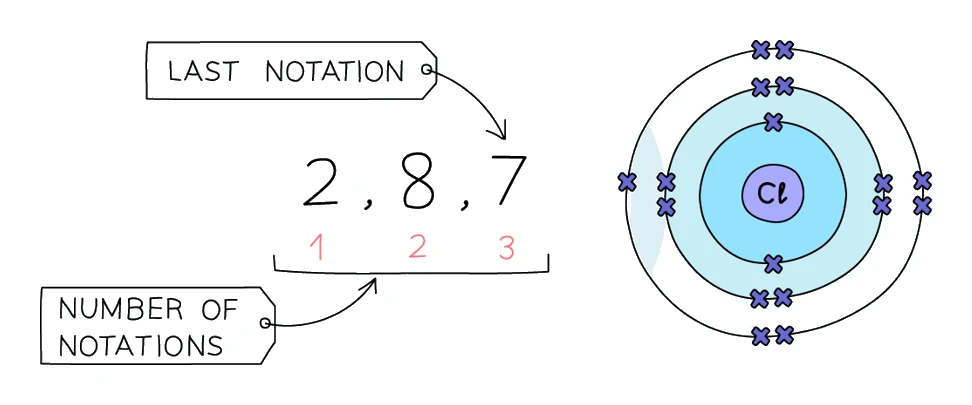
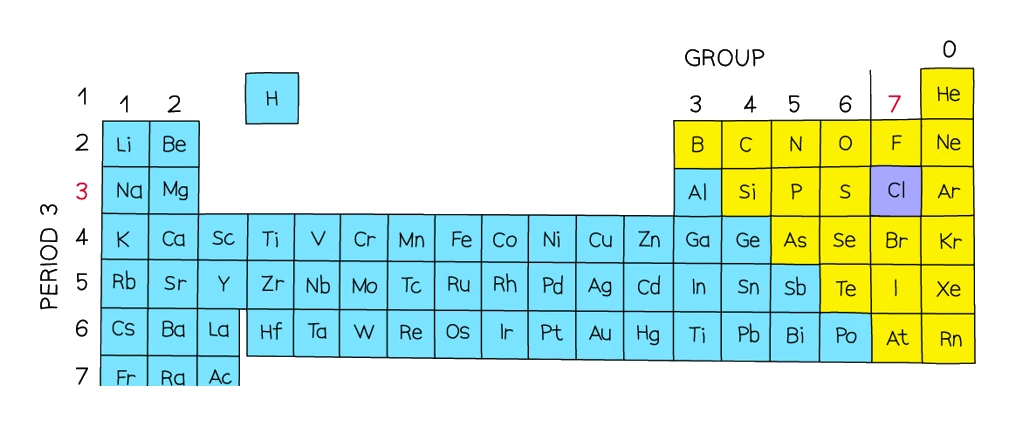
- Period number = number of separate notations in the configuration
- Group number = the last notation (for Groups 1 to 7)
- For example, chlorine has configuration 2,8,7:
- 3 notations → 3 occupied shells → 3
- Last notation is 7 → 7 outer electrons → 7
- Group 0 is the exception
- Group 0 elements have full outer shells, not a single matching outer-electron count
- Helium is in Group 0 even though its configuration is just 2 (only one full shell)
Common exam question
Giving the group and period of an element
Question: Give the number of the group and the period that contain an element, from a diagram of its atom or its electronic configuration (1 mark each, or 2 with an explanation).
Asked in 6 of the 23 papers, twice as multiple choice. Work from the configuration: the number of occupied shells is the period and the number of outer-shell electrons is the group. For a 1-mark part the bare number is enough. In the 2-mark "explain which group" version one mark is for the group and the other for the reason (the outer-shell electron count, or the written configuration), so a bare group number earns only the first.
If the data is a table of particle counts, the electron count works for an atom, but a row whose electrons and protons differ is an ion, so read the protons. Noble gases, helium included, go in Group 0.