4CH1
The Periodic Table
Principles of Chemistry
Comparing the two
| Property | Metals | Non-metals |
|---|---|---|
| Outer electrons | 1 to 3 | 4 to 7 |
| Bonding | Metallic (lose outer electrons) | Covalent (share outer electrons) |
| Electrical conductivity | Good conductors | Poor conductors |
| Type of oxide | Basic oxides | Acidic oxides (a few are neutral) |
| Reaction with acids | Many react with dilute acids | Usually do not react with acids |
| Appearance | Shiny (lustrous) | Dull, non-reflective |
| State at room temperature | Solid (except mercury, which is liquid) | Various: solid, liquid or gas |
| Mechanical properties | Malleable and ductile (can be bent and stretched) | Brittle (shatter when struck) |
| Melting and boiling points | High | Low |
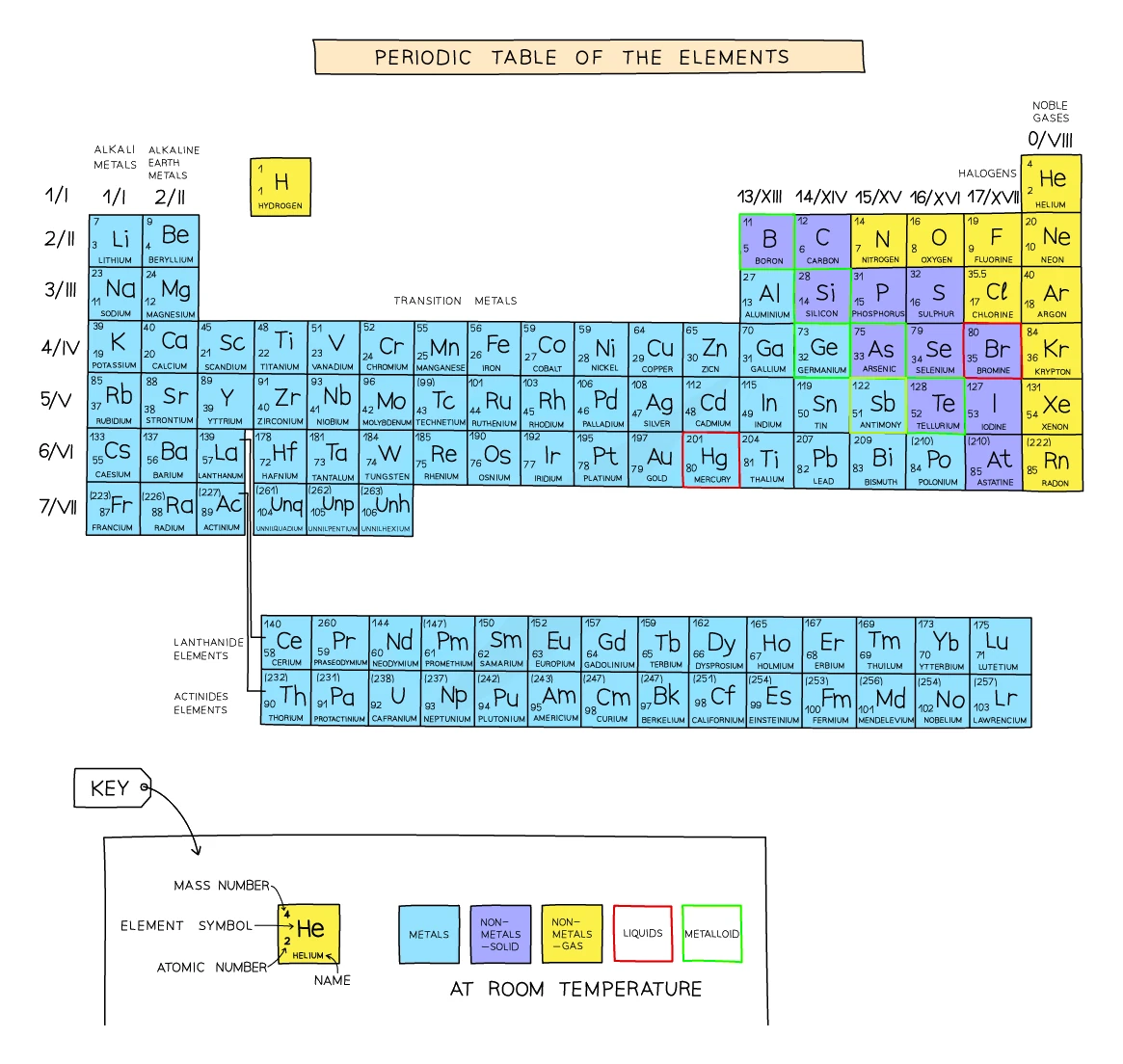
Position on the periodic table
- sit on the left and middle of the periodic table
- sit on the right
- A staircase-shaped zig-zag line on the right of the table separates the two
- The majority of known elements are metals
Metalloids
- Elements sitting right on the zig-zag border have a mixture of metallic and non-metallic properties
- These are called metalloids (also known as semi-metals)
- Examples: boron, silicon, germanium, arsenic