The Periodic Table
Principles of Chemistry
Why same-group elements react alike
- Elements in the same group all have the same number of outer-shell electrons
- Chemical behaviour is set almost entirely by the outer electrons
- So same-group elements:
- Form the same kinds of bonds
- React with the same other elements
- Show similar chemical reactions
- For example, lithium, sodium and potassium are all in Group 1 and all react with chlorine (Group 7) to form ionic chlorides (LiCl, NaCl, KCl)
Why elements in the same group have similar chemical properties
What comes up: explain why two elements in the same group (e.g. lithium and sodium, or chlorine and bromine) have similar reactions.
Write: they have the same number of electrons in their outer shell (e.g. both have 1 outer-shell electron), so their chemical behaviour is the same.
Watch out: "same number of protons" scores zero — proton count differs between group members; it is the outer-electron count that is identical. The mark scheme also allows "same number of valence electrons" as an alternative phrasing.
Trends in reactivity down a group
- 1 (): reactivity increases going down the group
- The outer electron is held more loosely the further it sits from the nucleus, so it is lost more easily
- Group 7 (): reactivity decreases going down the group
- The outer shell sits further from the nucleus, so an incoming electron is attracted less strongly
- The detailed chemistry of these groups is in Topic 10 (Group 1) and Topic 11 (Group 7)
The noble gases (Group 0)
- The Group 0 elements are called the
- Common properties:
- Monatomic (exist as single atoms, not bonded into molecules)
- Colourless gases at room temperature
- Non-flammable
- They are inert (extremely unreactive)
- Most elements react in order to gain, lose or share electrons until they have a full outer shell
- Noble gases already have a full outer shell, so they have no chemical incentive to react
- Outer-shell electrons:
- Helium has 2 (a full 1st shell)
- All other noble gases have 8 outer electrons
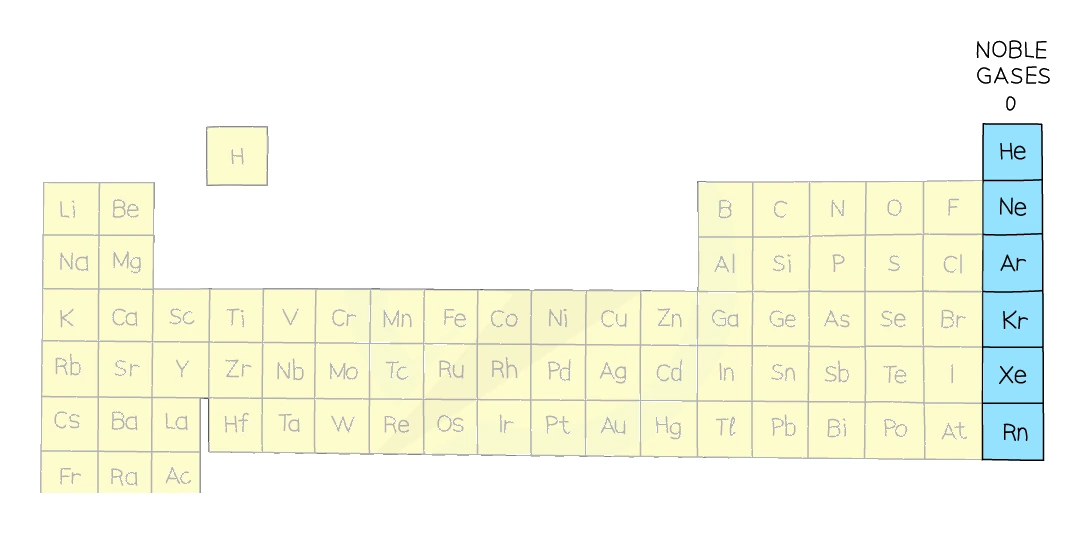
Why noble gases do not react
What comes up: explain, in terms of electron configuration, why a noble gas such as neon or argon is unreactive (commonly 2 marks; occasionally 1 mark as "state why").
Write (two marks): (1) Its outer shell is full (neon: 2,8; argon: 2,8,8 — 8 electrons in the outer shell). (2) It therefore has no need to lose, gain, or share electrons.
Watch out: for a 1-mark "state" question, either mark point alone is accepted — but for the 2-mark "explain" version both points are needed. Do not write "noble gases are metals" or confuse Group 0 with Group 8; the mark scheme says IGNORE references to "noble gas" as a reason on its own.
Noble-gas electronic configurations
| Noble gas | Z | Electronic configuration |
|---|---|---|
| Helium (He) | 2 | 2 |
| Neon (Ne) | 10 | 2,8 |
| Argon (Ar) | 18 | 2,8,8 |
| Krypton (Kr) | 36 | 2,8,18,8 |
| Xenon (Xe) | 54 | 2,8,18,18,8 |
- From krypton onwards the third shell holds its full 18 electrons (the simplified rule applies only to the first 20 elements)