Electrolysis
Principles of Chemistry · 2 question types
Goal of the practical
- Pass a current through aqueous NaCl, dilute H2SO4 and CuSO4, then collect and test whatever is released at the cathode and the anode for each electrolyte
Apparatus and method
- A beaker containing the solution to be electrolysed
- Two inert graphite electrodes dipping into the liquid, connected to a low-voltage d.c. power supply
- Two small test tubes are filled with the same solution and inverted over the electrodes so that any gas produced collects inside them
- Switch on the supply, allow electrolysis to proceed until enough gas (or solid) has formed, then switch off and test the products
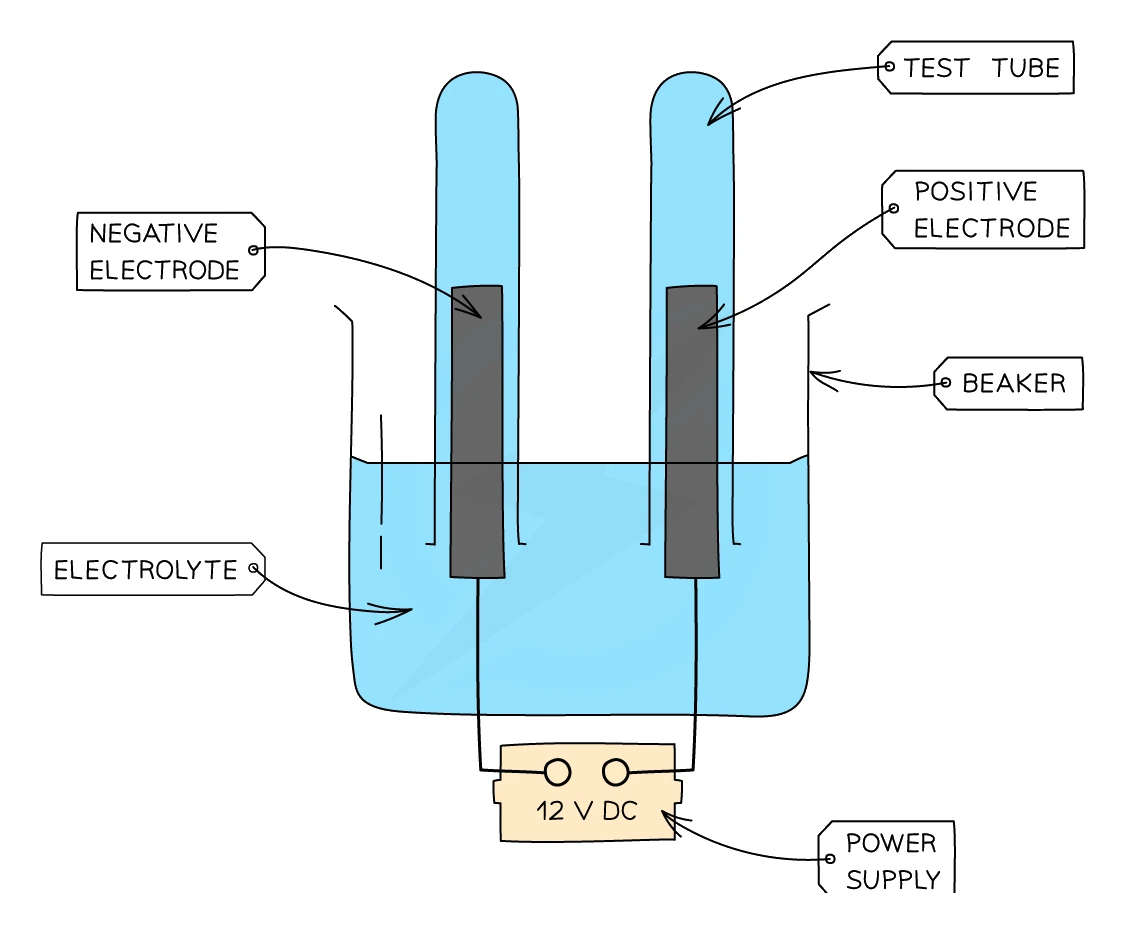
Identifying the products
- A gas that gives a pop with a lighted splint is hydrogen
- A gas that relights a glowing splint is oxygen
- A gas that bleaches damp blue litmus paper is chlorine
- A solid coating that builds up on the cathode is the metal — its colour is a clue to its identity (pink-brown for copper)
Results
| Electrolyte | At the cathode | At the anode |
|---|---|---|
| Sodium chloride | Colourless gas, pops with a lighted splint (hydrogen) | Pale yellow-green gas, bleaches damp blue litmus (chlorine) |
| Dilute sulfuric acid | Colourless gas, pops with a lighted splint (hydrogen) | Colourless gas, relights a glowing splint (oxygen) |
| Copper(II) sulfate | Pink-brown solid builds up on the electrode (copper) | Colourless gas, relights a glowing splint (oxygen) |
Describing and identifying products at the electrodes
What comes up: "Describe what you would observe at the cathode / anode" or "Name the gas produced and state the test used to identify it."
Write: Hydrogen — colourless gas; test with a lighted splint and it gives a squeaky pop. Chlorine — pale yellow-green gas; test with damp blue litmus paper and it bleaches the paper (turns it white). Oxygen — colourless gas; test by holding a glowing splint near the opening and it relights. Copper — a pink or pink-brown solid deposit forms on the cathode surface.
Watch out: For hydrogen, the mark scheme rejects "use a glowing splint" — the splint must be lighted (burning), not glowing. For copper, the mark scheme accepts pink, pink-brown, orange-brown, brown, and red-brown as correct colours, but explicitly rejects "red" and also rejects the word "precipitate" — the copper is a solid deposit or coating, not a precipitate.