Electrolysis
Principles of Chemistry · 2 question types
Oxidation and reduction in terms of electrons
- is loss of electrons. is gain of electrons. (mnemonic: OIL RIG)
- At the anode, anions lose electrons → oxidation
- At the cathode, cations gain electrons → reduction
- A writes out the change at one electrode, showing the species, the electrons (e−), and the product
- The charge on each side of a half-equation must balance
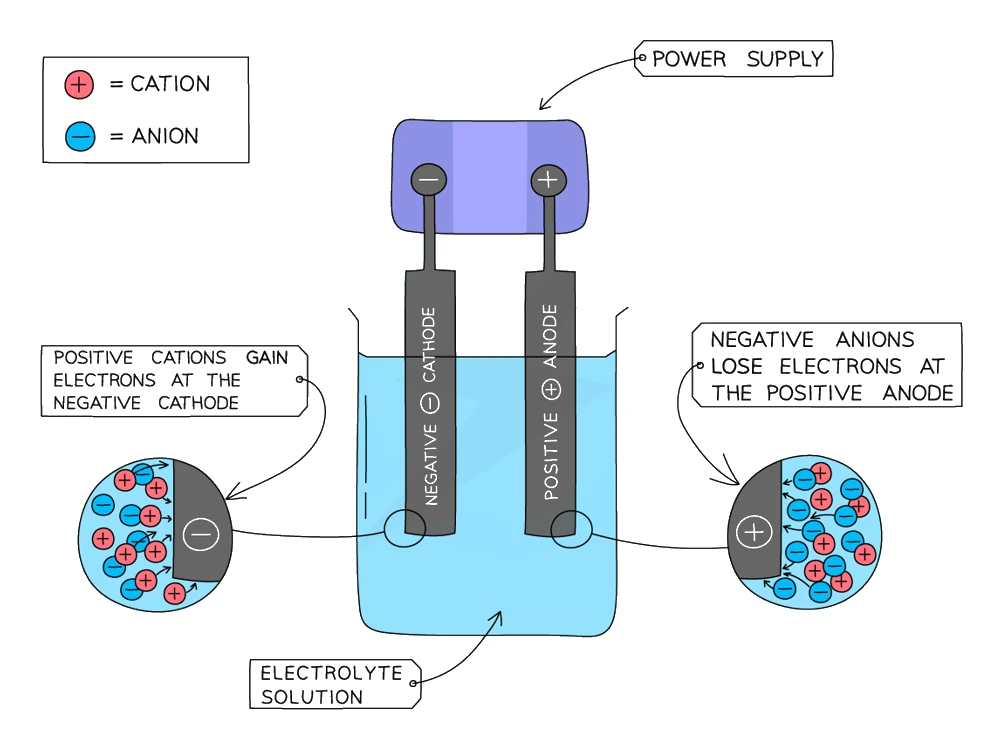
Why an electrode reaction is oxidation or reduction
Question: State why the reaction shown by a given half-equation is an oxidation reaction, or a reduction reaction (1 mark).
Asked in 4 of the 23 papers, always for one mark and always answered in terms of electrons: oxidation because electrons are lost, reduction because electrons are gained. "Electrons are lost" on its own is enough. If you name the species, name the ion that changes: chloride ions lose electrons, magnesium ions gain electrons. "Chlorine loses electrons", "bromine loses electrons" and "magnesium gains electrons" are all rejected, because the element is the product, not the species that transfers the electrons. When oxygen forms from water, "water loses electrons" is accepted. An answer about gaining or losing oxygen is rejected.
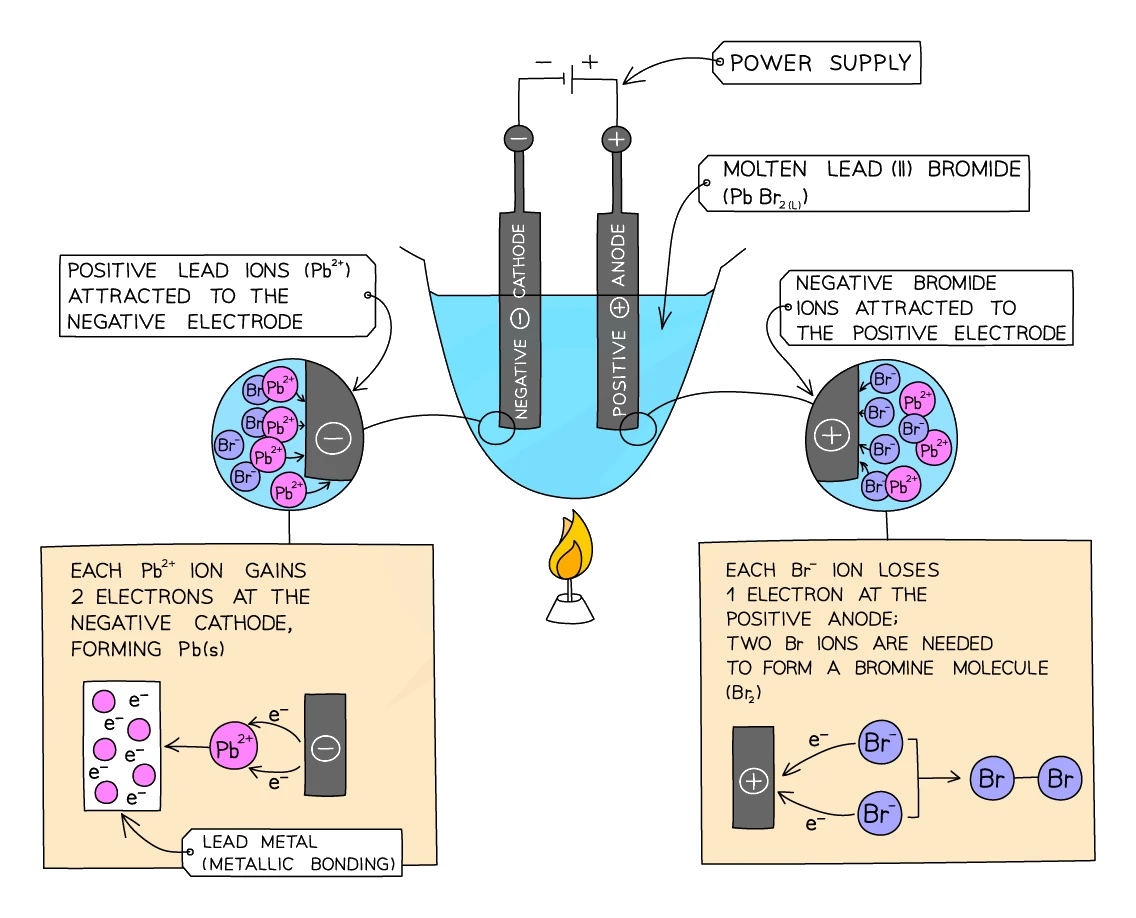
Molten lead(II) bromide
- Cathode: Pb2+ + 2e− → Pb (reduction)
- Anode: 2Br− → Br2 + 2e− (oxidation)
- Observations: silvery-grey molten lead collects at the cathode and red-brown bromine vapour is released at the anode
Aqueous sodium chloride
- Cathode: 2H+ + 2e− → H2
- Anode: 2Cl− → Cl2 + 2e−
Dilute sulfuric acid
- Cathode: 2H+ + 2e− → H2
- Anode: 2H2O → O2 + 4H+ + 4e−
- Water (not OH−) is the oxidised species because the solution is acidic and contains almost no OH−
Aqueous copper(II) sulfate
- Cathode: Cu2+ + 2e− → Cu
- Anode: 2H2O → O2 + 4H+ + 4e−
Writing an ionic half-equation for an electrode
Question: Write, or complete, the ionic half-equation for the product formed at the anode or cathode (1–2 marks).
Asked in 9 of the 23 papers, the most common electrolysis question. The species being discharged on the left, the product on the right, balance the atoms, then add electrons to balance the charge: on the left at a cathode (2H⁺ + 2e⁻ → H₂), on the right at an anode (2Cl⁻ → Cl₂ + 2e⁻). Electrons subtracted on the left (2Cl⁻ − 2e⁻ → Cl₂), multiples and fractions are all accepted.
State symbols are ignored, even when wrong, unless asked for; then they are the second of two marks, still earned by follow-through if the charge or balancing is wrong. The oxygen equation usually carries two marks, the first for the right species, the second for the balanced equation. Two correct equations against the wrong electrodes score one of two.
Balancing the half-equation for oxygen at the anode
Dilute sodium sulfate solution is electrolysed with inert electrodes and oxygen is given off at the anode. Give the half-equation for the oxygen, starting from water.
Solution:
- Sulfate ions are not discharged, so the oxygen comes from water, which is oxidised to oxygen gas and hydrogen ions: H₂O → O₂ + H⁺ (not yet balanced)
- Balance the oxygen atoms: 2H₂O → O₂ + H⁺ (two on each side)
- Balance the hydrogen atoms: 2H₂O → O₂ + 4H⁺ (four on each side)
- Balance the charge: the left is neutral and the right is 4+, so four electrons are given up: 2H₂O → O₂ + 4H⁺ + 4e⁻
- Check: the right is (+4) + (−4) = 0, matching the left, and electrons on the right confirm that this is oxidation
- 2H₂O → O₂ + 4H⁺ + 4e⁻
The same working from hydroxide ions gives 4OH⁻ → O₂ + 2H₂O + 4e⁻, which earns the same marks when the question does not fix the starting species; when it prints 2H₂O as the start, the hydroxide version scores only one.