4CH1
Electrolysis
Principles of Chemistry · 2 question types
Why most covalent substances do not conduct
- An electric current is a flow of charged particles
- In a metal wire the moving charges are electrons
- In a molten or aqueous ionic substance the moving charges are ions
- Most covalent compounds have no charged particles that are free to move, so they do not conduct
- This makes them useful as electrical insulators in a wide range of forms
- Solid: the plastic sheathing on household wiring (poly(ethene), PVC)
- Liquid: silicone oils inside transformer cores
- Gas: sulfur hexafluoride (SF6) inside high-voltage switchgear
Why ionic compounds conduct only when molten or dissolved
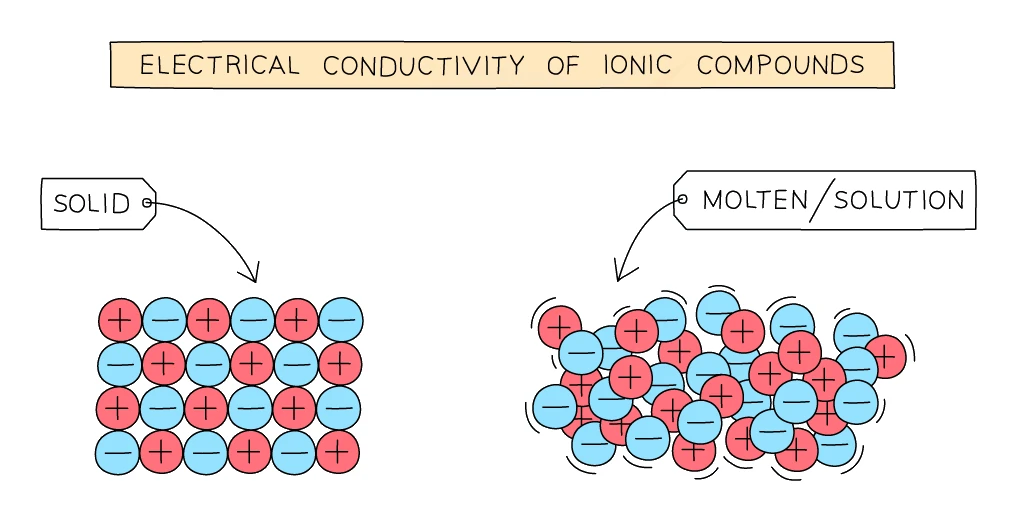
- In the solid state, the ions sit in fixed positions within the giant ionic lattice and cannot move past one another, so the solid does not conduct
- In the molten state, the lattice has broken down and the ions are free to move and carry charge through the liquid
- In aqueous solution, the water separates the ions from each other and the dissolved ions are again free to move and carry charge
- An ionic substance set up so that current can pass through it is called the
Exam tip
Why an ionic compound must be molten or dissolved to conduct
What comes up: "Explain why lead(II) bromide does not conduct electricity in the solid state but does conduct when molten."
Write (two marks): (1) In the solid state the ions are in fixed positions and cannot move. (2) When molten, the ions are free to move and carry charge through the liquid.
Watch out: The mark scheme credits "ions can move" for M2 and explicitly rejects any reference to electrons moving as the reason an ionic compound conducts — ionic conductivity comes from ions, not electrons.
Cations, anions, and the electrodes
- A cation is a positively charged ion (Na+, Mg2+, H+)
- An anion is a negatively charged ion (Cl−, O2−, SO42−)
- In an electrolysis cell, two electrodes dip into the electrolyte and are connected to a d.c. supply
- The cathode is the negative electrode
- The anode is the positive electrode
- Once the supply is switched on, the ions migrate toward the oppositely charged electrode
- Cations move to the
- Anions move to the
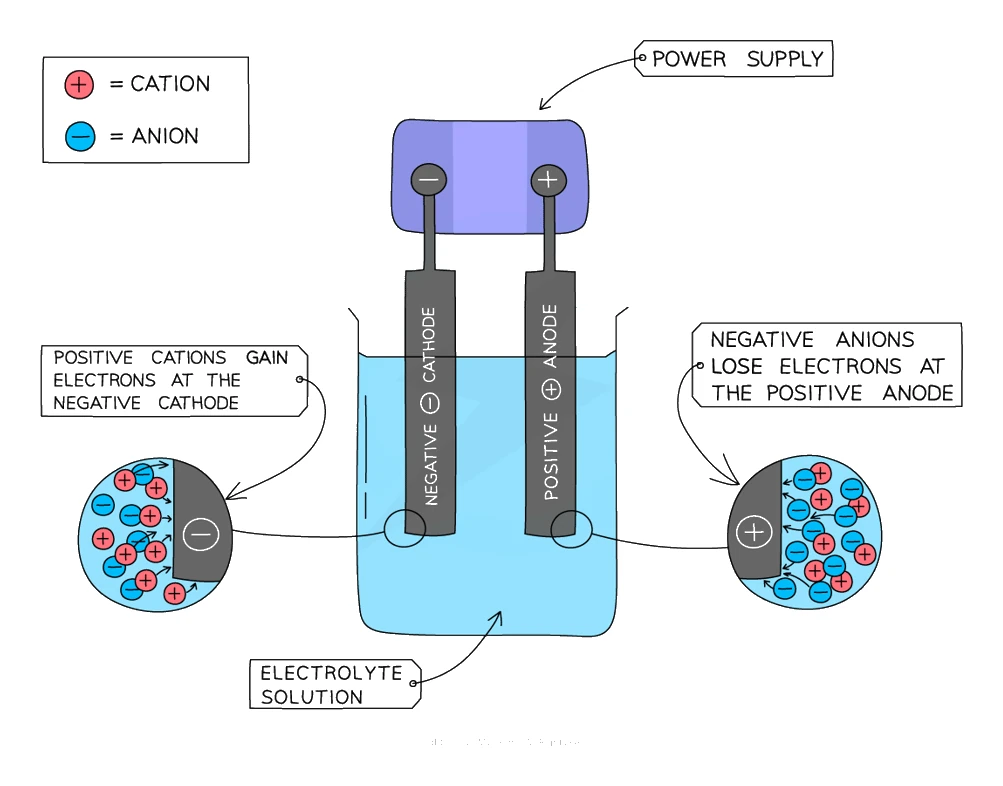
- Electrons flow in the external wire from the anode to the cathode, completing the circuit