4CH1
Group 1: The Alkali Metals
Inorganic Chemistry · 1 question type
What Group 1 is
- Group 1 is the leftmost vertical group on the periodic table
- Its elements are the alkali metals: lithium, sodium, potassium, rubidium, caesium and francium
- They are called the alkali metals because they react with water to form alkaline solutions (pH > 7)
- Each atom has one electron in its outermost shell, which is why all six elements share a family resemblance in their chemistry
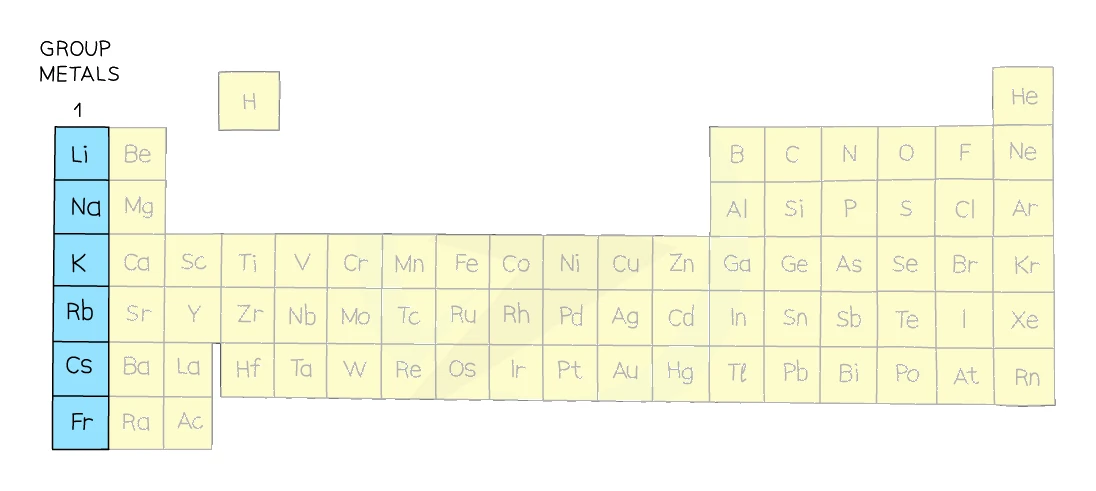
Physical properties shared by all Group 1 metals
- All six are soft enough to be cut with a knife
- A freshly cut surface is shiny and silvery
- They have relatively low densities — the top three (Li, Na, K) actually float on water
- They have low melting points compared with most other metals
- They are stored under oil to keep them away from air and moisture
General reaction with water
- Every Group 1 metal reacts with cold water to give the corresponding and hydrogen gas
2 M(s) + 2 H2O(l) → 2 MOH(aq) + H2(g)
- The hydroxide dissolves to give a colourless alkaline solution (lithium hydroxide, sodium hydroxide, potassium hydroxide and so on)
- The hydrogen gas can be tested by holding a lit splint over the bubbles — it gives the characteristic squeaky pop