Acids, Alkalis and Titrations
Inorganic Chemistry
Indicators and the pH Scale
What an indicator is
- An indicator is a substance that changes colour to show whether a solution is acidic, neutral or alkaline
- A two-colour shows one colour in acid and a different colour in alkali — its colour flips sharply at the of an acid–alkali reaction
- A universal indicator is a mixture of several indicators that goes through a continuous range of colours, giving a rough numerical pH rather than a single switch
Common two-colour indicators
- Phenolphthalein — stays colourless in acid; flips to a clear pink in alkali
- Methyl orange — looks red while the solution is acidic; turns yellow once the solution becomes alkaline
- Litmus — red in acid, blue in alkali; supplied either as a solution or as red and blue paper strips for testing drops of liquid or moist gases
- Phenolphthalein and methyl orange give sharp colour changes and are the indicators used in (see section 3)
- Litmus solution gives a less sharp change than the other two, passing through a purple band rather than a single clean transition, although the mark schemes do accept litmus solution as a titration indicator
Common exam question
Choosing a titration indicator and its colour
Question: Name a suitable indicator for an acid–alkali titration and give its colour, or its colour change, in the flask (1–2 marks).
Asked in 5 of the 23 papers. Methyl orange, phenolphthalein or litmus solution all score; universal indicator is rejected, so is litmus paper, and the abbreviation "pp" is ignored, so spell phenolphthalein out. The colour follows what the flask holds. Methyl orange is yellow in alkali (orange accepted) and red in acid (pink accepted; yellow to orange or to pink is allowed for the change); phenolphthalein is pink in alkali and colourless in acid; litmus is blue in alkali (purple accepted) and red in acid. When alkali is run into acid the final colour is the alkaline one, and when acid is run into alkali methyl orange goes from yellow to red, which must be given in that order.
When name and colour are both asked, the colour mark depends on the name: a colour alone scores nothing, a name alone scores one.
The pH number line
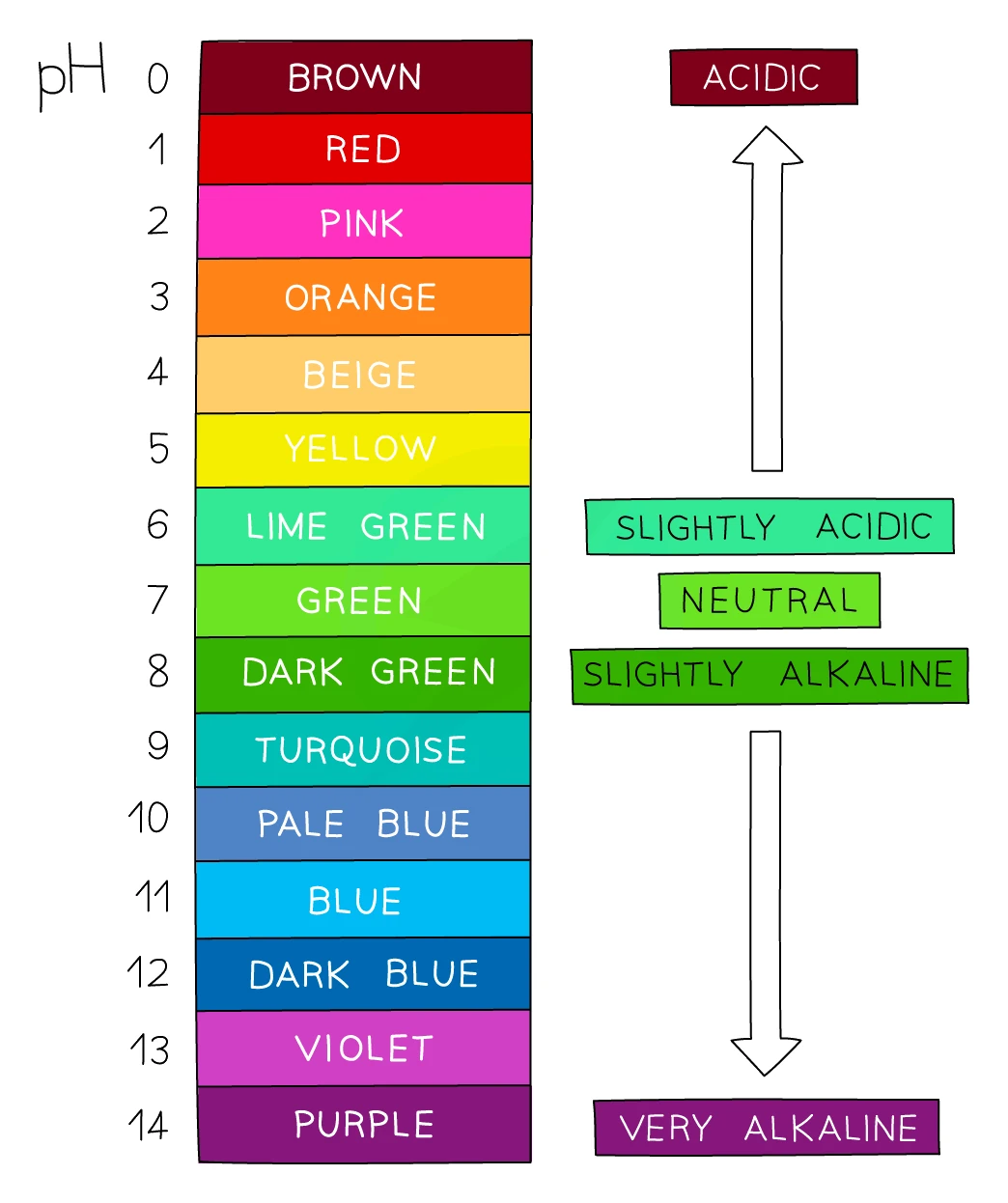
- The pH scale is a number scale that runs from 0 (most acidic) to 14 (most alkaline)
- pH = 7 is (pure water at room temperature)
- The scale measures the concentration of H+ ions in solution; the more H+ ions, the lower the pH
- Rough guide:
| pH range | What it describes | Examples |
|---|---|---|
| 0–3 | Strong acid | Hydrochloric, sulfuric and nitric acid in the lab; stomach acid |
| 4–6 | Weak acid | Lemon juice, vinegar, rainwater |
| 7 | Neutral | Pure water, sodium chloride solution |
| 8–10 | Weak alkali | Sodium hydrogencarbonate solution, soap |
| 11–14 | Strong alkali | Sodium hydroxide, potassium hydroxide, oven cleaner |
Common exam question
Giving a pH value
Question: Give the pH of a neutral solution, or a pH value that fits a weakly acidic or weakly alkaline solution (1 mark each).
Asked in 2 of the 23 papers, both times in question 1. Neutral is exactly 7. For a weakly acidic solution any value from 4 up to, but not including, 7 is accepted, so a safe choice is 5. A solution of pH 9 is weakly alkaline, not strongly alkaline: the strong ends of the scale are 0 to 3 and 11 to 14.
Using universal indicator
- A few drops of universal indicator are added to the solution under test
- The resulting colour is matched against a printed chart that maps each colour band to a pH value
- Universal indicator gives only an estimate; the exact colours vary between brands, so the supplied chart must be used
- Because the change is gradual, universal indicator is not suitable for titrations — the end-point would be impossible to pin down
Common exam question
Explaining the colour of an indicator in a solution
Question: Give the colour of an indicator in an acidic or an alkaline solution, or give or explain its final colour in the solution formed by a reaction such as a Group 1 metal in water or sulfur dioxide dissolving (1–2 marks).
Asked in 9 of the 23 papers. The first mark is the colour: universal indicator turns blue or purple in an alkali and red, orange or yellow in an acid; phenolphthalein turns pink (red and purple are rejected); methyl orange turns yellow in alkali; litmus turns red in acid (pink accepted, red-orange rejected). The second mark is the reason, and it is about the ions: an alkaline solution has formed because hydroxide ions, OH⁻, are present, or an acidic one because it contains hydrogen ions, H⁺. Naming the alkali made, such as sodium hydroxide, is also accepted. The indicator's colour before the reaction is ignored, so do not spend words on it.
Common exam question
Why universal indicator is not used in a titration
Question: Give a reason why universal indicator is not suitable for a titration, or explain why a named indicator should replace it (1–2 marks).
Asked in 3 of the 23 papers. One statement earns the single mark: universal indicator gives no sharp colour change, so there is no clear end-point, or it changes colour gradually over a range of pH values, giving a range of colours. Either scores on its own. When a faulty method is given and you are asked to improve it, the pair is worth two marks: name the replacement (methyl orange, phenolphthalein or litmus) and give the reason, that it gives a sharp colour change, or has just two colours, one in acid and one in alkali.