Gases in the Atmosphere
Inorganic Chemistry · 1 question type
Composition of Air
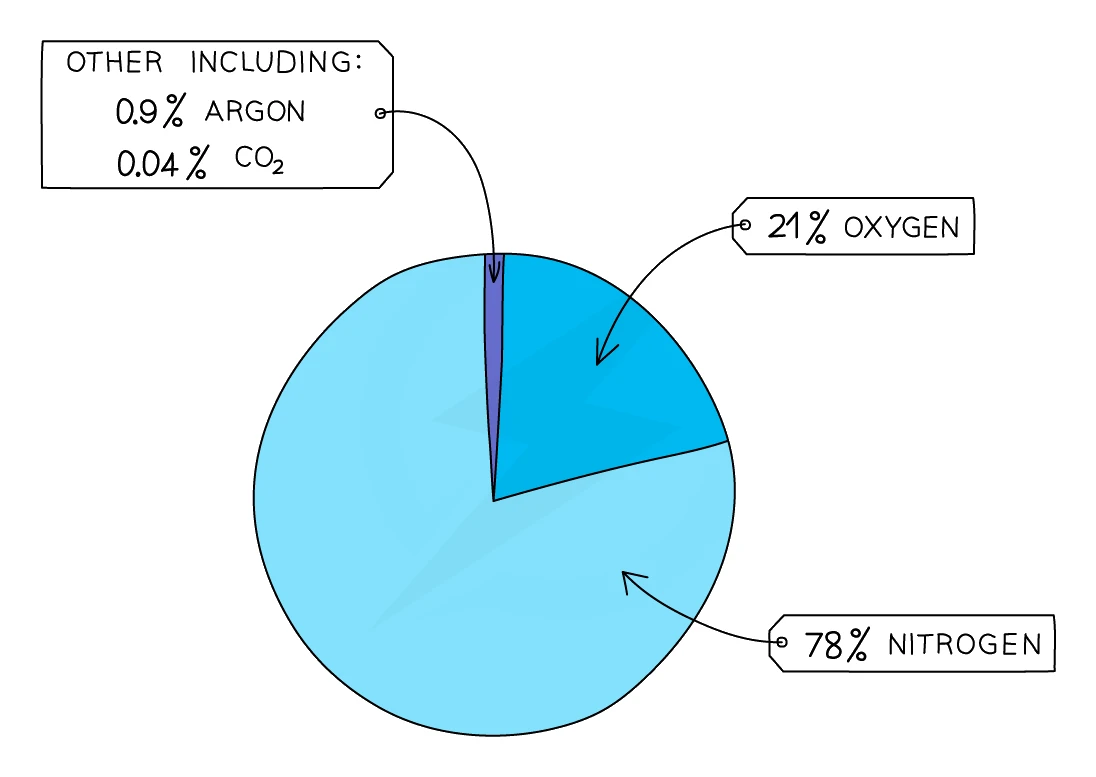
Approximate proportions
- Dry air is a mixture, not a compound
- It is made up of:
- Nitrogen, N2 — about four-fifths of the air, roughly 78–80%
- Oxygen, O2 — about one-fifth, roughly 20–21%
- Argon and other noble gases — about 1% in total
- Carbon dioxide, CO2 — about 0.04% (small but a key )
- Water vapour — a variable amount depending on humidity
- These proportions have stayed roughly constant for the last 200 million years; only the trace gases (especially CO2) have shifted noticeably over the last two centuries
Identifying a gas of the air from its percentage or property
Question: Name, or pick from a list, the gas that is most abundant in air, makes up about 1%, is the least reactive, is a greenhouse gas, or is not normally found in the atmosphere (1 mark each).
Asked in 9 of the 23 papers, sometimes as a pie chart or a table. About four-fifths (78–80%) of air is nitrogen and about one-fifth (21%) is oxygen. The noble gas at roughly 1% is argon, also the least reactive gas. Carbon dioxide (0.04%) has the lowest percentage of the gases usually listed, is the only compound among them and is the greenhouse gas (water vapour and methane are also accepted). The gas not normally present is hydrogen.
Write the name in full: N₂ is accepted but one scheme ignores a bare N. Argon exceeds carbon dioxide, so of those four the lowest percentage is carbon dioxide and the largest trace gas is argon. Air is a mixture, so it has no formula or relative formula mass.