Group 7: The Halogens
Inorganic Chemistry
Each halogen has seven outer electrons
- Fluorine (proton number 9): 2, 7
- Chlorine (proton number 17): 2, 8, 7
- Bromine (proton number 35): 2, 8, 18, 7
- A halogen reacts by gaining one electron to complete its outer shell, which then has the noble gas configuration of the following group 0 element
- That captured electron makes the atom a 1−
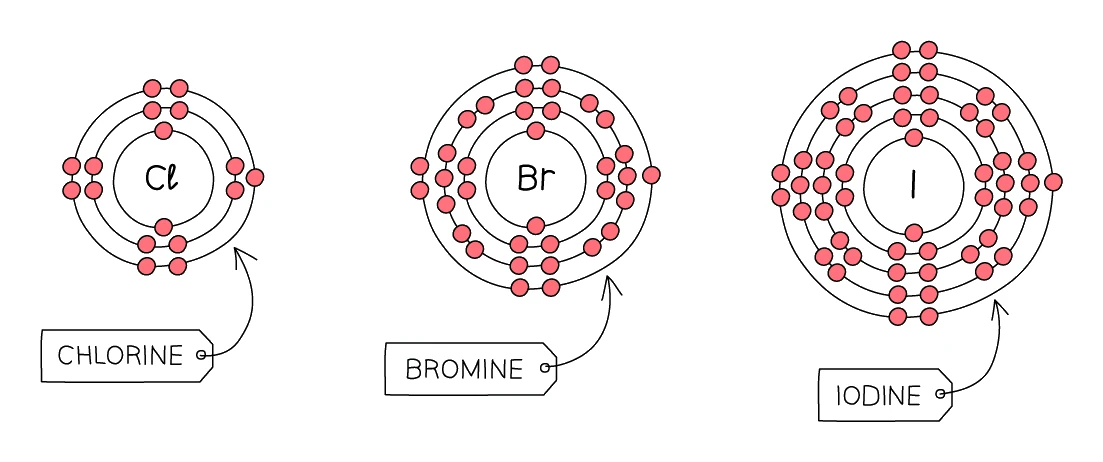
Why reactivity decreases down Group 7
- An extra electron shell is added at each step down the group
- The outer shell therefore sits further from the positive nucleus
- The pull from the nucleus on an incoming electron is weaker the larger the atom (more distance, plus shielding by the inner shells)
- The atom finds it harder to grab a passing electron and complete its outer shell, so it reacts less readily
- Fluorine sits at the top with the smallest atom, the strongest pull, and is therefore the most reactive halogen; iodine sits much lower and is the least reactive of the four common halogens
Explaining why reactivity decreases down Group 7
What comes up: a 4-mark question asks you to explain the relative reactivities of two halogens (for example, fluorine versus chlorine) using their electronic configurations.
Write (four marks): (1) fluorine is more reactive than chlorine (state the conclusion first); (2) the outer shell of electrons is closer to the nucleus in fluorine, because fluorine has fewer electron shells; (3) the attraction from the nucleus to an incoming electron is therefore stronger in fluorine (less shielding from inner shells); (4) so fluorine gains an electron more readily and reacts more vigorously.
Watch out: this is a "gain-electron" argument — the opposite logic to Group 1 metals, which react by losing electrons. Never say halogens "lose" electrons to explain reactivity. The mark scheme credits "smaller atomic radius" and "less shielding" as alternatives for M2 and M3 respectively.