Group 1: The Alkali Metals
Inorganic Chemistry
The Group 1 Alkali Metals
What Group 1 is
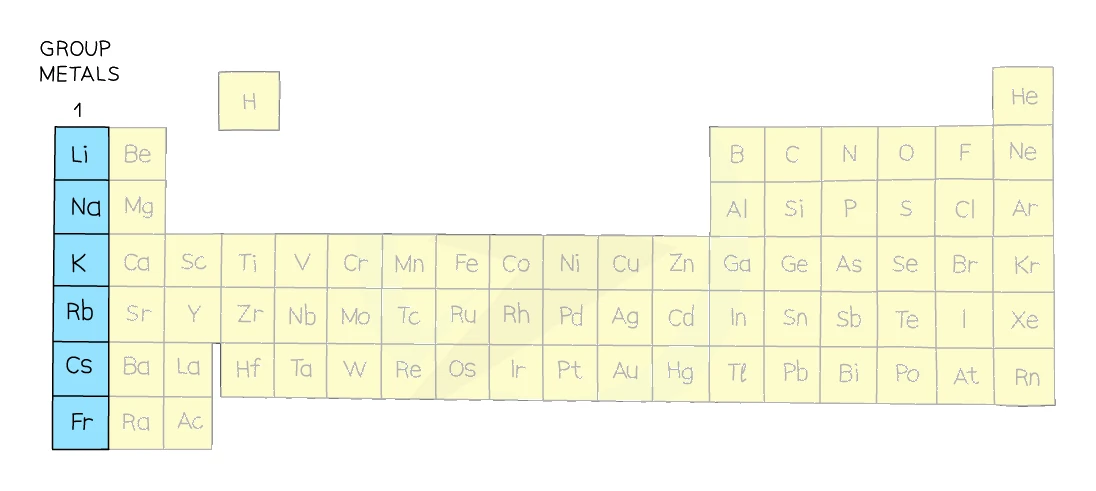
- Group 1 is the leftmost vertical group on the periodic table
- Its elements are the alkali metals: lithium, sodium, potassium, rubidium, caesium and francium
- They are called the alkali metals because they react with water to form alkaline solutions (pH > 7)
- Each atom has one electron in its outermost shell, which is why all six elements share a family resemblance in their chemistry
Physical properties shared by all Group 1 metals
- All six are soft enough to be cut with a knife
- A freshly cut surface is shiny and silvery
- They have relatively low densities — the top three (Li, Na, K) actually float on water
- They have low melting points compared with most other metals
- They are stored under oil to keep them away from air and moisture
General reaction with water
- Every Group 1 metal reacts with cold water to give the corresponding and hydrogen gas
2 M(s) + 2 H2O(l) → 2 MOH(aq) + H2(g)
- The hydroxide dissolves to give a colourless alkaline solution (lithium hydroxide, sodium hydroxide, potassium hydroxide and so on)
- The hydrogen gas can be tested by holding a lit splint over the bubbles — it gives the characteristic squeaky pop
Common exam question
Explaining the indicator colour after the reaction
Question: Universal indicator, phenolphthalein or methyl orange is in the water an alkali metal reacts with, or is added afterwards. Give, or explain, the final colour (1–2 marks).
Asked in 5 of the 23 papers. One mark is for the colour and one for the reason, which has two halves: the solution is alkaline because hydroxide ions (the metal hydroxide) have formed. Write both halves, because in one scheme "alkaline" only duplicates the colour mark and the second mark is reserved for the hydroxide ions.
Universal indicator turns blue or purple (violet and lilac are accepted). Phenolphthalein turns pink, and red or purple is rejected. Methyl orange turns yellow. Saying that a metal oxide forms earns nothing.