Group 1: The Alkali Metals
Inorganic Chemistry · 1 question type
Reactions with water become more vigorous down the group
- All Group 1 + water reactions give the same products, but the speed and energy of each reaction increase as you go down the group
| Metal | Word equation | Observations |
|---|---|---|
| Lithium | lithium + water → lithium hydroxide + hydrogen | Floats, fizzes steadily, moves slowly across the surface |
| Sodium | sodium + water → sodium hydroxide + hydrogen | Floats as a molten silvery ball, fizzes vigorously, darts about, can ignite to a yellow-orange flame |
| Potassium | potassium + water → potassium hydroxide + hydrogen | Reacts faster again, ignites at once and burns with a lilac flame above the water |
- Balanced symbol equations:
- 2 Li(s) + 2 H2O(l) → 2 LiOH(aq) + H2(g)
- 2 Na(s) + 2 H2O(l) → 2 NaOH(aq) + H2(g)
- 2 K(s) + 2 H2O(l) → 2 KOH(aq) + H2(g)
Reactions with oxygen become more vigorous down the group
- The alkali metals tarnish in air: a dull coating of metal oxide builds up on a freshly cut surface within seconds
- Tarnishing is faster the further down the group the metal sits — this is why the metals are stored under oil
- The general equation is 4 M(s) + O2(g) → 2 M2O(s):
- 4 Li(s) + O2(g) → 2 Li2O(s)
- 4 Na(s) + O2(g) → 2 Na2O(s)
- 4 K(s) + O2(g) → 2 K2O(s)
Physical trends down the group
- Softness increases: lithium can be cut with a knife with some effort, caesium with almost none
- Density rises overall down the group (Li 0.53 g cm−3, Na 0.97, K 0.86, Rb 1.53, Cs 1.93)
- Melting point falls down the group (Li 181 °C, Na 98 °C, K 63 °C, Rb 39 °C, Cs 29 °C)
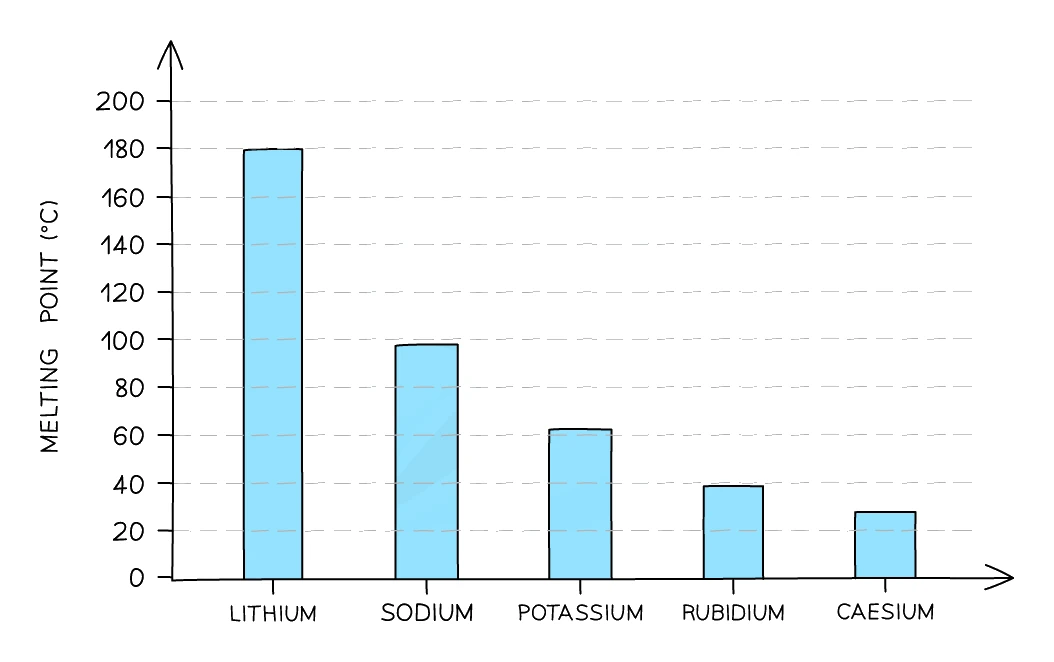
Predicting properties of rubidium, caesium and francium
- Reactivity continues to increase, so the heavier alkali metals react with water explosively
- Rubidium should be a soft, silvery metal that is denser than potassium and melts below 63 °C
- Caesium is even softer, denser and lower-melting than rubidium
- Francium is radioactive and short-lived, but is predicted to be the most reactive Group 1 metal of all
Observations when an alkali metal reacts with water
What comes up: you are told one or two observations and asked to give two more (2 marks each, any two from the list accepted).
Write (two marks): pick two from this list that are not already given in the question: (1) the metal moves across the surface / darts about; (2) effervescence / fizzing / bubbles are seen; (3) the metal melts and forms a small ball or sphere; (4) the metal gets smaller / disappears. For potassium specifically: a lilac (or purple) flame is seen above the surface — this is credited as a distinctive observation not seen with lithium or sodium.
Watch out: writing "a flame is seen" for sodium is ignored by the mark scheme — the examiner only credits the lilac flame for potassium. Similarly, writing "hydrogen gas is produced" instead of a visual observation is not credited for the observation marks (the equation has already told you the products). For lithium questions, "melts / forms a ball / flame" is ignored — only effervescence, the metal moving, and the metal getting smaller are credited.