Group 7: The Halogens
Inorganic Chemistry
The Group 7 Halogens
What the halogens are
- Group 7 contains the halogens: fluorine, chlorine, bromine, iodine and astatine
- They are reactive non-metals, all toxic, and many are coloured
- Each halogen atom has seven electrons in its outermost shell, which gives the group its family resemblance
- Halogens exist as diatomic molecules (F2, Cl2, Br2, I2) — a pair of atoms held together by one single covalent bond, sharing a pair of electrons
Physical state and appearance at room temperature
| Halogen | State at room temperature | Colour | Note |
|---|---|---|---|
| Fluorine, F2 | Gas | Pale yellow | Most reactive of all elements |
| Chlorine, Cl2 | Gas | Pale yellow-green | Dense, pungent |
| Bromine, Br2 | Liquid | Red-brown | Volatile; gives orange-brown vapour |
| Iodine, I2 | Solid | Dark grey, shiny crystals | Sublimes on warming to a violet vapour |
- The colour deepens as you go down the group (pale yellow → yellow-green → red-brown → dark grey/violet)
State and colour of a halogen at room temperature
Question: Which halogen is a liquid, or a solid, at room temperature; what colour is solid iodine; which halogen is palest; or complete a table of the halogens' states and colours (1–2 marks).
Asked in 6 of the 23 papers: as multiple choice, a table to complete, or a one-line request for the element that is liquid at room temperature (mercury is accepted there as well as bromine). Learn the set as one pattern that darkens down the group: fluorine is a pale yellow gas and the palest halogen (pale green is also credited), chlorine a green gas, bromine the only liquid and red-brown, iodine a grey solid, and astatine, below iodine, a solid as well. The fact asked most often is that bromine is the liquid. Iodine's colour comes next, and the wrong options offered for it were brown, black and purple: purple is the colour of its vapour, not of the solid. When iodine is not among the options for the solid halogen, choose astatine.
Trend in melting and boiling points
- Both the melting point and the boiling point increase steadily down the group
- F2 boils at −188 °C, Cl2 at −34 °C, Br2 at 59 °C, I2 at 184 °C
- The halogens are simple molecular structures, so it is the intermolecular forces between molecules that are overcome on melting or boiling — not the strong covalent bond inside each molecule
- As the molecules get larger going down the group, the intermolecular forces become stronger and more energy is needed to overcome them — so the melting and boiling points rise
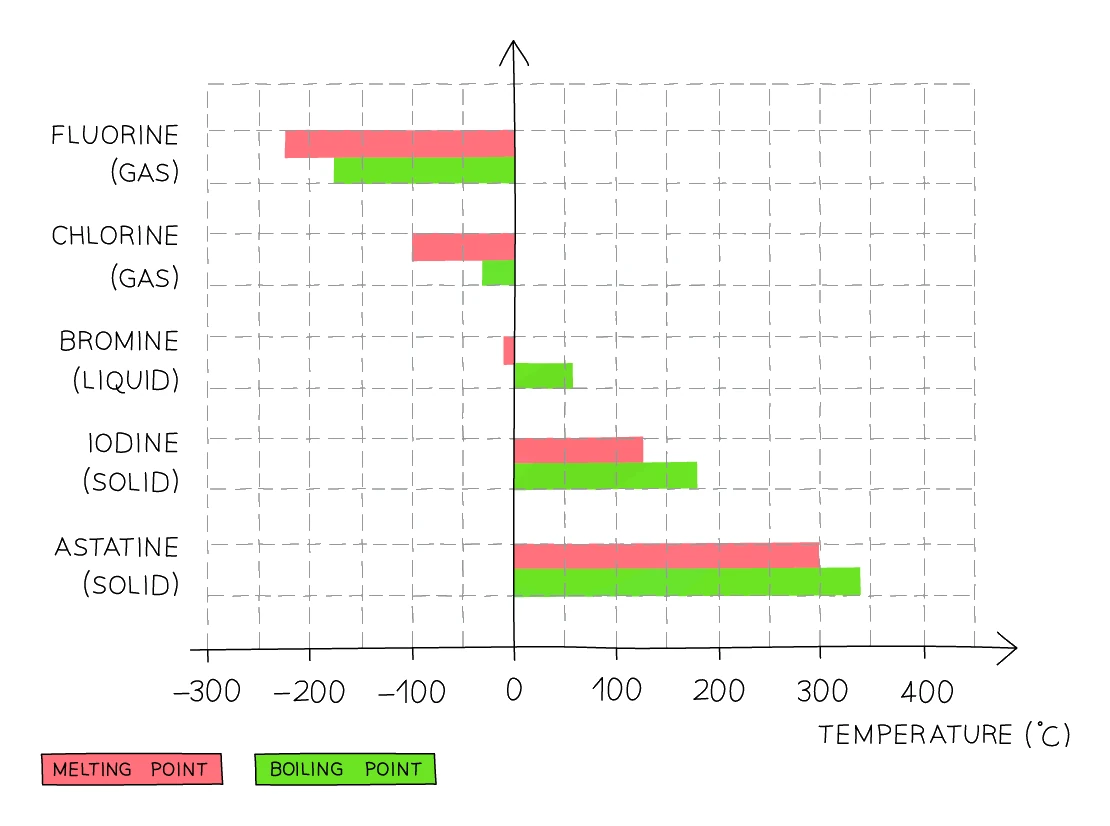
Explaining the trend in boiling points down Group 7
Question: Use a table of boiling points to explain the trend down the group, or choose why a halogen boils at a higher temperature than other gases (1–3 marks).
Set in 2 of the 23 papers, once as a 3-mark explanation and once as multiple choice. The credited chain has four links, of which three are needed: the boiling points increase down the group; because the forces between the molecules get stronger; as the molecules get bigger, with more mass, more electrons and more shells; so more energy is needed to pull the molecules apart. Mention breaking covalent or ionic bonds anywhere and every mark after the first is lost, because the bond inside each molecule stays intact when a halogen boils. In the multiple-choice version the right option is the strongest attraction between molecules; "covalent bonds between molecules" and "covalent bonds between atoms" are both wrong.