Group 1: The Alkali Metals
Inorganic Chemistry · 1 question type
Each alkali metal has one outer electron
- Lithium (proton number 3): 2, 1
- Sodium (proton number 11): 2, 8, 1
- Potassium (proton number 19): 2, 8, 8, 1
- The lone outer electron is the only thing the atom needs to lose in order to react
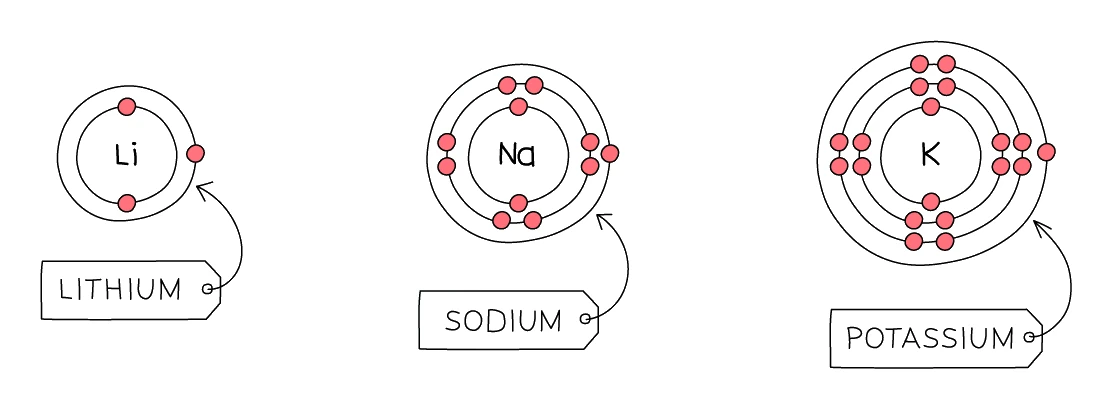
Why the alkali metals react in a similar way
Question: State, with reference to electronic configurations, why lithium, sodium and potassium have similar reactions with water (1 mark).
Set in 2 of the 23 papers. The mark is for the outer electron count: each atom has one electron in its outer shell, so they all have the same number of outer-shell (valence) electrons. That is the whole answer. The question says "electronic configurations", so being metals, or sitting in the same group, is not what it is asking for, and neither is a description of the reaction.
Forming 1+ ions
- When a Group 1 atom reacts, it loses its single outer electron to form a 1+ ion (Li+, Na+, K+, Rb+, Cs+)
- The shell below becomes the new outermost shell — it is already full, so the ion has the noble gas configuration of the previous group 0 element
Why reactivity increases down the group
- Going from lithium down to caesium, one extra electron shell is added at each step
- The outer electron therefore sits further from the nucleus
- The attraction between the outer electron and the positive nucleus is weaker (more distance, and inner shells partly shield the nuclear charge)
- Less energy is needed to remove the outer electron, so the atom loses it more easily
- An atom that loses its outer electron more readily reacts more readily — so the metals get more reactive as you descend the group
Explaining why reactivity increases down Group 1
Question: Explain why potassium is more reactive than lithium, or why lithium is less reactive than sodium, referring to atomic structure (3 marks).
Asked in 4 of the 23 papers, always on Paper 2. Three linked steps earn the marks. A potassium atom is larger, with more shells, so its outer electron is further from the nucleus (or write out both configurations); that outer electron is therefore less strongly attracted to the nucleus; so it is lost more easily and the metal is more reactive. The reverse argument for lithium scores the same.
Name the outer electron (or outer-shell electron) at every step: one recent scheme docks a mark if it is never named and another for writing "electrons" in the plural. Shielding by inner shells is accepted wording for a step, not a substitute for the others, and "lithium has fewer outer shells" is rejected because every atom has one outer shell.