Group 7: The Halogens
Inorganic Chemistry
Halogens with metals: metal halides
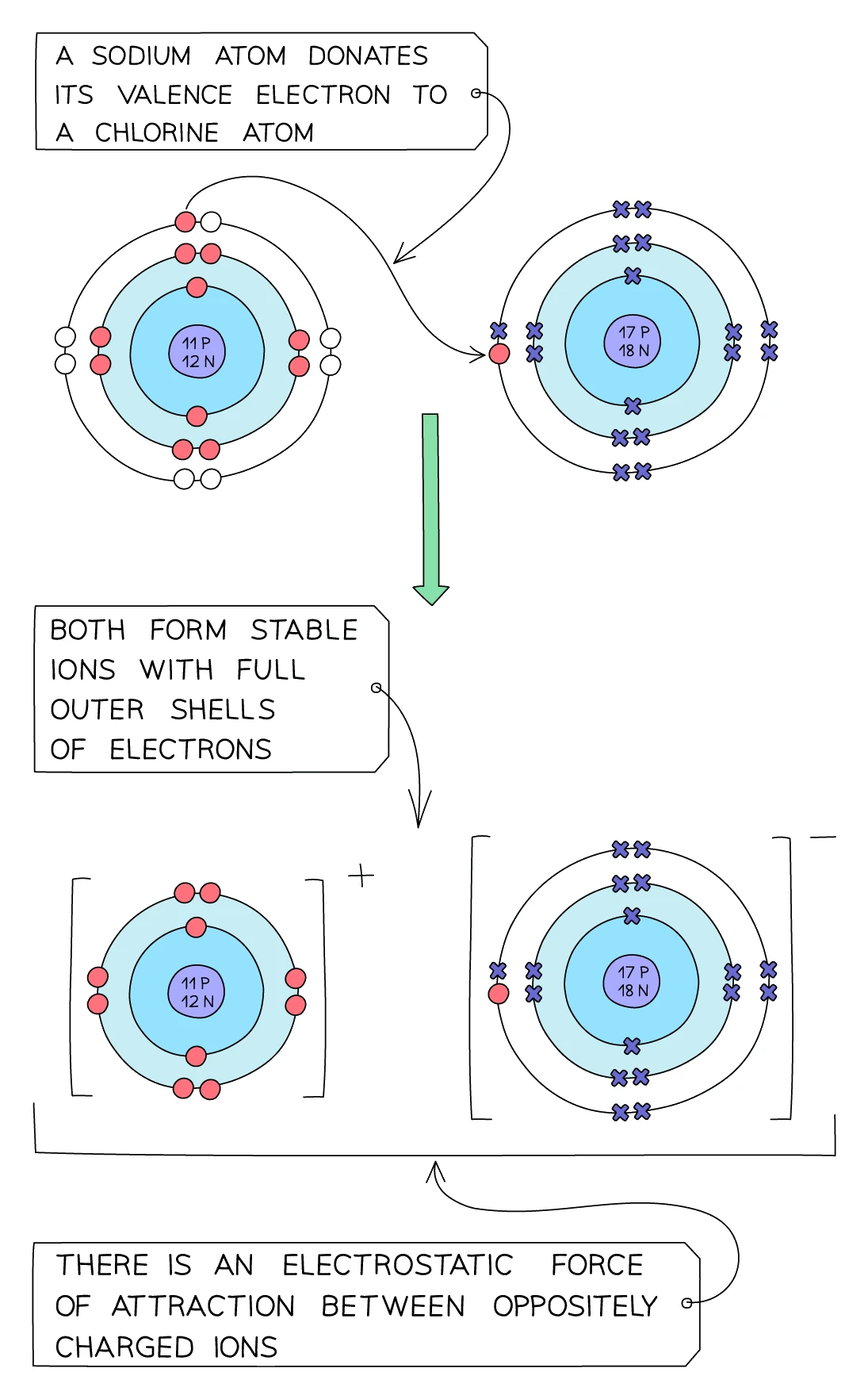
- Halogens react with many metals to form ionic metal halide salts
- Each halogen atom gains one electron to form a with a 1− charge (F−, Cl−, Br−, I−)
- The formula of the metal halide depends on the charge on the metal ion:
- Group 1 metals form M+ ions, giving compounds like NaCl
- 2 Na(s) + Cl2(g) → 2 NaCl(s)
- Group 2 metals form M2+ ions, giving compounds like CaBr2
- Ca(s) + Br2(l) → CaBr2(s)
- Iron forms FeX3 with chlorine and bromine
- 2 Fe(s) + 3 Cl2(g) → 2 FeCl3(s)
- Group 1 metals form M+ ions, giving compounds like NaCl
- Reactivity falls down the group, so the same metal reacts more slowly with bromine or iodine than with chlorine
Halogens with non-metals: hydrogen halides
- With non-metal partners, the halogens form simple molecular covalent compounds
- With hydrogen, every halogen gives a hydrogen halide:
- H2(g) + F2(g) → 2 HF(g) (very vigorous, even in the dark and cold)
- H2(g) + Cl2(g) → 2 HCl(g) (needs UV light or heat)
- H2(g) + Br2(g) → 2 HBr(g) (slower, needs heat)
- H2(g) + I2(g) → 2 HI(g) (slow, partial reaction)
- The vigour of the reaction falls down the group — the same pattern as for the metals
Displacement reactions of the halogens
- A displacement reaction happens when a more reactive halogen pushes a less reactive halogen out of an aqueous solution of its halide salt
- The reactivity order in Group 7 is: chlorine > bromine > iodine
- Chlorine in water (pale green) displaces both bromine and iodine:
- Cl2(aq) + 2 KBr(aq) → 2 KCl(aq) + Br2(aq) — solution turns orange
- Cl2(aq) + 2 KI(aq) → 2 KCl(aq) + I2(aq) — solution turns brown
- Bromine in water (orange) displaces iodine:
- Br2(aq) + 2 KI(aq) → 2 KBr(aq) + I2(aq) — solution turns brown
- Iodine cannot displace either chlorine or bromine because it is the least reactive
- These reactions are sometimes called single replacement reactions
Displacement reactions: predict, observe, conclude
What comes up: you are given two halide solutions and asked to explain how mixing them demonstrates the reactivity order — including the observation for each pair.
Write (four marks): (1) mix the two solutions; (2) state the observation — for bromine added to potassium iodide the solution turns brown (iodine is produced), for bromine added to potassium chloride there is no reaction/no colour change; (3) bromine displaces iodine because iodine is a less reactive halogen; (4) conclude the overall reactivity order from the results.
Watch out: the mark scheme penalises (deducts a mark) for confusing the "-ine" and "-ide" endings — for example, writing "chloride displaces bromide" instead of "chlorine displaces bromide ions". Also, the mark scheme accepts "orange" as the colour of the displaced bromine, but the credited colour for the displaced iodine (in solution) is brown, not "purple" or "black".
| Add → | Cl2(aq) | Br2(aq) | I2(aq) |
|---|---|---|---|
| KCl(aq) | — | No reaction | No reaction |
| KBr(aq) | Solution turns orange (Br2 formed) | — | No reaction |
| KI(aq) | Solution turns brown (I2 formed) | Solution turns brown (I2 formed) | — |
Test for chlorine gas
What comes up: "Describe a test for chlorine gas" (2 marks).
Write (two marks): (1) hold a piece of damp blue litmus paper in the gas; (2) the litmus paper is bleached and turns white.
Watch out: the mark scheme accepts "damp blue litmus paper turns red and then bleaches" for M1 only (the bleaching must still appear as a separate point for M2). Writing just "turns red" without the bleaching scores M1 only and misses M2. The mark scheme ignores whether you test the gas or the solution — test the gas with the paper, not the liquid.