Gases in the Atmosphere
Inorganic Chemistry · 1 question type
What thermal decomposition is
- Thermal decomposition is a reaction in which a single compound breaks down into two or more simpler products when heated
- Metal carbonates from the lower half of the reactivity series break down readily on heating to give the metal oxide plus carbon dioxide
- General equation:
metal carbonate → metal oxide + carbon dioxide
- The carbon dioxide given off can be confirmed by bubbling it through limewater (calcium hydroxide solution), which turns milky/cloudy
Other examples
- ZnCO3(s) → ZnO(s) + CO2(g) (the white solid turns yellow when hot and back to white once cool)
- CaCO3(s) → CaO(s) + CO2(g) (the same reaction used industrially to make lime from limestone)
- Group 1 carbonates (Na2CO3, K2CO3) do not decompose at Bunsen-burner temperatures because their carbonates are very stable
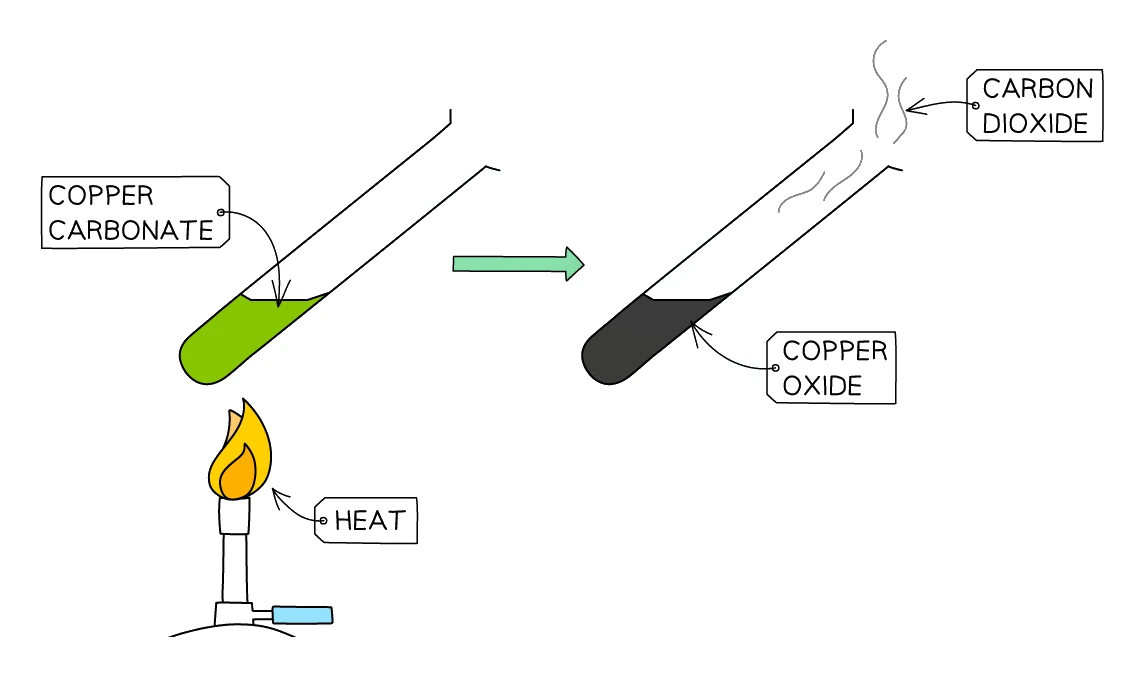
Thermal decomposition of copper(II) carbonate
Question: Name the type of reaction when copper(II) carbonate is heated, give the colour change, and give the chemical equation (1–2 marks per part).
Set in 3 of the 23 papers, twice as multiple choice. The reaction is thermal decomposition, the solid turns from green to black, and the equation is CuCO₃ → CuO + CO₂ (state symbols are not needed). When the colour change is worth two marks, one is for green and one for black, in that order. Copper(II) carbonate is green, not blue, and copper(II) oxide is black, not orange or white: the multiple-choice options offer both errors.
A fourth paper asked what the term thermal decomposition means: give both halves, a compound breaks down, by heating. "Elements" instead of a compound loses the first mark, and saying heat is given out loses the second. It also asked why a white, soluble solid cannot be copper(II) carbonate: green and insoluble.