Gases in the Atmosphere
Inorganic Chemistry
Principle
- A reactive material is sealed inside a fixed volume of air and allowed to combine with the oxygen in that air
- The reacted oxygen leaves the gas phase, so the trapped gas volume shrinks
- The change in volume, divided by the starting volume, gives the percentage of oxygen
Method: iron in a burette
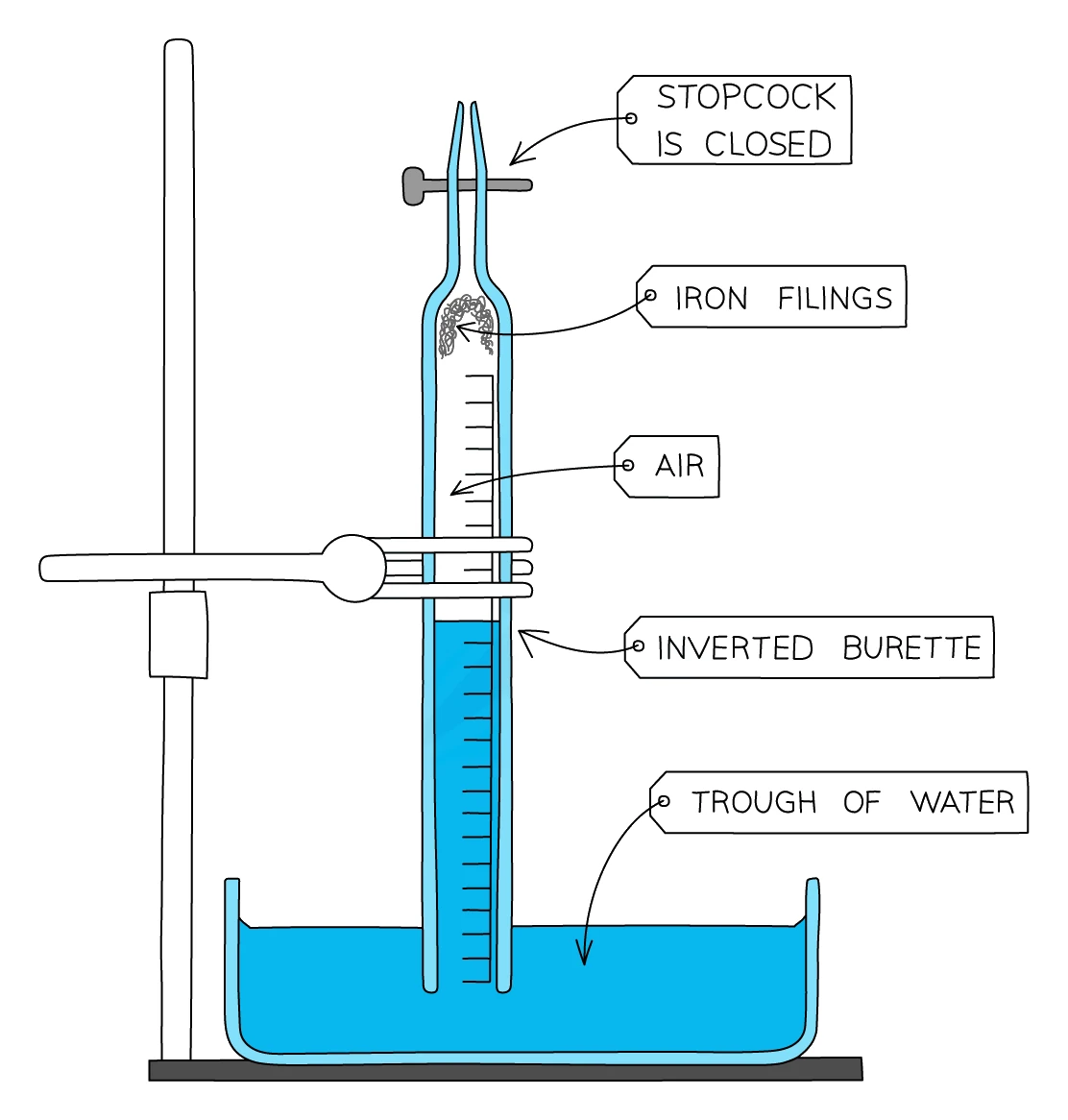
- Push damp iron wool into the closed end (the tap end) of an inverted burette, so the iron has plenty of contact with water and air
- Stand the burette mouth-down in a trough of water, with the tap closed at the top
- Read the water level inside the burette against the scale and write it down as the initial reading
- Leave the apparatus for several days while the iron slowly rusts, using up oxygen from the trapped air
- Once the water level stops rising, take a second reading against the same scale
Common exam question
Explaining the steps of the oxygen-in-air experiment
Question: Give a reason for a step, or state an observation, in an experiment to find the percentage of oxygen in air (1–2 marks per part).
Set in 6 of the 23 papers, with damp iron, hot copper between two syringes, or magnesium under a bell jar:
- Iron must be wet because rusting needs water; it turns brown as hydrated iron(III) oxide forms (write Fe₂O₃ when the formula is asked for; "iron oxide" alone is ignored). Powder rusts faster than lumps: larger surface area.
- Copper is heated because it does not react when cold, and turns black as copper(II) oxide forms (copper(I) oxide is rejected). Argon or neon is unreactive because its outer shell is full.
- Cool the gas before reading its volume, since gas volume changes with temperature; the readings stop changing once all the oxygen has reacted.
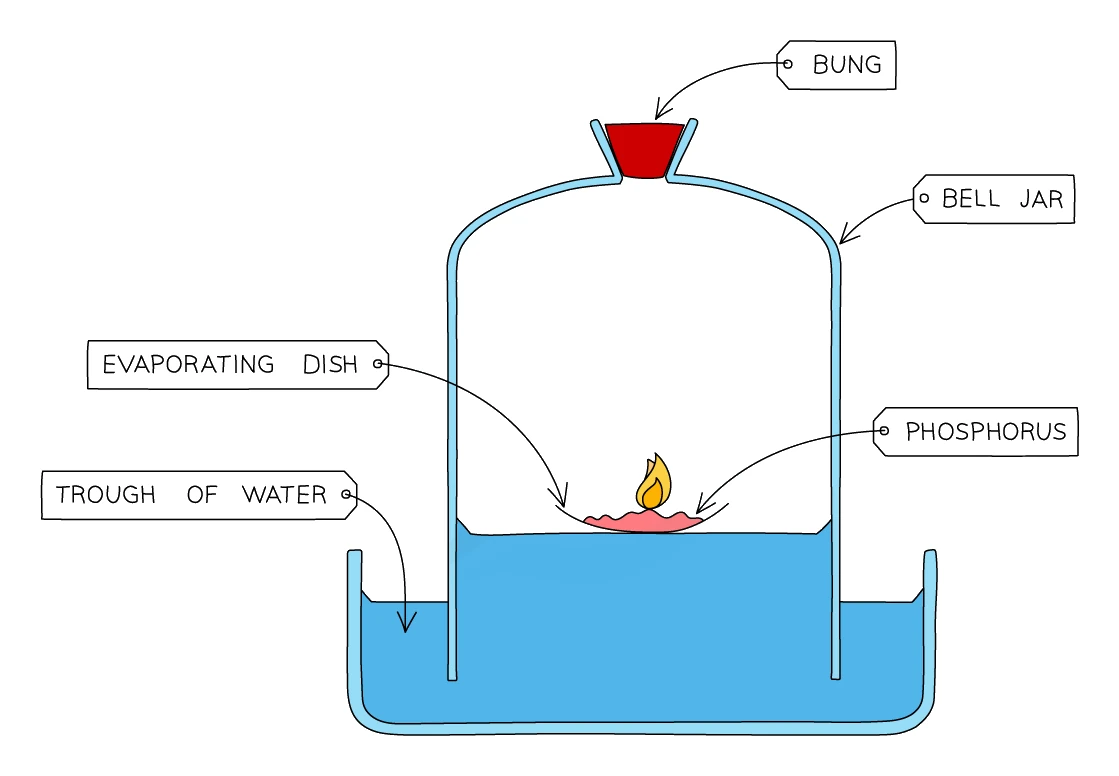
- Under the bell jar the water rises because the oxygen is used up, so the gas volume (or pressure) falls and water takes its place.
Sample calculation (worked through)
- Suppose the trapped air column measured 45.0 cm3 at the start, and 36.0 cm3 once rusting had stopped
- The volume of oxygen used up = 45.0 − 36.0 = 9.0 cm3
- Percentage of O2 in the original air = (9.0 ÷ 45.0) × 100 = 20.0%
- This is close to the accepted value near 21%; the small shortfall is because rusting is slow and some oxygen may remain unreacted
Common exam question
Calculating the percentage of oxygen from the volume change
Question: Use the starting and final volumes, or lengths of the gas column, to calculate the percentage of oxygen in the air (2–4 marks).
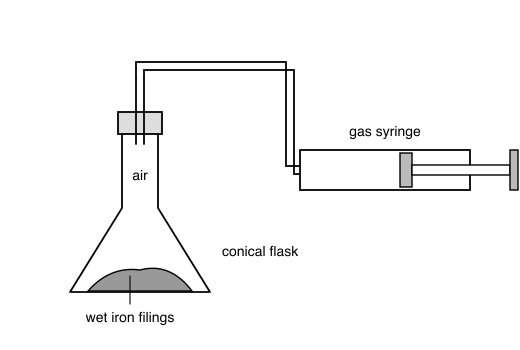
Set in 7 of the 23 papers. One mark is for the volume of oxygen used (start minus end) and the next for dividing it by the total starting volume and multiplying by 100. With a flask joined to a gas syringe, the total is flask plus syringe; dividing by the flask alone loses a mark. A correct answer scores full marks without working, except in a "show that" question, where the working must be written out.
Giving the percentage of gas left over instead of the oxygen earns only the first mark. Round correctly: a scheme rejects 17.8 or 17.85 where the value is 17.86. One paper reversed it, asking for the gas left from a known volume of air: 79% of the start (80% allowed); the oxygen volume alone scores 2 of 3.
Worked example
Percentage of oxygen with a flask and a gas syringe
The diagram shows the apparatus a student uses to measure how much of the air is oxygen. The flask and its connecting tube hold 240 cm³ of air, and the syringe reads 80 cm³ at the start. After a week the syringe reads 14 cm³ and stops changing. Work out the percentage of oxygen, by volume, in this sample of air, to three significant figures.
Solution:
- Volume of oxygen used = fall in the syringe reading = 80 − 14 = 66 cm³ (the flask's volume does not change)
- Total volume of air at the start = flask + syringe = 240 + 80 = 320 cm³
- Percentage of oxygen = 66 ÷ 320 × 100 = 20.625% = 20.6%
Common exam question
Why the measured percentage of oxygen is not 21%
Question: Give a reason why the percentage of oxygen calculated from the results is less than 21%, or may not be accurate (1 mark).
Set in 2 of the 23 papers, and the credited reason depends on the method. With damp iron left in a tube for a week, the answer is that not all the oxygen reacted: too little iron, or the reaction was incomplete or too slow. Water vapour in the gas column, or a change in temperature or pressure, is also allowed.
With hot copper and two syringes, where the gas is passed back and forth until the reading stops falling, "not all the oxygen reacted" is ignored. Give instead a leak in the apparatus, a temperature that differed between readings, or the gas not being cooled to room temperature before its volume was read.
Alternative material: burning phosphorus
- Phosphorus burns readily in a sealed bell jar over water, consuming oxygen quickly rather than over days
- The water rises into the jar as the trapped gas contracts, by the same volume principle
- Phosphorus is toxic, so the iron-wool method is normally preferred for school work