Acids, Alkalis and Titrations
Inorganic Chemistry
What a titration is and what it tells you
- A titration is a quantitative procedure used to find how much of one solution exactly reacts with a measured volume of another
- For acid–alkali titrations, the question usually asked is: what volume of acid (of known concentration) neutralises a fixed volume of alkali (of unknown or known concentration)?
- From the titration result you can work out the moles that reacted, the concentration of the unknown solution, or the volume of acid needed in a salt preparation
Method (acid in burette, alkali in flask)
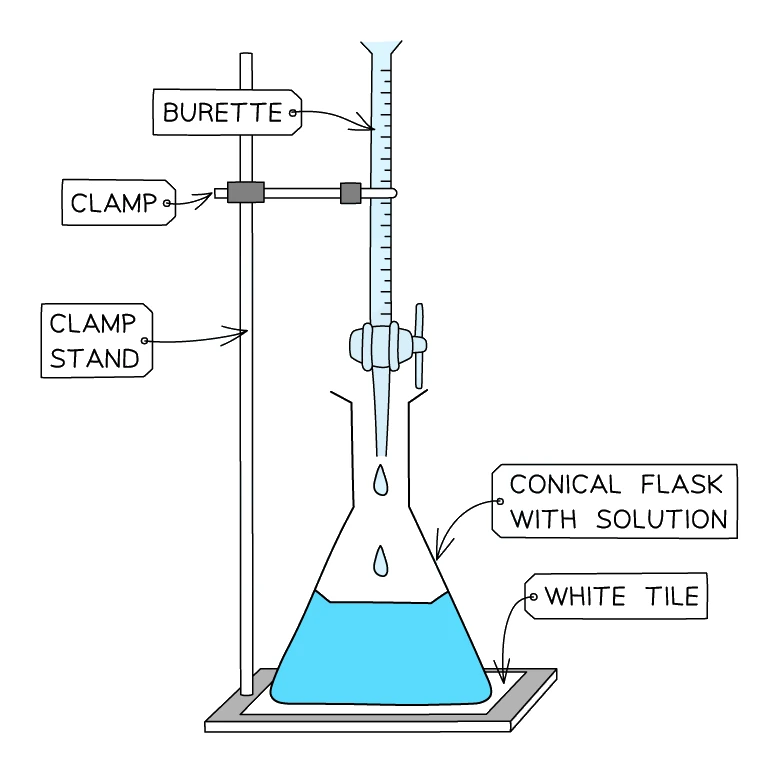
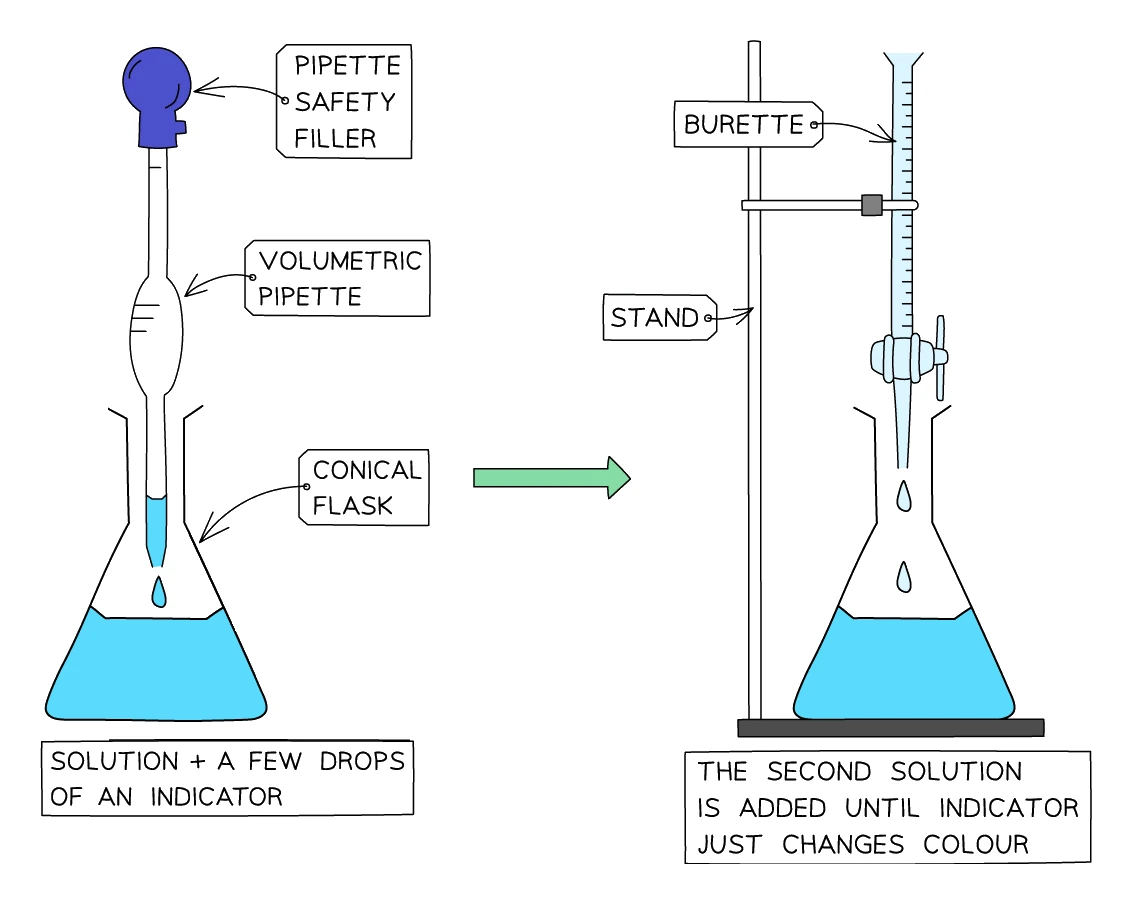
- Pipette a fixed, known volume (e.g. 25.0 cm3) of the alkali into a clean conical flask, using a pipette and pipette filler
- Add 2–3 drops of a suitable indicator (phenolphthalein or methyl orange) to the alkali
- Fill the with the acid; record the initial reading by lining up the bottom of the meniscus with the scale, reading to the nearest 0.05 cm3
- Position the conical flask directly under the burette tip, sitting it on a white tile so any colour change shows up clearly against the pale background
- Do one rough run first — open the tap and let the acid run in steadily, swirling the flask, and close the tap as soon as the indicator changes colour. Record the rough titre
- For each accurate run, deliver the acid quickly to about 1 cm3 short of the rough titre, then add it drop by drop with swirling between each addition, stopping the moment the indicator flips colour
- Record the final reading to the nearest 0.05 cm3; the titre is the final reading minus the initial reading
- Repeat until two titres agree to within 0.1 cm3 — these are concordant results — and take their mean as the answer
Sample results
| Run | Initial reading / cm³ | Final reading / cm³ | Titre / cm³ |
|---|---|---|---|
| Rough | 0.00 | 22.80 | 22.80 |
| 1 | 0.00 | 22.10 | 22.10 |
| 2 | 0.00 | 22.15 | 22.15 |
| 3 | 22.15 | 44.30 | 22.15 |
- Runs 1, 2 and 3 are within 0.1 cm3 of each other and are taken as concordant
- Mean titre = (22.10 + 22.15 + 22.15) ÷ 3 = 22.13 cm3
- The rough run is excluded from the mean — it is used only to find the end-point quickly so that the careful runs can be timed
Common reasons accurate runs miss
- Filling the burette while a funnel is still in place — drops from the funnel after the start give a false initial reading
- Air bubble trapped in the burette's jet below the tap — the bubble dislodges during the run and the volume reading is off
- Reading the meniscus from above or below eye level — parallax error of up to 0.1 cm3
- Adding the acid too fast near the end-point — the indicator flips colour past the equivalence point and the titre is too large
Describing how to carry out an accurate titration
What comes up: the exam asks you to describe or evaluate key steps in an accurate titration. Questions ask which piece of apparatus measures the alkali (pipette) or the acid (burette), and how to make the runs accurate and repeatable.
Write: include as many of these credited steps as the mark allocation requires: (1) rinse the burette with the solution it will contain before filling it; (2) fill the burette and check the jet contains liquid with no air bubble; (3) add a few drops of indicator to the conical flask (any named indicator except universal indicator is accepted); (4) add the solution from the burette slowly, swirling the flask, then dropwise close to the end-point; (5) stop when the indicator colour changes permanently; (6) record the initial and final burette readings and calculate the titre by subtracting; (7) repeat until concordant results are obtained (titres within 0.1 cm³ of each other). When asked about rinsing the conical flask between runs, rinse only with distilled or deionised water, never with the solution itself.
Watch out: the mark scheme rejects rinsing the conical flask with the solution (this would change the number of moles present). Adding indicator name and colour as part of the "end-point" step does not earn a mark for that step — the mark is for reaching the end-point by dropwise addition, so keep those as separate points. A measuring cylinder is rejected as a substitute for a pipette.
Identifying the pipette and the burette
What comes up: the exam shows a diagram labelling two pieces of apparatus (e.g. X = pipette, Y = burette) and asks you to identify each, or asks why the pipette is preferred over a measuring cylinder for delivering the known volume.
Write (two marks): (1) the pipette delivers the fixed known volume of one solution to the conical flask; (2) the burette holds the solution being added and allows the volume to be read to 0.05 cm³ — giving a more precise measurement than a measuring cylinder.
Watch out: a dropping pipette (Pasteur pipette) is rejected in place of a volumetric pipette. The key word for the pipette's advantage is that the volume is more precise (or more accurate/exact), not merely "easier to use".