4CH1
Acids, Alkalis and Titrations
Inorganic Chemistry
What makes a solution acidic or alkaline
- An acid is a substance that releases hydrogen ions, H+, into aqueous solution
- Hydrochloric acid: HCl(aq) → H+(aq) + Cl−(aq)
- Sulfuric acid: H2SO4(aq) → 2 H+(aq) + SO42−(aq)
- Nitric acid: HNO3(aq) → H+(aq) + NO3−(aq)
- An alkali is a soluble base that releases hydroxide ions, OH−, into aqueous solution
- Sodium hydroxide: NaOH(aq) → Na+(aq) + OH−(aq)
- Potassium hydroxide: KOH(aq) → K+(aq) + OH−(aq)
- Aqueous ammonia: NH3(aq) + H2O(l) ⇌ NH4+(aq) + OH−(aq)
Neutralisation
- A reaction is the reaction between an acid and a base (or an alkali) that produces a and water
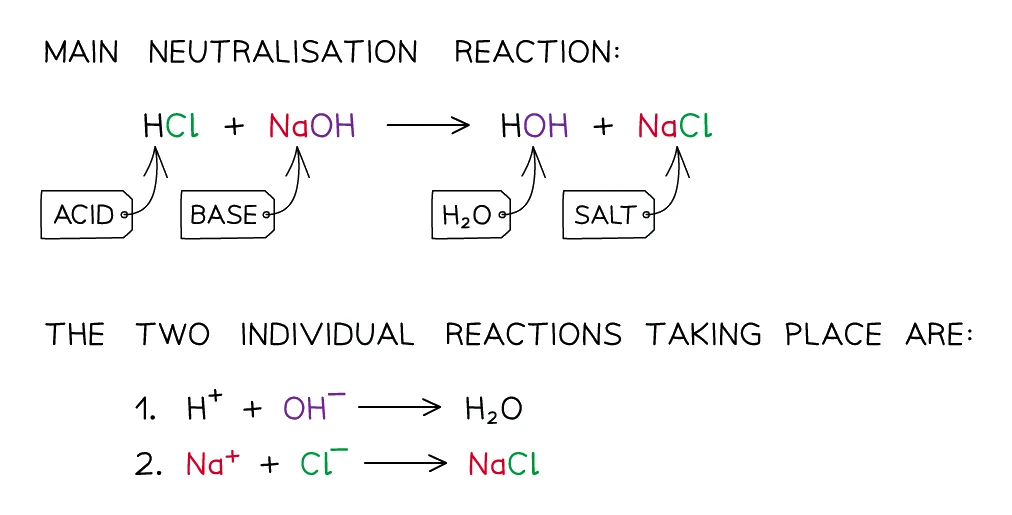
- For an alkali, the central chemistry is that H+ ions from the acid combine with OH− ions from the alkali to form water:
H+(aq) + OH−(aq) → H2O(l)
- This is the net ionic equation for every acid–alkali neutralisation; the spectator ions (e.g. Na+ and Cl−) move from reactants to products unchanged
- Example: hydrochloric acid neutralised by sodium hydroxide
- Full equation: HCl(aq) + NaOH(aq) → NaCl(aq) + H2O(l)
- Net ionic equation: as above
- Example: sulfuric acid neutralised by potassium hydroxide
- H2SO4(aq) + 2 KOH(aq) → K2SO4(aq) + 2 H2O(l)
Not every acid reaction is a neutralisation
- A metal reacting with an acid gives a salt and hydrogen gas, not water, so it does not count as a neutralisation (see topic 13 section 1)
- Neutralisation specifically requires that water be produced alongside the salt — so it is the acid + base / alkali / metal carbonate type reactions that qualify
A practical use: treating acidic soil
- Many crops grow poorly when the soil pH drops below 7
- Farmers spread bases such as crushed limestone (calcium carbonate) or quicklime (calcium oxide) on acidic soil
- These bases neutralise the soil acidity and raise the pH back into the range crops tolerate