Acids, Alkalis and Titrations
Inorganic Chemistry
What an indicator is
- An indicator is a substance that changes colour to show whether a solution is acidic, neutral or alkaline
- A two-colour shows one colour in acid and a different colour in alkali — its colour flips sharply at the of an acid–alkali reaction
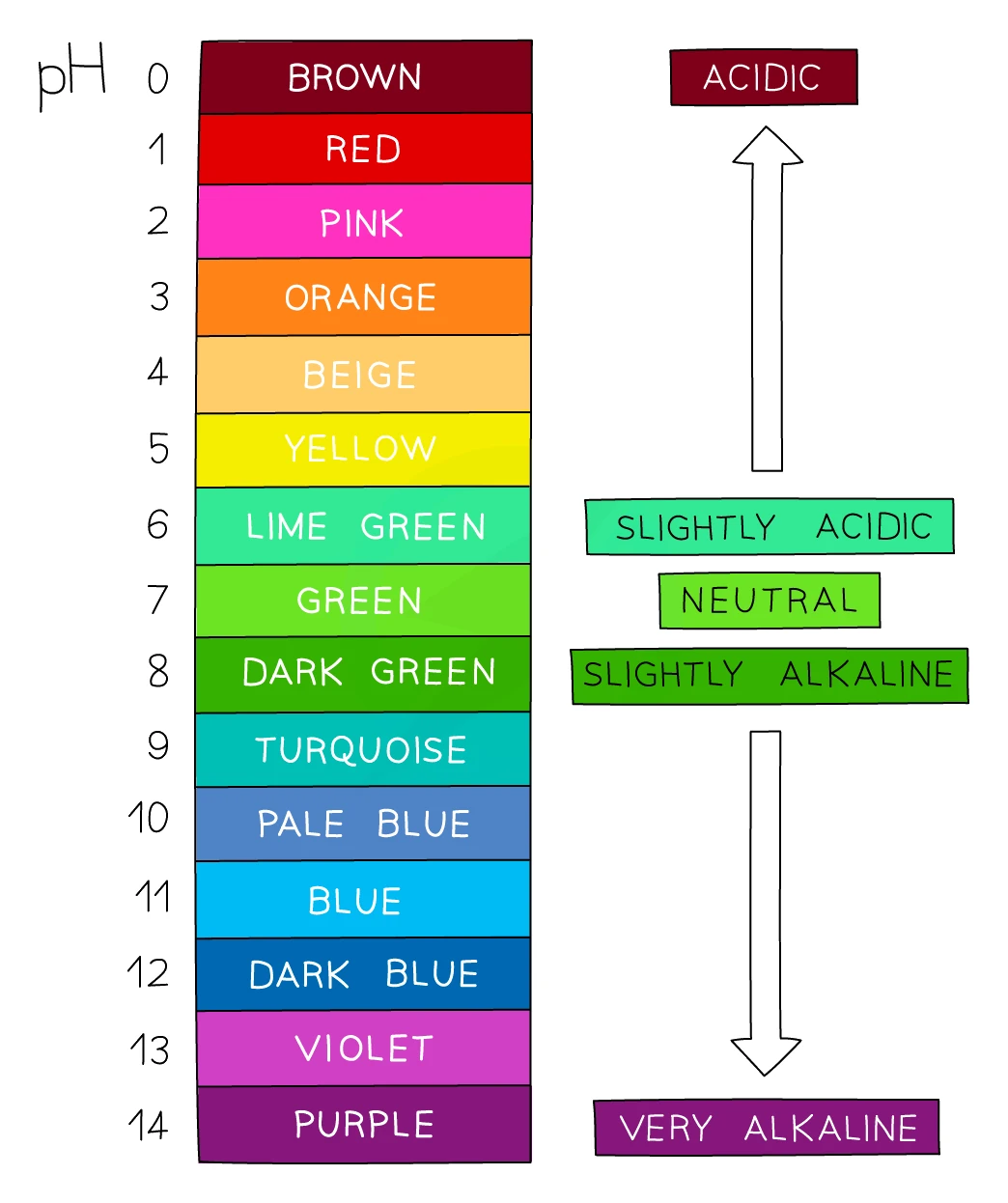
- A universal indicator is a mixture of several indicators that goes through a continuous range of colours, giving a rough numerical pH rather than a single switch
Common two-colour indicators
- Phenolphthalein — stays colourless in acid; flips to a clear pink in alkali
- Methyl orange — looks red while the solution is acidic; turns yellow once the solution becomes alkaline
- Litmus — red in acid, blue in alkali; supplied either as a solution or as red and blue paper strips for testing drops of liquid or moist gases
- Phenolphthalein and methyl orange give sharp colour changes and are the indicators used in (see section 3)
- Litmus solution is not used in titrations because its colour change passes through a fuzzy purple band rather than a single clean transition
The pH number line
- The pH scale is a number scale that runs from 0 (most acidic) to 14 (most alkaline)
- pH = 7 is (pure water at room temperature)
- The scale measures the concentration of H+ ions in solution; the more H+ ions, the lower the pH
- Rough guide:
| pH range | What it describes | Examples |
|---|---|---|
| 0–3 | Strong acid | Hydrochloric, sulfuric and nitric acid in the lab; stomach acid |
| 4–6 | Weak acid | Lemon juice, vinegar, rainwater |
| 7 | Neutral | Pure water, sodium chloride solution |
| 8–10 | Weak alkali | Sodium hydrogencarbonate solution, soap |
| 11–14 | Strong alkali | Sodium hydroxide, potassium hydroxide, oven cleaner |
Using universal indicator
- A few drops of universal indicator are added to the solution under test
- The resulting colour is matched against a printed chart that maps each colour band to a pH value
- Universal indicator gives only an estimate; the exact colours vary between brands, so the supplied chart must be used
- Because the change is gradual, universal indicator is not suitable for titrations — the end-point would be impossible to pin down
Naming an indicator and stating its colour in alkali
What comes up: the exam asks you to name a suitable two-colour indicator and state the colour it turns in an alkaline solution.
Write (two marks): (1) name one of: litmus (solution), methyl orange, or phenolphthalein; (2) give the matching colour in alkali — litmus turns blue (purple accepted), methyl orange turns yellow (orange accepted), phenolphthalein turns pink.
Watch out: litmus paper is rejected — only litmus solution is accepted. Universal indicator is also rejected. Writing the name alone without the colour scores only one mark; both parts are required.
Why universal indicator cannot be used in a titration
What comes up: the exam asks why universal indicator is not suitable for a titration, or why a named two-colour indicator must be used instead.
Write (two marks): (1) universal indicator does not give a sharp (clear) colour change; (2) it changes colour gradually across a range of pH values, so the end-point cannot be identified precisely.
Watch out: saying only that "the colour change is gradual" without linking it to the inability to find the end-point often scores just one mark — both points need to be present.