Extraction and Uses of Metals
Inorganic Chemistry
What an alloy is
- An alloy is a mixture of a metal with one or more other elements, usually another metal or a non-metal such as carbon
- Examples already encountered:
- Steel: iron + carbon (see section 3)
- Brass: about 70% copper + 30% zinc — used for fittings, decorative work and musical instruments
- Bronze: copper + tin — used for statues, bells and bearings
Why alloys are harder than the pure metal
- Pure metals deform easily because layers of identical-size atoms slide cleanly over one another (this was the malleability argument in topic 08)
- In an alloy, the added element has atoms of a different size, which disrupts the regular layered packing
- The disrupted layers can no longer slide smoothly, so the alloy is harder and more rigid
- Many alloys are also chosen because they resist corrosion (stainless steel, bronze) or tolerate higher temperatures (nichrome heating elements)
- The detailed structural picture sits in topic 08 Metallic Bonding, section 3
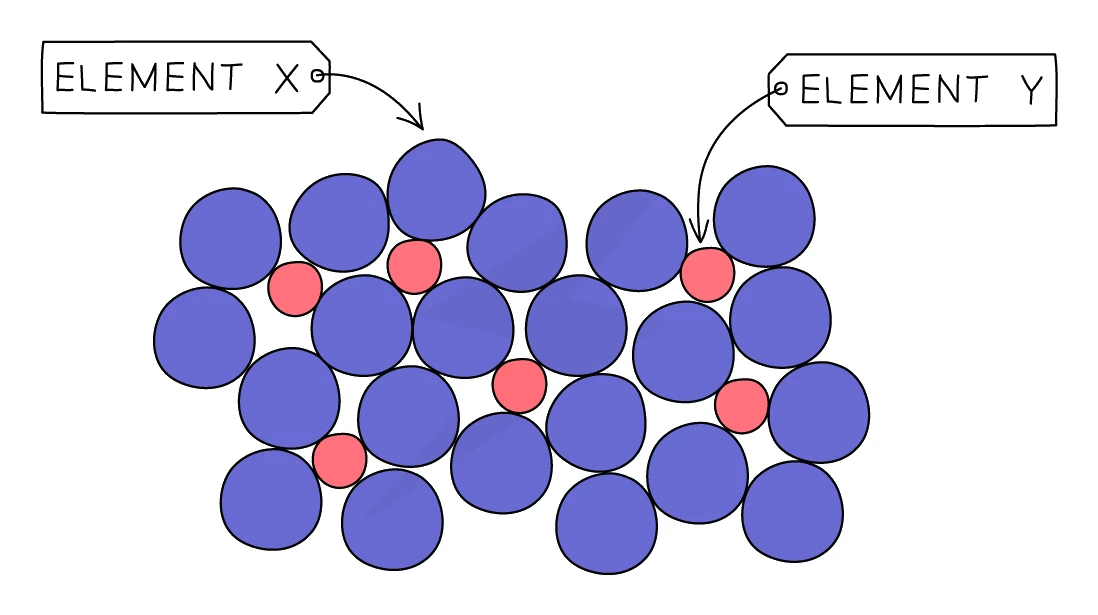
Explain why an alloy is harder (less malleable) than the pure metal
What comes up: a 2–3-mark question asking you to use a diagram of particle arrangement to explain why an alloy is harder or less malleable than the pure metal.
Write (three marks): (1) in the pure metal, layers of atoms slide over one another easily; (2) in the alloy, atoms of a different size disrupt the regular arrangement; (3) this disruption prevents the layers from sliding, making the alloy harder.
Watch out: the mark scheme deducts a mark if you never mention layers/rows/sheets of atoms — you must use that language. It also rejects "molecules", "intermolecular forces", "ionic bonds", or "covalent bonds" as the reason layers cannot slide; stick to atoms/cations and their arrangement. Saying the metallic bonds are stronger is explicitly ignored.