Extraction and Uses of Metals
Inorganic Chemistry
Choosing an extraction method from the reactivity series
- Metals above carbon in the reactivity series (K, Na, Li, Ca, Mg, Al) are too reactive to be reduced by carbon
- They must be extracted by electrolysis of their molten compound
- Metals below carbon but above the unreactive group (Zn, Fe, Sn, Pb, Cu) can be reduced by heating their oxide with carbon (or carbon monoxide)
- Metals below hydrogen (Cu, Ag, Au) are unreactive and the least reactive of these are simply mined as the free element
| Metal | Position relative to carbon | Extraction method |
|---|---|---|
| K, Na, Ca, Mg, Al | Above carbon | Electrolysis of the molten compound |
| Zn, Fe, Sn, Pb | Below carbon | Reduction by heating with carbon or carbon monoxide |
| Cu | Below carbon | Reduction by heating with carbon (or roasting copper sulfide) |
| Ag, Au, Pt | Native (unreactive) | Mined directly from the crust as the free element |
Explaining which extraction method to use, and why
What comes up: a 2-mark question asking you to explain, using the reactivity series, why a particular method (carbon reduction or electrolysis) is suitable for extracting a named metal.
Write (two marks): (1) name the correct method (for iron: extraction by carbon/carbon monoxide; for sodium or aluminium: electrolysis); (2) justify it using position in the reactivity series — for iron, carbon is above iron in the reactivity series / carbon is more reactive than iron, so it can remove oxygen from iron(III) oxide; for sodium, sodium is above carbon in the reactivity series so carbon cannot reduce its compound.
Watch out: if the question specifies extraction using carbon versus electrolysis, naming the wrong method in M1 scores zero for the whole answer. State the method first, then give the reactivity reasoning.
Extraction of iron in the blast furnace
- Iron is extracted from haematite using a blast furnace — a continuous, high-temperature reactor charged at the top and tapped at the bottom
- Three raw materials are loaded in:
- Iron (haematite, Fe2O3) — the source of iron
- (an impure form of carbon) — the reducing agent and the source of heat
- (calcium carbonate, CaCO3) — to remove acidic impurities from the ore
- Hot air is blasted in near the bottom
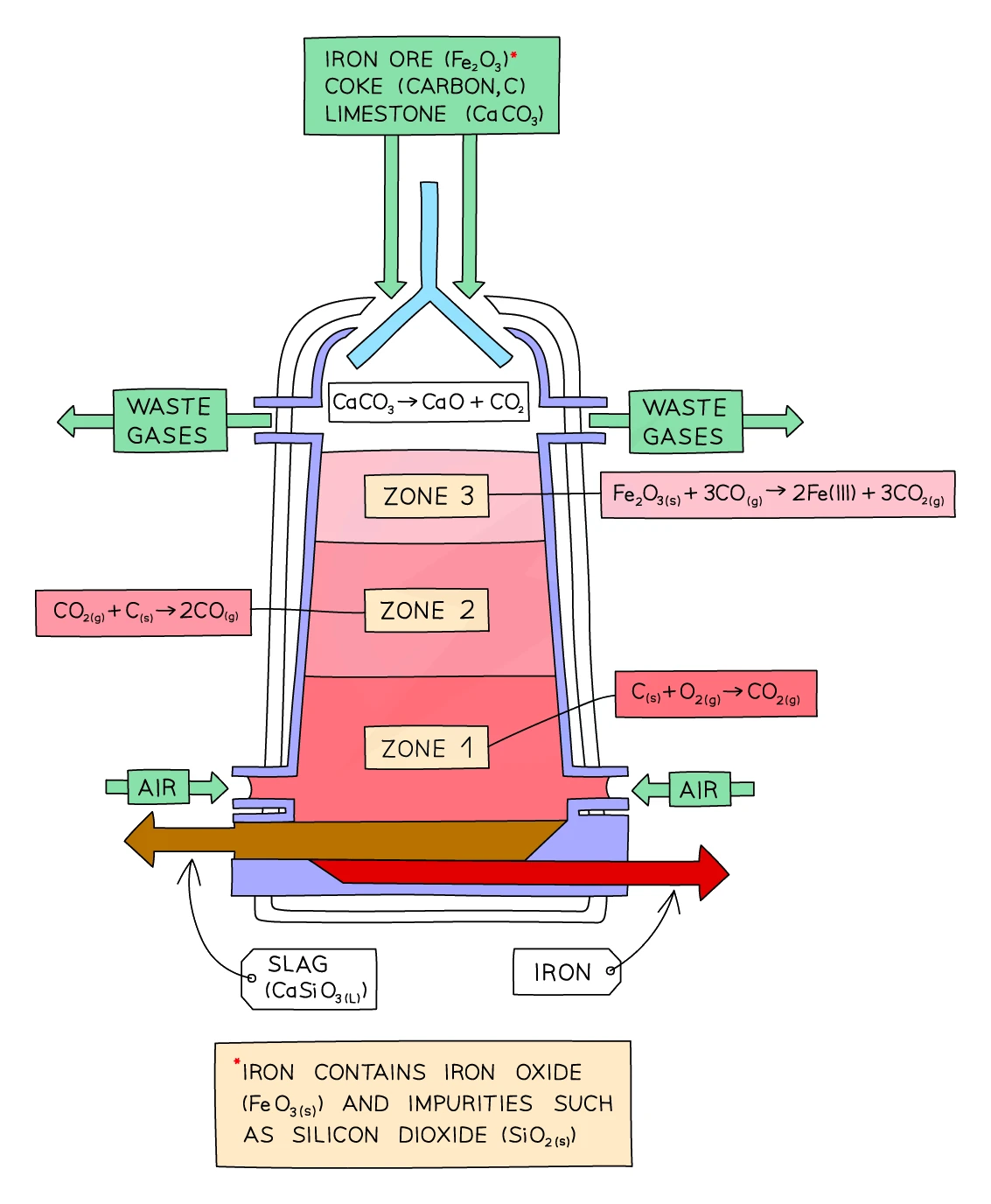
The chemistry inside the furnace
- Combustion zone (hottest, near the air blast) — the coke ignites in the incoming blast of preheated air, supplying the heat that drives the rest of the furnace
- C(s) + O2(g) → CO2(g) (exothermic)
- Carbon-monoxide-forming zone — the very hot carbon dioxide reacts with more coke to make carbon monoxide, the true reducing agent
- CO2(g) + C(s) → 2 CO(g)
- Iron-forming zone — carbon monoxide rises and reacts with iron(III) oxide in the haematite, stripping its oxygen
- Fe2O3(s) + 3 CO(g) → 2 Fe(l) + 3 CO2(g)
- The molten iron drips to the bottom and is tapped off
- Slag formation — limestone removes the sandy SiO2 impurity:
- First, the limestone is thermally decomposed: CaCO3(s) → CaO(s) + CO2(g)
- Then the calcium oxide neutralises the acidic silica: CaO(s) + SiO2(s) → CaSiO3(l)
- Calcium silicate () floats on top of the denser molten iron and is tapped off separately and used for road foundations
Extraction of aluminium by electrolysis
- Aluminium sits above carbon in the reactivity series, so carbon cannot reduce its oxide — electrolysis is needed
- The ore () is purified first to give pure aluminium oxide, Al2O3
- Al2O3 melts at over 2000 °C, far too hot to be practical on its own
- It is therefore dissolved in molten (Na3AlF6)
- The mixture melts around 950 °C, drastically cutting the energy bill, and cryolite is chemically inert so the electrolysis chemistry is unchanged
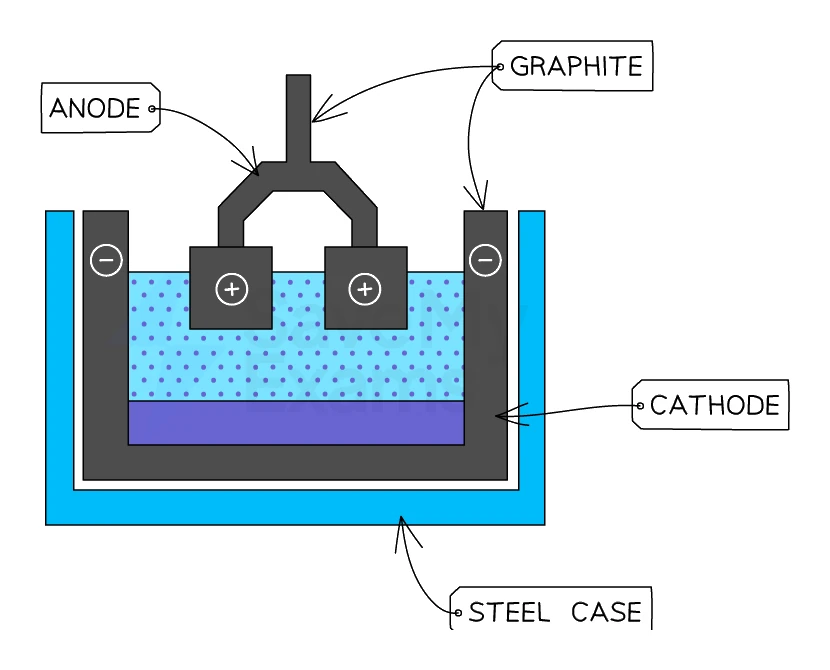
- The cell is a steel tank lined with carbon (graphite). The lining is the cathode; large carbon blocks dipping into the melt from above are the anodes
What happens at each electrode
- At the cathode (the carbon lining): aluminium ions gain electrons and are reduced to liquid aluminium
- Al3+(l) + 3 e− → Al(l)
- Molten aluminium is denser than the electrolyte and sinks to the floor of the tank, from where it is siphoned off
- At the anode (the carbon blocks): oxide ions lose electrons and are oxidised to oxygen
- 2 O2−(l) → O2(g) + 4 e−
- The anodes are made of carbon, so the oxygen produced burns the carbon away:
- C(s) + O2(g) → CO2(g)
- The anodes wear out and have to be replaced regularly, which is a continuing cost
- Aluminium extraction uses a great deal of electricity, which is the main reason it is expensive compared with iron extraction
State why aluminium cannot be extracted by heating its oxide with carbon
What comes up: a 1-mark question asking why reduction by carbon is not suitable for aluminium.
Write: aluminium is more reactive than carbon, so carbon cannot remove oxygen from aluminium oxide. Equivalently: aluminium is above carbon in the reactivity series (accept either form).
Watch out: the mark scheme accepts the reverse argument ("carbon is less reactive than aluminium") — so phrase it whichever way feels natural, but you must make the comparison explicit. Simply saying "aluminium is too reactive" without comparing to carbon does not clearly answer the question.