4CH1
Atomic Structure
Principles of Chemistry · 1 question type
Atoms and molecules
- An atom is the smallest particle of an element that still has that element's chemical properties
- A molecule is two or more atoms chemically bonded together to form one identifiable unit
Inside an atom
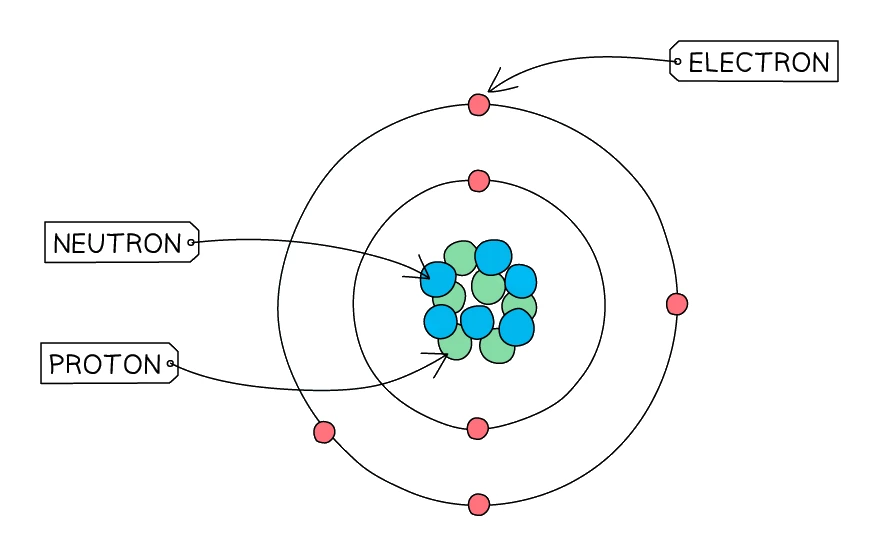
- Every atom contains three types of subatomic particle:
- Protons — positive charge, found in the nucleus
- Neutrons — no charge, found in the nucleus
- Electrons — negative charge, found in shells around the nucleus
- The nucleus is the dense centre of the atom holding the protons and neutrons together
- It is positively charged (because of the protons)
- move around the nucleus in (also called energy levels)
- Almost all of the atom's mass sits in the nucleus; the mass of an electron is negligible
Relative masses and charges
- Subatomic particles are far too small for their masses to be measured in grams or their charges in coulombs
- Their masses and charges are quoted relative to each other instead
| Particle | Relative mass | Relative charge |
|---|---|---|
| Proton | 1 | +1 |
| Neutron | 1 | 0 |
| Electron | negligible (about 1/1840) | −1 |
- A proton and a neutron have almost identical masses; both are given a relative mass of 1
- An electron is roughly 1840 times lighter than a proton, so its mass is treated as negligible in exam answers
Exam tip
Completing a relative mass and relative charge table
What comes up: a table with some cells blank asks you to fill in the relative mass and/or relative charge of a proton and a neutron (the electron row is usually pre-filled with mass 1/1840, charge −1).
Write (two marks): both rows correct scores 2; any two or three correct entries still scores 1. The values to know: proton relative mass 1, relative charge +1; neutron relative mass 1, relative charge 0.
Watch out: the neutron's charge is zero, not negative. Writing −1 for the neutron (confusing it with the electron) or writing the electron's negligible mass (1/1840) for the proton are the two marks most commonly lost.