ChemistryExam code: 4CH1
Atomic Structure
Principles of Chemistry
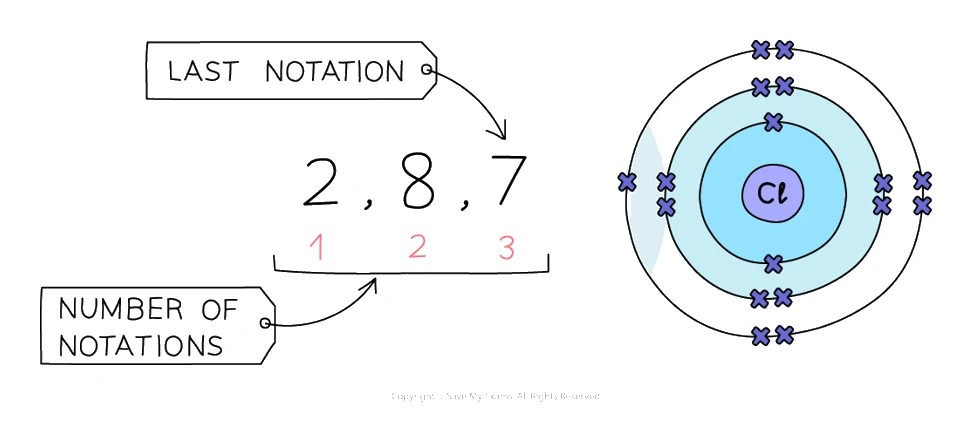
- Electrons occupy around the nucleus, filling from the innermost shell outwards
- For the first 20 elements, the shell capacities are:
- 1st shell: up to 2 electrons
- 2nd shell: up to 8 electrons
- 3rd shell: up to 8 electrons
- 4th shell starts to fill once the 3rd has reached 8
- An electronic configuration is written as the number of electrons in each shell, separated by commas, starting from the innermost shell:
- sodium (Z = 11): 2,8,1
- chlorine (Z = 17): 2,8,7
- calcium (Z = 20): 2,8,8,2
Reading an electronic configuration
- The total of all the numbers equals the (= number of electrons)
- The number of electrons in the outermost shell equals the element's group number for groups 1–7 (this is why same-group elements behave alike chemically)
- The number of shells used equals the element's period number on the periodic table
Common exam question
Reading a diagram of an atom
Question: From a diagram of an atom, name a labelled particle or the nucleus, or give its atomic number, mass number, group, period, or the charge on its ion (1 mark each).
Asked in 7 of the 23 papers, usually as question 1. Particles marked + are protons, unmarked nucleus particles are neutrons, the central cluster is the nucleus, and the particles on the rings are electrons. Protons give the atomic number and the element, protons plus neutrons the mass number, rings the period, outer electrons the group.
Groups 1 to 3 lose their outer electrons and form 1+, 2+ and 3+; groups 5 to 7 gain and form 3−, 2− and 1−. Give size and sign, because "positive" alone is ignored.